How to Use the Planet Name Generator
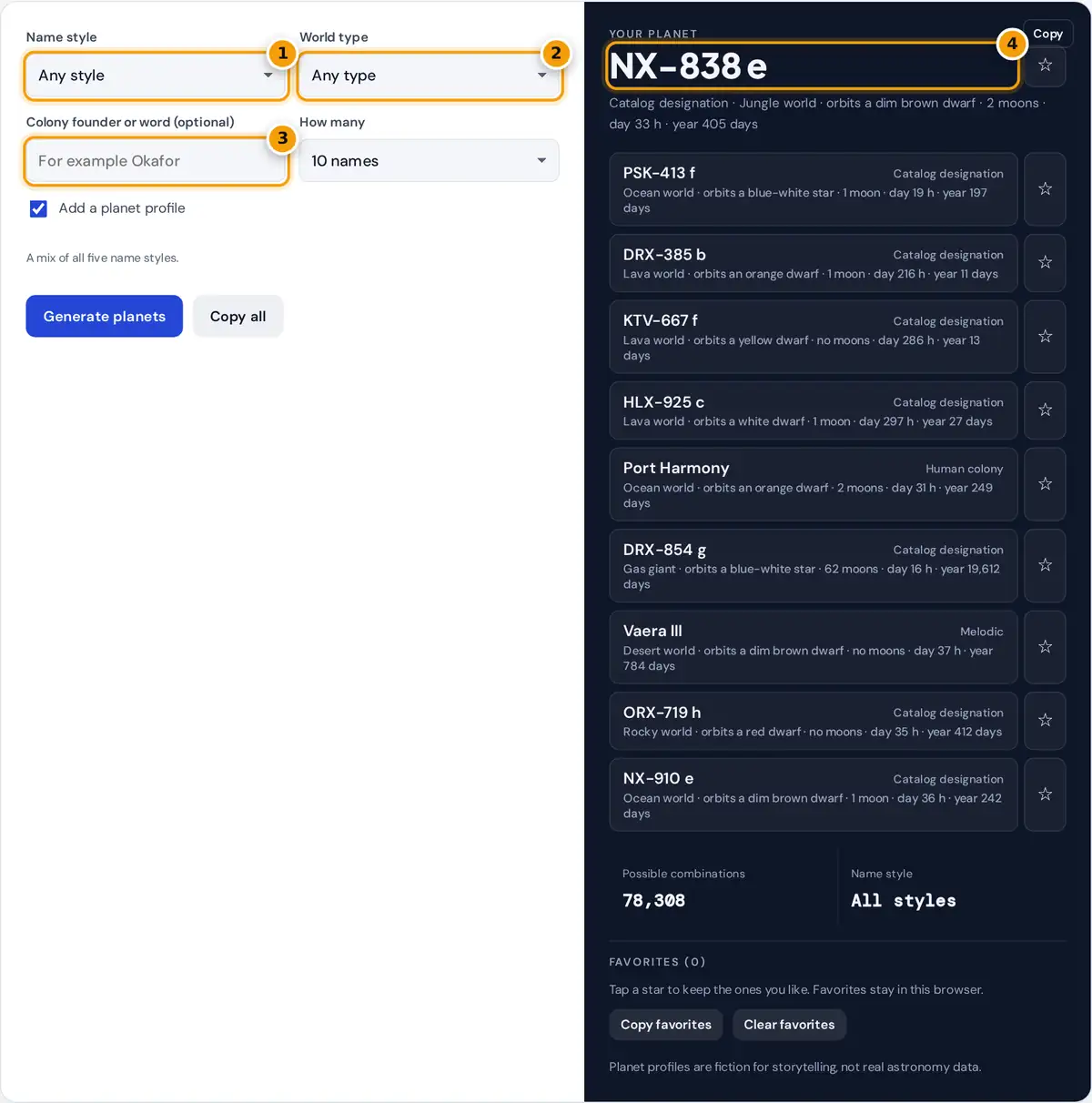
- Choose a name style: melodic, alien, classical, catalog or colony.
- Pick a world type such as ocean world or gas giant.
- Optionally add a founder's name for colony names.
- Read your planet with its profile. Copy the name or tap the star to save it.
Choose a name style: Melodic, Harsh and alien, Ancient and classical, Catalog designation or Human colony. Keep Any style for a mix. Then pick a world type such as an ocean world, a gas giant or a lava world, or leave it on Any type for variety. Press Generate for a new star map's worth of planets.
With the profile box ticked, every planet gets a short profile: its type, the star it orbits, how many moons it has and how long its day and year last. Type a founder's name or a word to create colony names such as New Okafor or Okafor's Landing. Click a planet to copy its name, or tap the star to save it.
Planet Name Styles
| Style | How it sounds | Examples |
|---|---|---|
| Melodic | Soft vowels, flowing endings | Talithea, Elylune VII |
| Harsh and alien | Hard consonants, apostrophes | Skar'oth, Grakuun Prime |
| Ancient and classical | Latin-like, imperial | Tiberion, Vesperia |
| Catalog designation | Survey code, number, letter | ORX-417 c |
| Human colony | Hopeful settler names | New Providence, Port Concord |
Syllable names join an opening and an ending chosen to sound related. The melodic style has 16 openings and 14 endings, and each melodic name can also appear with one of eight Roman numerals, a convention in science fiction for a planet's order from its star.
catalog names = 12 catalogs × 900 numbers × 7 letters = 75,600
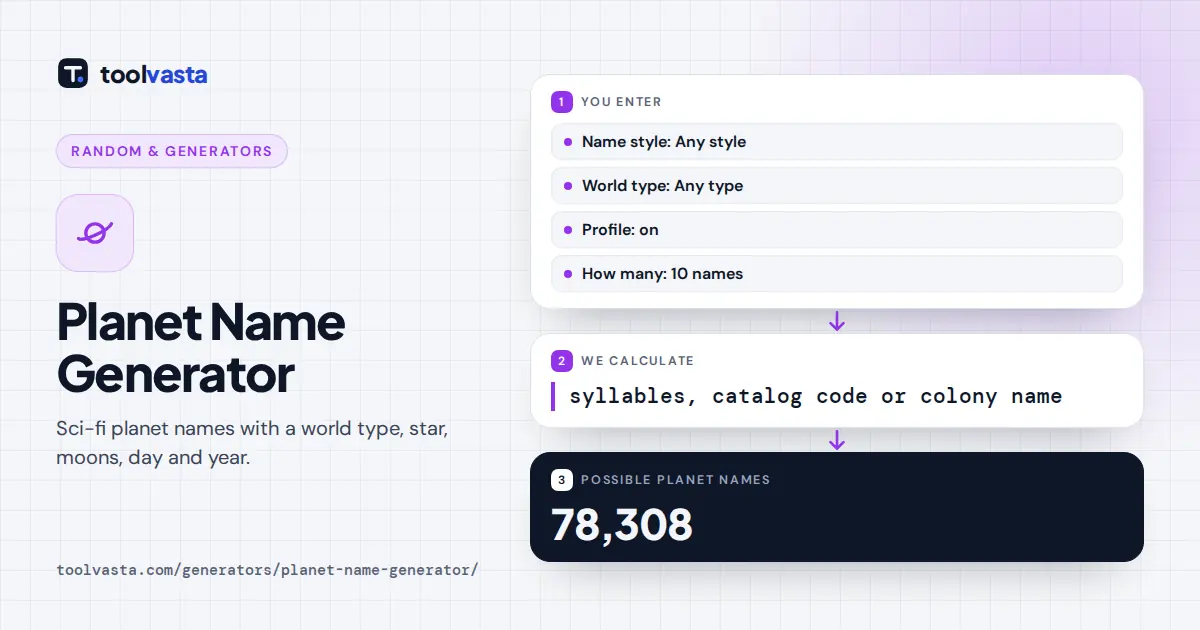
Across all five styles there are 78,308 possible planet names. The syllable lists were checked against well-known planets from popular fiction, so you will not get a famous world by accident. Names are picked with your browser's secure random source.
How Real Planets Are Named
Real exoplanets usually take the name of their star plus a lowercase letter. The first planet found around a star is "b", the next is "c", and so on in order of discovery, not distance from the star. Stars themselves often carry catalog names made of a survey abbreviation and a number. The catalog style imitates this pattern with invented survey codes, so ORX-417 c reads like a real discovery without copying a real one. The International Astronomical Union also runs public naming campaigns that give some exoplanets proper names.
Most planets in our own solar system are named after Roman gods, a tradition the ancient and classical style borrows: Latin-sounding endings such as -ia, -ion and -us give a world the weight of an old empire.
Using the Planet Profiles
Profiles are quick story seeds, not physics. Gas giants get many moons and long years, lava worlds circle close to their stars with years of only a few days, and ice worlds sit far out with very long years. Use these hints to decide what life is like there. A planet with a 70 hour day might have long, cold nights; a world with no moons has no tides from a moon; a binary star gives two sunsets.
Tips for Naming Fictional Planets
- Name by who named it. Natives, explorers and corporations would name the same world differently. A local name can be melodic while the survey still calls it HLX-208 b.
- Keep a system consistent. Planets in one system often share a root, such as Vesperia I, II and III, or a theme.
- Match sound to mood. Harsh names suit war worlds and prisons. Melodic names suit garden worlds and peaceful civilizations.
- Make it pronounceable. Readers will meet the name dozens of times. If they stumble on it, simplify.
For a whole star system, generate one list, star the planets you like and copy them all at once. Give the inner worlds short, bright names and the outer worlds colder ones, and you have a believable system map in a few minutes.
Frequently asked questions
How do I come up with a planet name?
Decide who named the planet and what it is like, then choose a style. Explorers might use a catalog code, settlers a hopeful colony name, and natives a melodic or harsh name that fits their language.
How are real exoplanets named?
Most take their star's name plus a lowercase letter. The first planet discovered around a star is b, then c, and so on in order of discovery. Some also receive proper names through IAU public naming campaigns.
What do the Roman numerals in planet names mean?
In science fiction, a Roman numeral usually marks a planet's order from its star, so Elylune VII would be the seventh planet. The generator adds numerals to some melodic names in that tradition.
Are the planet profiles scientifically accurate?
They are story seeds, not real data. Ranges are chosen to feel plausible, such as many moons for gas giants and very short years for lava worlds close to their stars, but no planet here really exists.
How many planet names can the generator make?
It can make 78,308 names across five styles. Catalog designations alone account for 75,600, and melodic names with optional Roman numerals add 2,016 more. A founder's name adds three colony names.
Can I use these planet names in my book or game?
Yes. The names are invented for this tool and checked against famous fictional planets, so they are free to use in novels, games and tabletop campaigns. Search a name before publishing to be sure.