How to Use the Random Element Generator
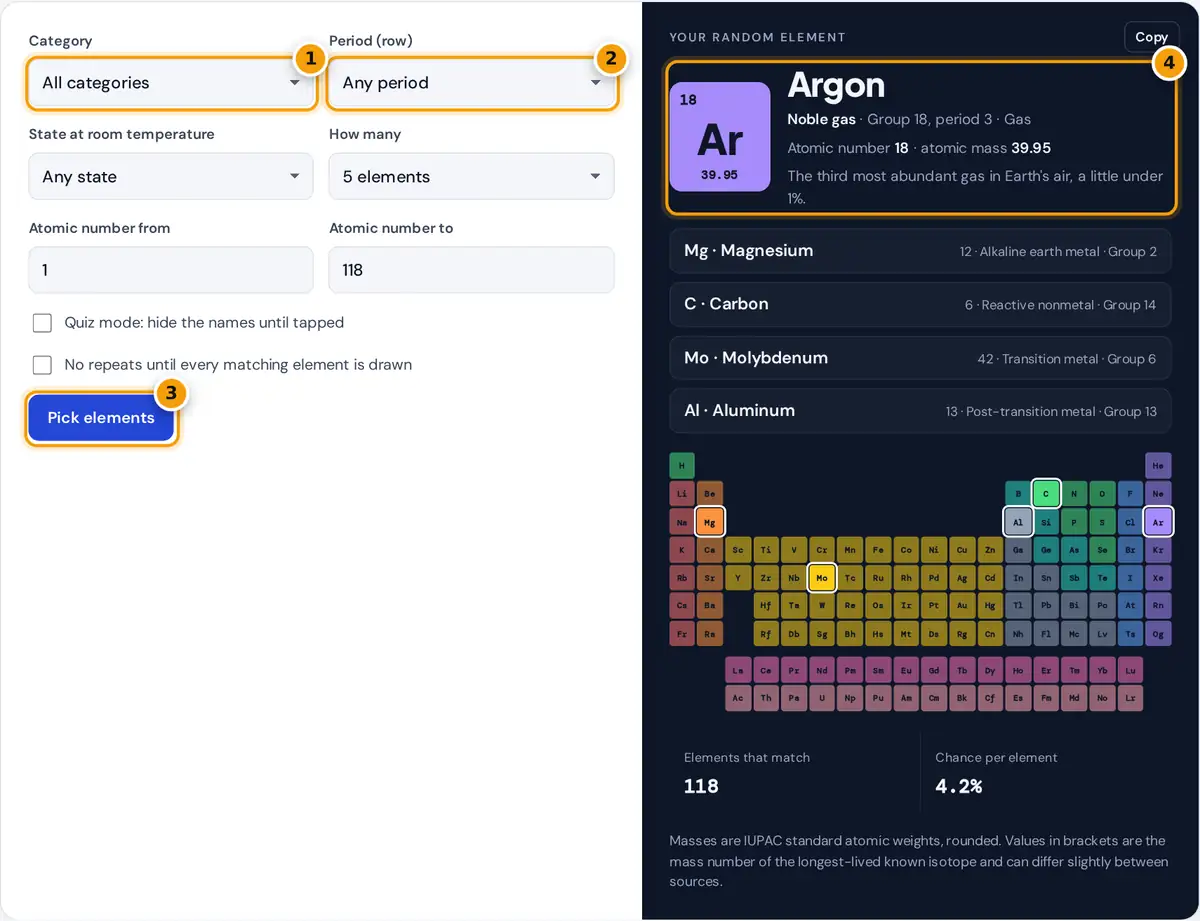
- Choose a category such as noble gases or transition metals.
- Optionally limit the draw to one period.
- Press Pick elements for a new draw.
- Read the symbol, atomic number, mass, group, period and state.
Press Pick elements to draw random elements from the periodic table. The first pick appears as a large tile with its symbol, atomic number and atomic mass, followed by its name, category, group, period and state at room temperature. The other picks are listed below, and every pick is outlined on the mini periodic table so you can see where it sits.
Narrow the draw with the filters. Choose a category such as noble gases or transition metals, a period (row), a state, or an atomic number range such as 1 to 20 for the elements most school courses start with. Tick Quiz mode to hide the names and test yourself on the symbols, or tick No repeats to work through every matching element before any comes back.
What Each Element Shows
The data covers all 118 elements confirmed by IUPAC, with the names IUPAC approved in 2016 for elements 113, 115, 117 and 118 (nihonium, moscovium, tennessine and oganesson). Names use US spelling, such as aluminum, cesium and sulfur.
- Atomic number: the number of protons in the nucleus, which defines the element.
- Atomic mass: the IUPAC standard atomic weight, rounded. For elements with no stable isotopes the value in brackets is the mass number of the longest-lived known isotope, such as [98] for technetium.
- Group and period: the column (1 to 18) and row (1 to 7). Lanthanides and actinides are shown as their own series.
- State: solid, liquid or gas at about 20 °C. Only bromine and mercury are liquids, and 11 elements are gases. Elements from fermium (100) upward have only been made a few atoms at a time, so their state is marked unknown.
How the Random Pick Works
The generator filters the 118 elements, shuffles the matches with your browser's cryptographic random source using the Fisher-Yates method, and shows the first few. Every matching element has the same chance.
Worked example: drawing 5 elements from all 118 gives each one a 5 ÷ 118 = 4.2% chance. Filter to the 7 noble gases and draw 1, and each has a 1 ÷ 7 = 14.3% chance. Choosing reactive nonmetals in period 2 leaves exactly 3 elements: carbon, nitrogen and oxygen.
Element Categories in the Generator
| Category | Elements | Symbols |
|---|---|---|
| Alkali metal | 6 | Li, Na, K, Rb, Cs, Fr |
| Alkaline earth metal | 6 | Be, Mg, Ca, Sr, Ba, Ra |
| Transition metal | 38 | Sc to Zn, Y to Cd, Hf to Hg, Rf to Cn |
| Post-transition metal | 12 | Al, Ga, In, Sn, Tl, Pb, Bi, Po, Nh, Fl, Mc, Lv |
| Metalloid | 6 | B, Si, Ge, As, Sb, Te |
| Reactive nonmetal | 7 | H, C, N, O, P, S, Se |
| Halogen | 6 | F, Cl, Br, I, At, Ts |
| Noble gas | 7 | He, Ne, Ar, Kr, Xe, Rn, Og |
| Lanthanide | 15 | La to Lu |
| Actinide | 15 | Ac to Lr |
Category boundaries vary slightly between textbooks. This tool counts zinc, cadmium and mercury as transition metals, treats polonium as a post-transition metal and astatine as a halogen, and places the superheavy elements 104 to 118 by their position in the table, even though their chemistry is mostly predicted rather than measured.
Ways to Use a Random Element
- Flash cards: turn on Quiz mode, read the symbol and say the name before you tap.
- Science projects: give each student a random element to research and present.
- Trivia and games: draw an element and ask for its group, a common use or a compound that contains it.
- Revision: filter to one period or group at a time and learn the trends across it.
For the official reference values, see the IUPAC Periodic Table of the Elements.
Reading the Mini Periodic Table
The mini table follows the standard layout. Elements that match your filters are shaded, picked elements are outlined, and colors show each category. The lanthanides and actinides sit in two separate rows below the main table, as on most printed charts.
Frequently asked questions
How many elements are in the random element generator?
It includes all 118 elements on the current periodic table, from hydrogen (1) to oganesson (118), using the names approved by IUPAC and US spelling such as aluminum, cesium and sulfur.
Can I pick a random element from one group?
Yes. Choose a category such as noble gases, halogens or alkali metals, a period, a state or an atomic number range. Only elements that match every filter can be drawn.
Why are some atomic masses in brackets?
Elements with no stable isotopes have no standard atomic weight. The bracketed number is the mass number of the longest-lived known isotope, such as [222] for radon.
Which elements are liquid at room temperature?
Only two: bromine, a nonmetal, and mercury, a metal. Gallium and cesium melt just above room temperature, so they can turn liquid on a warm day.
How does the quiz mode work?
Quiz mode hides each element's name behind a Tap to reveal button. Look at the symbol, atomic number and category, say the name, then tap to check your answer.
Is every element equally likely to be picked?
Yes. The generator shuffles the matching elements with your browser's secure random source, so each one has the same chance, shown as the chance per element under the result.