How to Use the Russian Name Generator
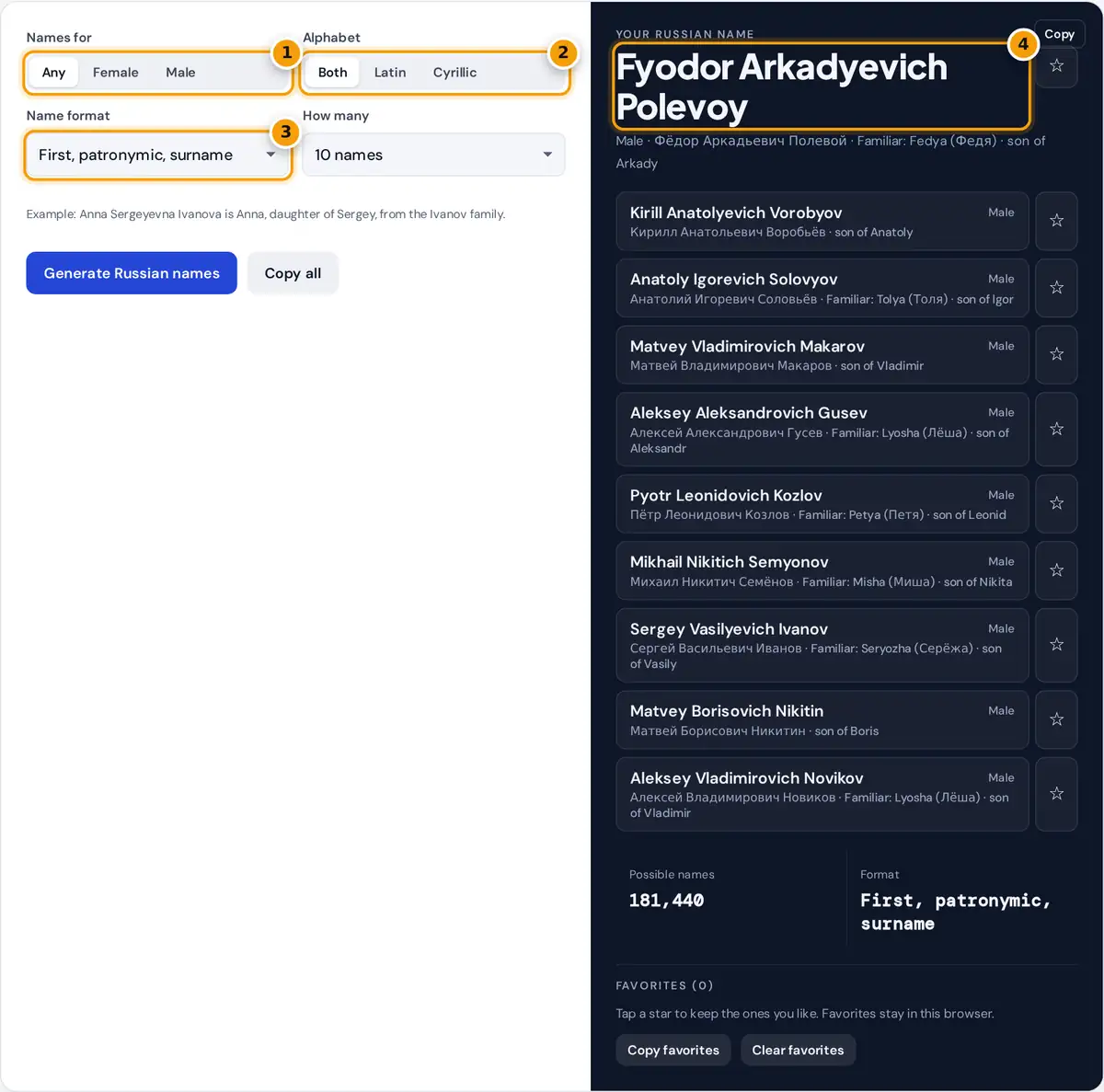
- Choose female, male or any Russian names.
- Show names in Latin letters, Cyrillic or both.
- Pick the full three-part name, first and surname, or the official surname-first order.
- Read the top name with its Cyrillic spelling, nickname and patronymic source.
Choose Female, Male or Any, pick the alphabet you want to see and choose a name format. The full format gives the three-part name Russians use on documents and in formal speech. The short format gives the first name and surname, and the official format puts the surname first, as on forms and lists.
With Both selected, each name is shown in English letters with the Cyrillic spelling underneath, together with the familiar short form and the father's name behind the patronymic. Click any name to copy it, or tap the star to keep it in your favorites for later.
The Three Parts of a Russian Name
A full Russian name has a given name (imya), a patronymic (otchestvo) and a surname (familiya). The patronymic is built from the father's first name, so Anna Sergeyevna Ivanova is Anna, daughter of Sergey, of the Ivanov family. Her brother would be Dmitry Sergeyevich Ivanov. Using the first name with the patronymic, as in Anna Sergeyevna, is the normal polite way to address a teacher, a colleague or an older person.
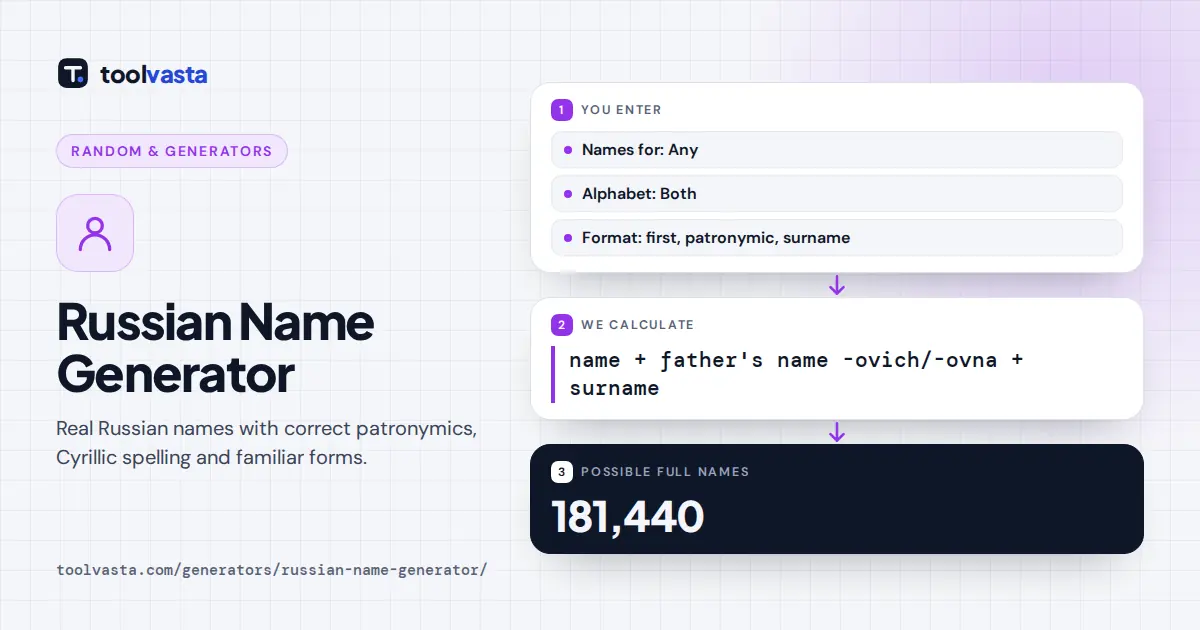
The generator draws from 40 female and 40 male given names, 36 fathers' names and 63 surnames. That gives 40 × 36 × 63 = 90,720 full female names and 181,440 full names in total.
How Patronymics Are Formed
| Father's name | Son | Daughter | Rule |
|---|---|---|---|
| Ivan (Иван) | Ivanovich | Ivanovna | Hard consonant: add -ovich or -ovna |
| Sergey (Сергей) | Sergeyevich | Sergeyevna | Ending in -y (й): add -evich or -evna |
| Igor (Игорь) | Igorevich | Igorevna | Soft sign ending: -evich or -evna |
| Grigory (Григорий) | Grigoryevich | Grigoryevna | Ending in -iy (ий): -yevich or -yevna |
| Nikita (Никита) | Nikitich | Nikitichna | Ending in -a: -ich or -ichna |
| Ilya (Илья) | Ilyich | Ilyinichna | Irregular |
| Pavel, Pyotr, Lev | Pavlovich, Petrovich, Lvovich | Pavlovna, Petrovna, Lvovna | The stem changes |
Surnames change with gender as well. Most end in -ov, -ev or -in for men and add -a for women: Ivanov becomes Ivanova and Nikitin becomes Nikitina. Surnames ending in -sky become -skaya (Kovalevsky, Kovalevskaya), and those ending in -oy become -aya (Donskoy, Donskaya). The generator applies these rules automatically, so a woman is never given a masculine surname.
Familiar Forms and Nicknames
Russians use short, familiar forms of first names with family and friends. Aleksandr and Aleksandra both become Sasha, Maria becomes Masha, Yekaterina becomes Katya, and Dmitry becomes Dima. These are not separate names, just the everyday version, and using one with a stranger can sound overly familiar. The generator shows the familiar form where there is a common one, which helps when you write dialogue for a story or game.
Spelling in English Letters
There are several systems for writing Russian in the Latin alphabet, so the same name can appear as Yelena or Elena, Aleksey or Alexei, and Fyodor or Fedor. This tool uses common English spellings and shows the Cyrillic original, so you can check it or copy it into a document. When you name a real person or a character in a published work, follow the spelling that person or your style guide prefers.
Using Russian Names in Stories and Games
Readers notice when a Russian character's name breaks the rules, for example a woman called Natalya Petrov or a man with a patronymic ending in -ovna. Generate names with the full format to keep families consistent: give siblings the same patronymic and surname, and give their father the first name the patronymic comes from. Then decide which form each character uses. A boss might call an employee by first name and patronymic, while friends use the familiar form, and that shift tells the reader a lot about the relationship.
The names here are common across generations, from classic names like Lyudmila and Anatoly, which feel older, to names like Sofia, Polina, Artyom and Matvey, which are popular with younger families. Mixing the two helps a cast of characters feel like a real community.
Frequently asked questions
What is a Russian patronymic?
A patronymic is a middle name made from the father's first name. Sons add -ovich or -evich and daughters add -ovna or -evna, so the children of Ivan are Ivanovich and Ivanovna.
Why do Russian surnames end in -ova for women?
Russian surnames agree with gender. Most masculine surnames end in -ov, -ev or -in, and the feminine form adds -a. Surnames ending in -sky change to -skaya, and -oy becomes -aya.
How do I address someone by their Russian name?
In polite or formal speech, use the first name and patronymic together, such as Anna Sergeyevna. Close friends and family use a familiar short form, such as Anya or Sasha, instead.
Are these real Russian names?
Yes. The 80 first names and 63 surnames are real and common in Russia, and the patronymics follow standard grammar rules. The combinations are random, so they do not refer to any real person.
Can I get the names in Cyrillic?
Yes. Choose Cyrillic to see names only in the Russian alphabet, or Both to see the English spelling with the Cyrillic version below it. Click a name to copy it exactly as shown.
Why are Russian names spelled differently in English?
Russian uses the Cyrillic alphabet, and several transliteration systems exist. That is why you see Yelena and Elena, or Aleksey and Alexei. All of them are correct ways to write the same name.