Quick answer: A random name picker chooses one or more names from your list with an equal chance for each. Paste your names, choose how many to pick and press Pick names. With 30 names and 1 pick, each person has a 1 in 30 (3.3%) chance; picking 3 raises that to 3 in 30, or 10%.
Why Draw Names Digitally Instead of from a Hat?
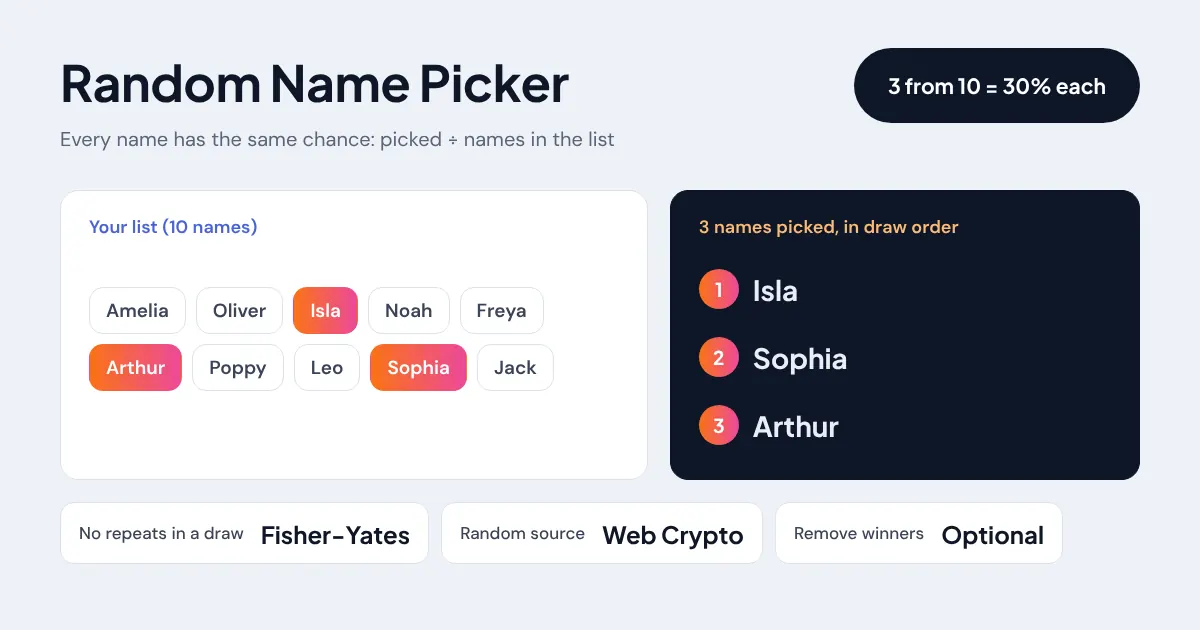
A random name picker is a tool that draws names from a list so that nobody can influence who is chosen. It does the job of names in a hat, without the folded paper, and it can draw several winners at once or put a whole class into a random order.
This picker has two modes. Pick names draws 1 or more names in a single draw, with no name chosen twice. Shuffle into an order arranges every name in a random sequence, which suits presentation slots, reading turns or a rota. Tick "Remove picked names" and each winner leaves the list, so repeated draws work through the whole group before anyone is chosen again. If you would rather watch a spin, the wheel spinner does the same fair draw on a prize wheel.
How Do You Draw Winners from a List?
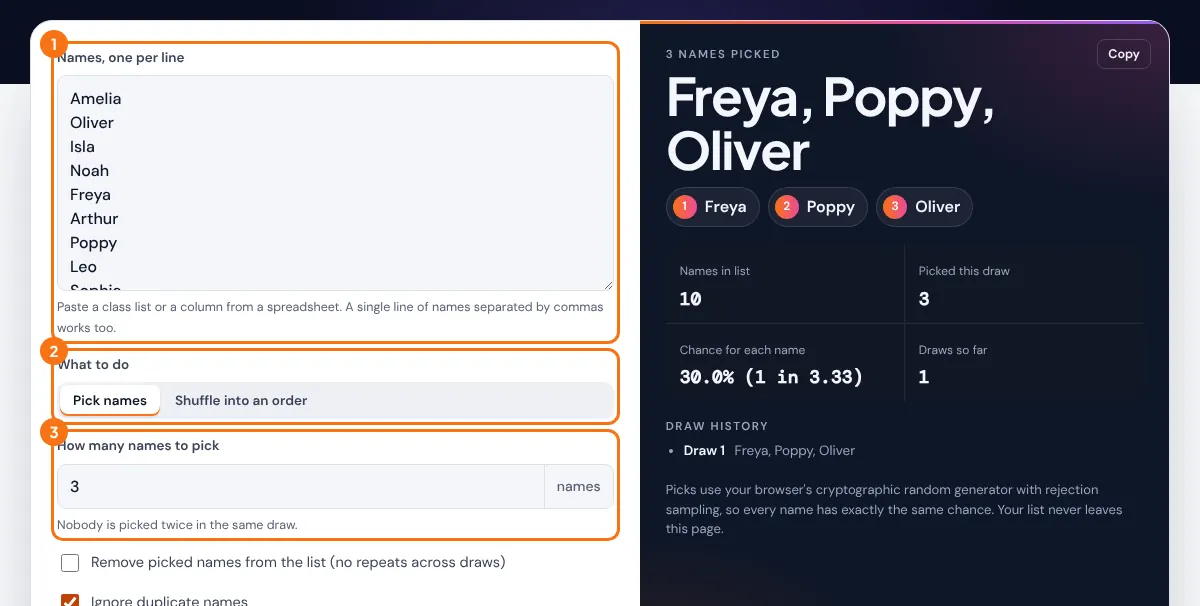
- Type or paste your names into the box, one per line. A single line of names separated by commas also works.
- Choose Pick names or Shuffle into an order.
- Enter how many names to pick, and tick Remove picked names if you want no repeats across draws.
- Press Pick names. The chosen names appear in order, and every draw is saved in the history below.
Duplicate names are ignored by default, so a name pasted twice does not get two chances. Untick that option for raffle-style draws in which someone bought 3 tickets and should appear 3 times. The list stays on this page and is never uploaded.
How Does the Picker Make Each Draw Fair?
Each draw is fair because every name has exactly the same probability of selection, and that probability depends only on how many names you enter and how many you pick.
k = names picked in one draw, n = names in the list
Worked example: a class of 28 pupils with 4 names drawn gives each pupil a chance of 4 ÷ 28 = 1 in 7, or 14.3%. With "Remove picked names" ticked, the next draw of 4 is made from the remaining 24, so after 7 draws everyone has been chosen exactly once.
| Names in list | Picked per draw | Chance for each name |
|---|---|---|
| 10 | 1 | 1 in 10 (10%) |
| 30 | 1 | 1 in 30 (3.3%) |
| 30 | 3 | 1 in 10 (10%) |
| 50 | 5 | 1 in 10 (10%) |
| 200 | 2 | 1 in 100 (1%) |
Behind the scenes, the picker uses the Fisher-Yates shuffle with numbers from the browser's cryptographic generator, defined in the W3C Web Cryptography specification. Rejection sampling discards the few raw values that would favour one position, so a list of 7 names is not nudged towards the first entries. The probability calculator can work out the odds of more complex outcomes, such as the same pupil being picked twice in a week.
When Should You Pick Names at Random?
Pick names at random whenever the choice should not depend on who asks loudest or who the organiser likes. Teachers use it for cold calling and choosing helpers, managers use it for stand-up order and office raffles, and clubs use it for prize draws.
- Classroom questions: tick Remove picked names so every pupil answers once before the list resets.
- Prize draws and giveaways: pick 1 winner and 2 reserves in one draw, then copy the result as a record.
- Rotas and presentation order: use Shuffle into an order and copy the numbered list into your calendar.
- Gift exchanges: for a full draw where nobody gets themselves, use the Secret Santa generator instead.
For a public prize promotion in the UK, keep the draw history and a screenshot. The CAP Code asks promoters to award prizes by chance and to be able to show how winners were selected.
Related Tools
- Wheel Spinner
- Decision Maker
- Secret Santa Generator
- Random Number Generator
- Coin Flip
- Random Word Generator
Need a fair pick for a group? See our guide to fair ways to pick teams, players and turns at random.
Frequently asked questions
Is the random name picker really random?
Yes. It uses your browser's cryptographic random number generator, the same source used for security keys, and a Fisher-Yates shuffle with rejection sampling, so every name has an equal chance.
Can I pick more than one name at once?
Yes. Enter any number from 1 up to the size of your list. No name is chosen twice in the same draw, and the names appear in the order they were drawn.
How do I stop the same person being picked again?
Tick Remove picked names. Each winner is taken off the list after the draw, so the next draw only uses people who have not been chosen yet.
Can I give someone more than one entry?
Yes. Untick Ignore duplicate names and enter that person once for each ticket. Someone listed 3 times in a list of 30 entries has a 3 in 30 chance of winning a single pick.
Is my list of names saved or uploaded?
No. The names stay in your browser tab and disappear when you close it. Nothing is sent to ToolVasta or anyone else.