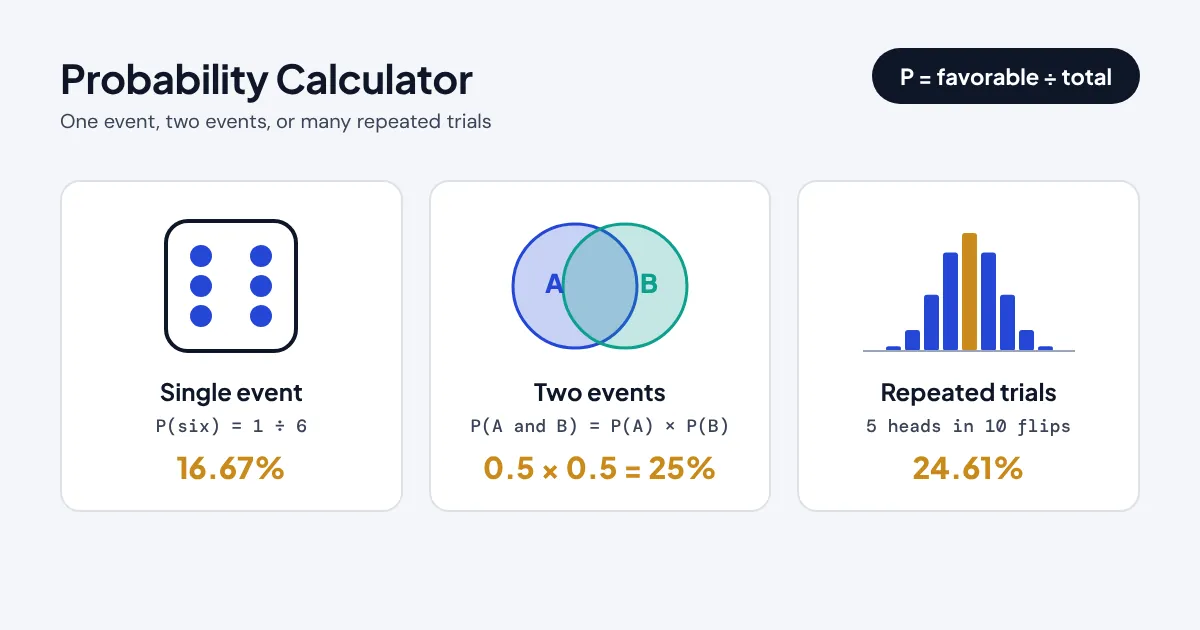
Quick answer: Probability is favorable outcomes divided by total outcomes, so rolling a 6 on a fair die is 1/6 ≈ 16.67%. For two independent events, multiply for "and" (0.5 × 0.5 = 0.25) and use P(A) + P(B) − P(A and B) for "or". This probability calculator also handles repeated trials with the binomial formula.
Which Probability Questions Can You Answer Here?
A probability calculator works out how likely an event is, as a decimal from 0 to 1 and as a percentage. This one covers the three questions people ask most. Single event finds the chance of one outcome from a count, such as drawing an ace from a deck. Two events combines independent probabilities to give "and", "or", "neither" and "exactly one". Repeated trials uses the binomial distribution to find the chance of a number of successes, such as 5 heads in 10 coin flips.
You can type probabilities as decimals, percentages or fractions, so 0.25, 25% and 1/4 all mean the same thing. Every result shows the formula and the arithmetic, which makes the calculator useful for checking statistics homework as well as everyday questions about games, forecasts and quality checks.
How Do You Work Out the Chance of an Event?
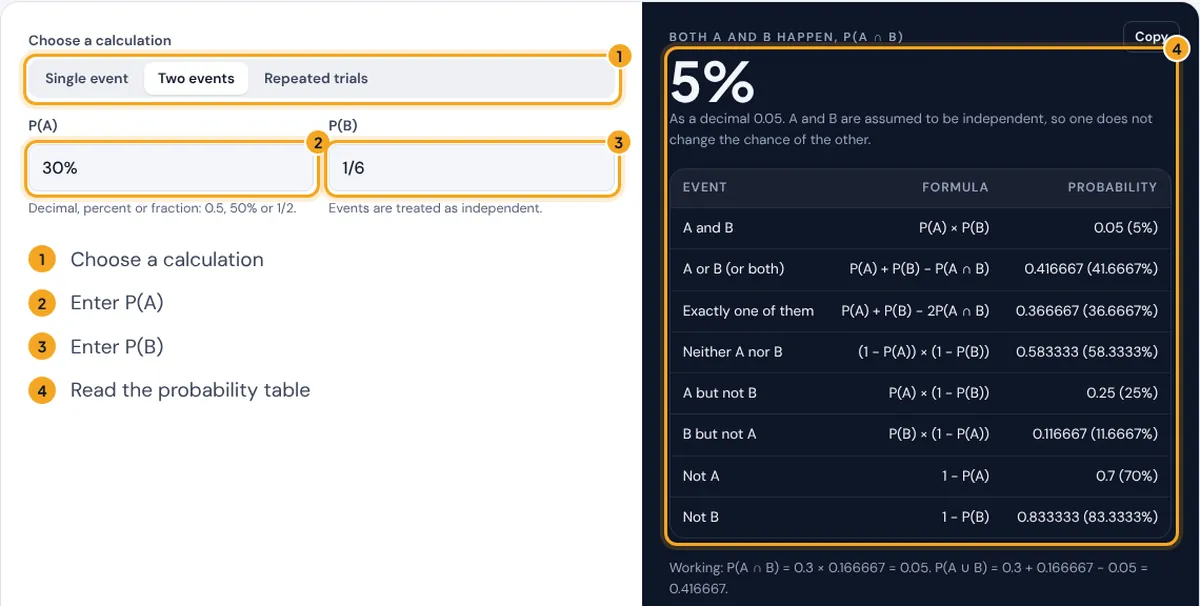
- Choose Single event, Two events or Repeated trials.
- Enter the counts or probabilities. Fractions such as 1/6 and percentages such as 30% are accepted.
- For repeated trials, add the number of trials n and the number of successes k.
- Read the main probability, then the table or stats for related results, and copy the one you need.
Two-event results assume the events are independent, meaning one happening does not change the chance of the other. Coin flips, dice rolls and separate random draws with replacement are independent. Drawing cards without putting them back is not, and needs the hypergeometric calculator instead.
What Are the Basic Probability Formulas?
The basic formulas come from counting equally likely outcomes and from the multiplication and addition rules. They match the probability models taught in grade 7 under the Common Core statistics and probability standards.
P(not E) = 1 − P(E)
P(A and B) = P(A) × P(B) (independent events)
P(A or B) = P(A) + P(B) − P(A and B)
Worked example. The forecast gives a 30% chance of rain, and you roll a fair die. What is the chance of rain and a six, and of rain or a six?
- P(A) = 0.3 and P(B) = 1/6 ≈ 0.1667.
- P(A and B) = 0.3 × 0.1667 = 0.05, or 5%.
- P(A or B) = 0.3 + 0.1667 − 0.05 = 0.4167, or about 41.67%.
The subtraction in the "or" rule stops the overlap from being counted twice. Without it, two events with a 60% chance each would add up to an impossible 120%.
How Do You Find the Probability of Repeated Events?
When the same trial is repeated n times with the same chance of success p, the number of successes follows a binomial distribution. The chance of exactly k successes is C(n, k) × pᵏ × (1 − p)ⁿ⁻ᵏ, where C(n, k) counts the ways to choose which trials succeed. The NIST Engineering Statistics Handbook gives the same formula along with the mean np and standard deviation √(np(1 − p)), which the calculator also reports.

| Question | p | n | Result |
|---|---|---|---|
| Exactly 5 heads in 10 flips | 0.5 | 10 | 24.61% |
| At least one six in 4 rolls | 1/6 | 4 | 51.77% |
| Exactly 2 sixes in 10 rolls | 1/6 | 10 | 29.07% |
| At least 1 defect in 20 parts at 2% | 0.02 | 20 | 33.24% |
| All 3 free throws at 75% | 0.75 | 3 | 42.19% |
| No heads in 10 flips | 0.5 | 10 | 0.098% |
"At least one" questions are easiest through the complement: 1 − (1 − p)ⁿ. That is why rolling at least one six in four rolls is just over even odds at 51.77%. For events that happen at a known average rate rather than a fixed number of trials, the Poisson distribution calculator is the better model.
What Is the Difference Between Probability and Odds?
Probability compares favorable outcomes with all outcomes, while odds compare favorable outcomes with unfavorable ones. Drawing an ace has a probability of 4/52 = 1/13, about 7.69%, but the odds are 1 to 12 for and 12 to 1 against, because 4 cards are aces and 48 are not. The single event mode gives both, so you can translate between a percentage and the odds format used in betting and games. For dice in particular, the dice probability calculator handles sums and multiple dice directly.
Related Tools
- Dice Probability Calculator
- Poisson Distribution Calculator
- Hypergeometric Calculator
- Standard Deviation Calculator
- Fraction to Percent Calculator
- Ratio Calculator
Frequently asked questions
How do you calculate probability?
Divide the number of favorable outcomes by the total number of equally likely outcomes. Rolling an even number on a die is 3 favorable out of 6, so the probability is 3/6 = 0.5, or 50%.
Can a probability be more than 1?
No. Every probability lies between 0, impossible, and 1, certain. If a calculation gives more than 1, an overlap has been counted twice or the events are not what you think.
When do you multiply probabilities?
Multiply when you want the chance that two independent events both happen. The chance of two heads in a row is 0.5 × 0.5 = 0.25.
When do you add probabilities?
Add when you want the chance that either event happens, then subtract the chance that both happen. If the events cannot happen together, the overlap is zero and you simply add.
What is the probability of at least one success?
Work out the chance of no successes, (1 − p)ⁿ, and subtract it from 1. For at least one six in four rolls: 1 − (5/6)⁴ = 0.5177, or 51.77%.