How to Use the Octagon Calculator
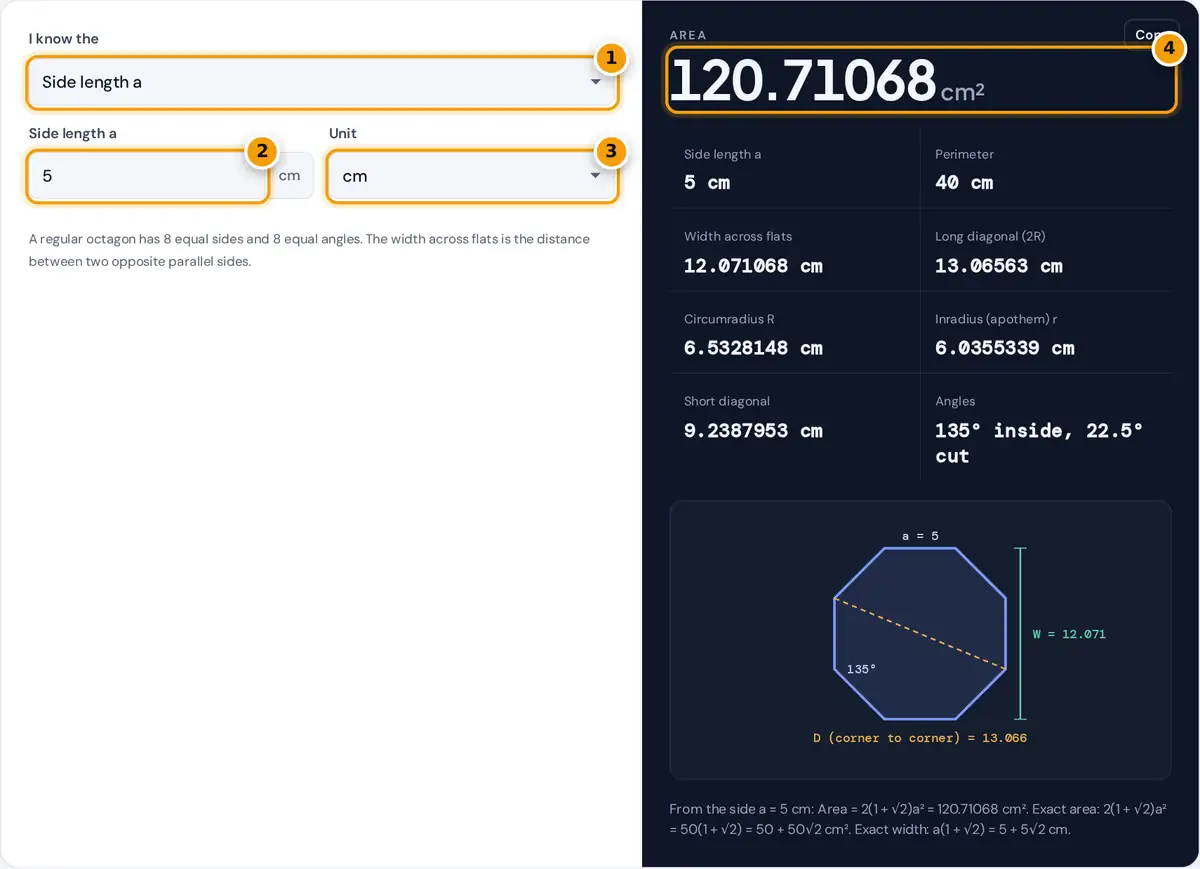
- Choose the measurement you know: side, width, diagonal, radius, perimeter or area.
- Enter its value.
- Pick the length unit.
- Read the area and every other dimension, with a labeled diagram.
Choose the measurement you already know from the menu: the side length, the width across flats, the long or short diagonal, the circumradius, the inradius (also called the apothem), the perimeter or the area. Type its value and pick a unit. Every other dimension of the regular octagon appears at once, together with a labeled diagram.
The result panel shows the area in square units and the side, perimeter, width, both diagonals and both radii in your unit. When you start from a side length, the note also gives the exact area and width in terms of √2. The angles line is a reminder for builders: each interior angle is 135°, and each of the 16 miter cuts on an octagonal frame is 22.5°.
Regular Octagon Formulas
Width across flats: W = a(1 + √2) ≈ 2.414214a Inradius: r = W ÷ 2
Long diagonal: D = a√(4 + 2√2) ≈ 2.613126a Circumradius: R = D ÷ 2
Short diagonal: a√(2 + √2) ≈ 1.847759a
All of these come from cutting a square of side W at the corners. Each corner triangle is a right isosceles triangle with legs a/√2, so W = a + 2(a/√2) = a(1 + √2). The octagon's area is the square, W², minus four corner triangles of area a²/4 each.
Worked Examples
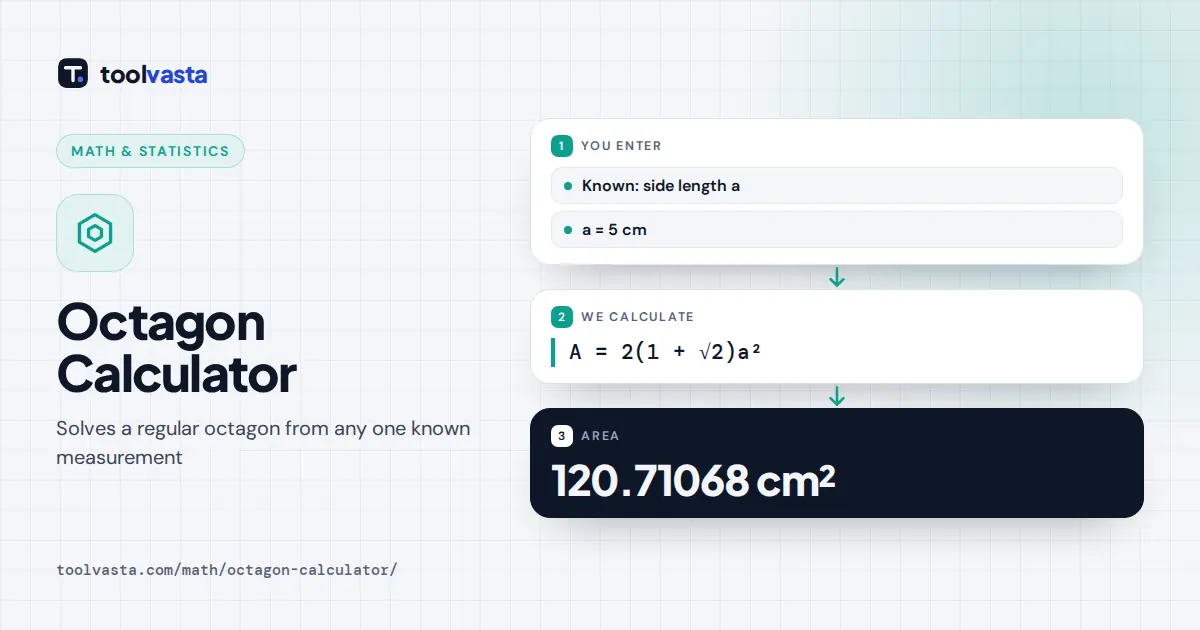
- Side 5 cm: area = 2(1 + √2) × 25 = 50 + 50√2 ≈ 120.71068 cm². The perimeter is 40 cm, the width across flats is 5(1 + √2) ≈ 12.07107 cm, the long diagonal is 13.06563 cm and the short diagonal is 9.238795 cm.
- Width 24 in (an octagonal table top cut from a 24-inch square): a = 24 ÷ (1 + √2) ≈ 9.941125 in, and the area is about 477.17402 in².
- Area 100 m²: a = √(100 ÷ 4.828427) ≈ 4.550899 m, so the perimeter is about 36.40719 m.
Octagon Dimensions for Common Sides
| Side a | Width across flats | Long diagonal | Area |
|---|---|---|---|
| 1 | 2.41421 | 2.61313 | 4.82843 |
| 5 | 12.0711 | 13.0656 | 120.711 |
| 10 | 24.1421 | 26.1313 | 482.843 |
| 12 | 28.9706 | 31.3575 | 695.294 |
Each value scales with the side: double the side and every length doubles while the area quadruples.
Building an Octagon
For an octagonal frame, gazebo floor or planter, each of the eight boards is cut at 22.5° at both ends, so neighboring boards meet at the 135° interior angle. To lay out an octagon inside a square of width W, measure W ÷ (2 + √2) ≈ 0.2929W in from each corner along both edges and cut off the corner triangles. A stop sign is a familiar example of a regular octagon.
Area Shortcuts From the Width or Radius
If you measure the width across flats W instead of the side, you do not need to find the side first. Substituting a = W ÷ (1 + √2) into the area formula gives a simpler result, and the same trick works with the circumradius R:
For a 24-inch octagonal table top, A ≈ 0.828427 × 576 = 477.17 in². That is about 82.8% of the 24-inch square it is cut from, so roughly 17% of the material is trimmed away at the corners. An octagon with a circumradius of 10 m covers 2√2 × 100 ≈ 282.84 m².
Tips and Limits
- The formulas apply to regular octagons only, with all sides and angles equal.
- Do not confuse the width across flats with the long diagonal. The long diagonal, corner to corner, is about 8% longer.
- Results are shown to 8 significant figures. Round to a practical precision before cutting material.
Frequently asked questions
What is the formula for the area of an octagon?
For a regular octagon with side a, the area is 2(1 + √2)a², about 4.828a². A side of 5 cm gives 50 + 50√2 ≈ 120.71 cm².
How do I find the side of an octagon from its width?
Divide the width across flats by 1 + √2, which is about 2.4142. For example, an octagon that is 24 inches wide from flat to flat has sides of about 9.94 inches.
What angle do I cut to make an octagon?
Cut each end of each of the eight pieces at 22.5°. Two such cuts meet to form the 135° interior angle of a regular octagon.
What is the interior angle of an octagon?
Each interior angle of a regular octagon is 135°. The angles add up to (8 − 2) × 180° = 1,080°, and 1,080 ÷ 8 = 135.
What is the difference between the width and the diagonal of an octagon?
The width across flats is measured between two opposite parallel sides. The long diagonal runs between opposite corners, so it is longer: about 1.082 times the width.
How do you find the perimeter of an octagon?
Multiply the side length by 8. If you only know the area, first find the side with a = √(A ÷ 4.828427), then multiply by 8.