How to Use the Golden Ratio Calculator
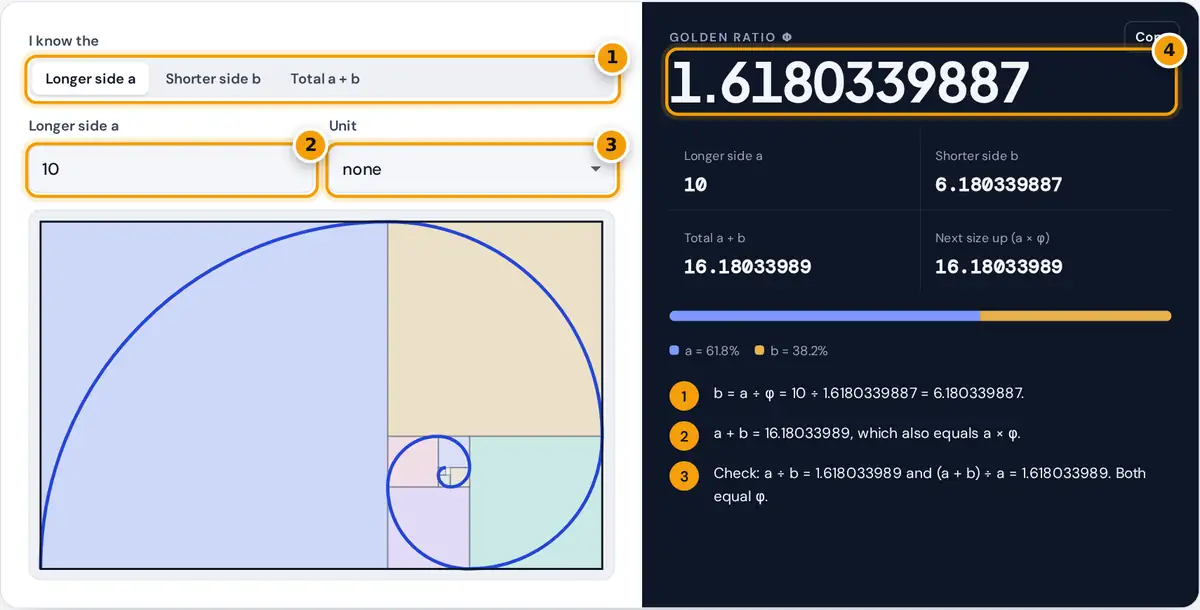
- Choose which length you know: the longer side a, the shorter side b, or the total.
- Enter that length.
- Optionally pick a unit such as px, mm, cm, in or pt.
- Read the other golden ratio lengths, the 61.8% and 38.2% split and the next size up.
Choose which length you know: the longer side a, the shorter side b, or the total length a + b. Enter it, pick an optional unit if you like, and the other two lengths appear instantly.
A bar under the results shows the 61.8% and 38.2% split, while a drawing shows a golden rectangle divided into squares with the golden spiral traced through them, updating live as you type each number.
The next size up value multiplies the longer side by phi once more, which helps when building a scale of related sizes. Click Copy to grab all results for a design file or your notes.
The Golden Ratio Formula
Two lengths a and b, with a larger, are in the golden ratio when the whole is to the longer part as the longer part is to the shorter part. That condition fixes the number.
φ = (1 + √5) ÷ 2 ≈ 1.6180339887
b = a ÷ φ a = b × φ a = (a + b) ÷ φ
1 ÷ φ = φ − 1 ≈ 0.618 φ² = φ + 1 ≈ 2.618
Setting a/b equal to phi turns the condition into the quadratic equation φ² = φ + 1. Its only positive solution is one plus the square root of 5, divided by 2, or about 1.6180339887 to ten decimal places.
Phi is an irrational number, so its decimals never end or repeat. It is often also called the golden mean, the golden section or the divine proportion, and its reciprocal is exactly phi minus one.
Worked Examples
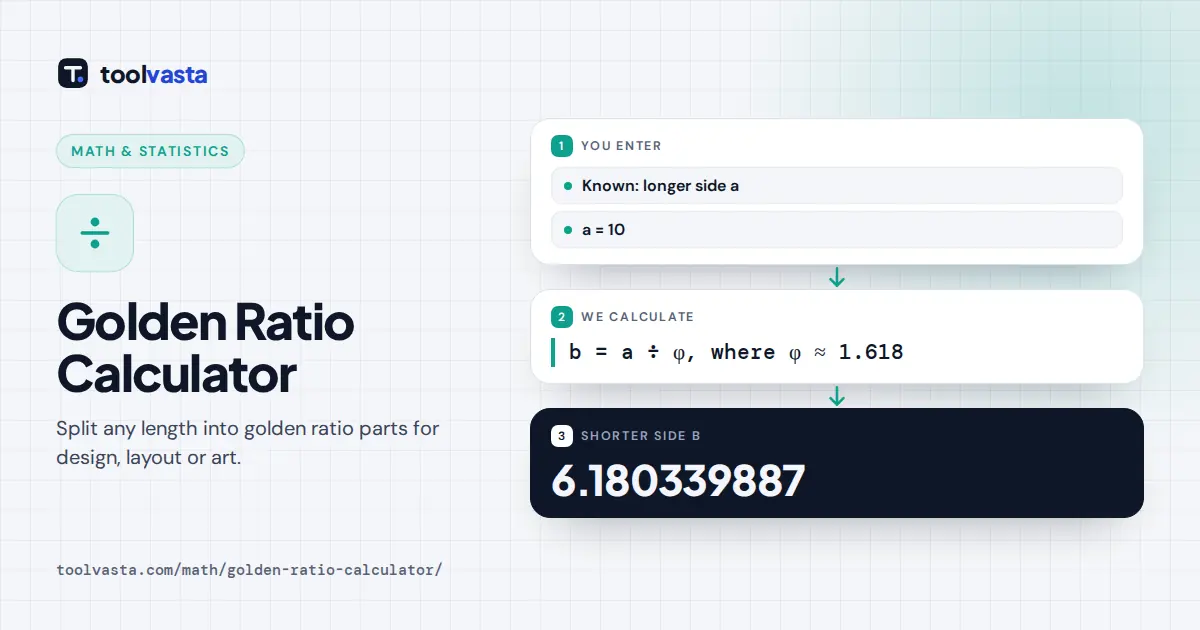
To find the golden ratio of a number, multiply by phi for the larger partner or divide by phi for the smaller one. If the longer side is 10, the shorter side is 6.180339887 units.
- Longer side known: a = 10 gives b = 6.180339887 and a + b = 16.18033989.
- Total known: a 100 cm shelf splits into 61.80339887 cm and 38.19660113 cm.
- Web layout: a 960 px area gives a main column of about 593 px and a sidebar of about 367 px.
When the total is known, divide it by phi to get the longer part. A 100 cm shelf therefore gets a divider about 61.8 cm from one end, which looks balanced without being perfectly symmetric.
For a 960 px content area, 960 ÷ 1.618 gives a main column near 593 px and leaves a sidebar near 367 px. Round to whole pixels and keep any gutters or margins inside those widths.
Golden Rectangle and Golden Spiral
A golden rectangle has sides in the ratio phi to 1. Cut a square from one end and the leftover piece is another golden rectangle, smaller but with exactly the same proportions as the original.
Repeat the cut and you get the nested squares shown in the drawing. Joining quarter circles drawn inside each square traces the golden spiral, which winds steadily inward toward one point without ever reaching it.
The true golden spiral is a logarithmic spiral that grows by a factor of phi every quarter turn. The quarter-circle version drawn here is a close, easy approximation used widely by designers, architects and artists.
The Golden Ratio and Fibonacci Numbers
In the Fibonacci sequence, each number is the sum of the two numbers before it: 1, 1, 2, 3, 5, 8, 13, 21, 34, 55 and so on, continuing forever with ever larger whole numbers.
| Fibonacci pair | Ratio | Difference from φ |
|---|---|---|
| 8 / 5 | 1.6 | −0.0180 |
| 13 / 8 | 1.625 | +0.0070 |
| 21 / 13 | 1.61538 | −0.0027 |
| 34 / 21 | 1.61905 | +0.0010 |
| 89 / 55 | 1.61818 | +0.00015 |
The ratio of consecutive Fibonacci numbers approaches phi, landing alternately above and below it, as the table above clearly shows. The OEIS entry for the Fibonacci numbers lists the full sequence and many related properties.
That is why a Fibonacci spiral built from squares of sides 1, 1, 2, 3, 5 and 8 looks almost identical to the golden spiral. Fibonacci pairs also give quick whole-number approximations for real measurements.
Using the Golden Ratio in Design
Designers use phi as a starting point for pleasing proportions in card shapes, column widths, logo construction and image crops. It gives a reasoned answer when choosing between two sizes would otherwise be a guess.
In typography, a golden modular scale multiplies each font size by 1.618. A 16 px body text pairs with a heading of about 26 px, and the next heading size up becomes about 42 px.
Photographers sometimes use a phi grid, placing guide lines at 38.2% and 61.8% instead of the thirds used by the rule of thirds. The result often feels slightly tighter toward the center of the layout.
Myths, Precision and Notes
Claims that the golden ratio is hidden everywhere in nature, the Parthenon and famous paintings are often exaggerated. Many examples rely on loose measurements, so treat phi as a useful guide rather than a law.
Results are always rounded to 10 significant digits, which is far more precise than any physical measurement made with a ruler. For the digits of phi beyond that, see the OEIS decimal expansion of phi.
Any unit works, because the ratio has no dimension: millimeters, inches, pixels or points all give the same proportions. Choosing a unit only labels the results so they are easier to copy into other tools.
Frequently asked questions
What is the golden ratio?
It is the number phi, equal to one plus the square root of 5, divided by 2, or about 1.6180339887. Two lengths are in the golden ratio when the longer divided by the shorter equals the total divided by the longer.
How do I calculate the golden ratio of a number?
Multiply the number by 1.618 to get the larger partner, or divide it by 1.618, which is the same as multiplying by 0.618, to get the smaller partner. For 100, that gives 161.8 and 61.8.
How do I divide a length into the golden ratio?
Divide the total by phi to get the longer part, about 61.8% of the total. The rest, about 38.2%, is the shorter part. A 100 cm length splits into roughly 61.8 cm and 38.2 cm.
What is the connection between the golden ratio and Fibonacci numbers?
Dividing each Fibonacci number by the one before it gives ratios that get closer and closer to phi, such as 13/8 = 1.625 and 89/55, which is about 1.6182.
Is the golden ratio the same as the rule of thirds?
No. The rule of thirds splits a frame at 33.3% and 66.7%. The golden ratio splits it at about 38.2% and 61.8%, which places guide lines slightly closer to the center.
How do I make a golden rectangle?
Choose the short side, then multiply it by 1.618 to get the long side. For a 5 inch short side, the long side is about 8.09 inches. Removing a square leaves another golden rectangle.