How to Use the Reynolds Number Calculator
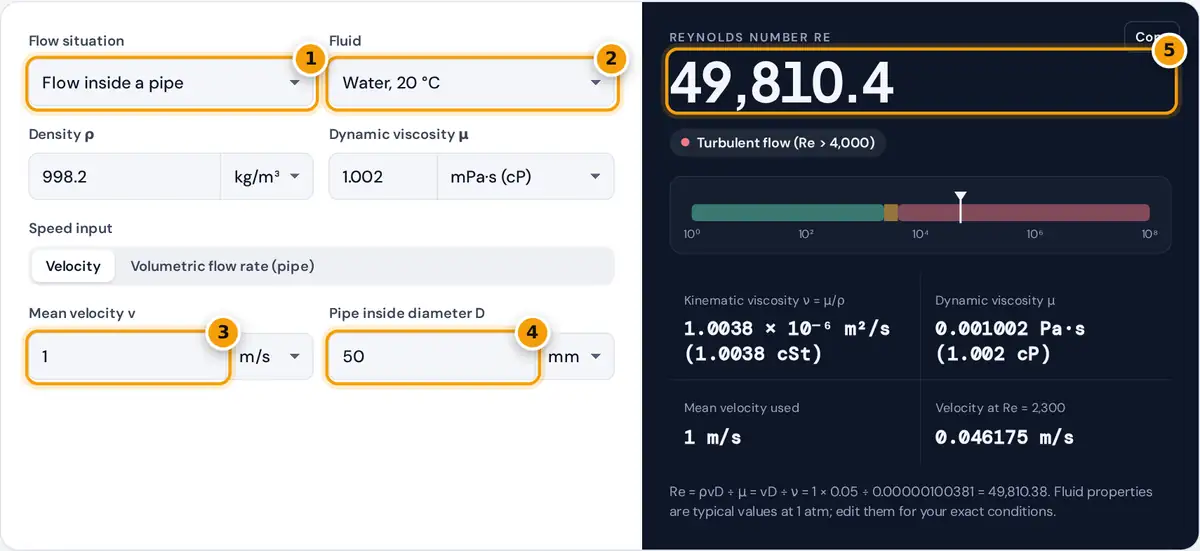
- Choose pipe flow, a flat plate or another shape.
- Pick a fluid preset or enter your own density and viscosity.
- Enter the mean velocity, or switch to flow rate for a pipe.
- Enter the pipe inside diameter or the characteristic length.
- Read Re, the flow regime and the velocity at the critical Reynolds number.
Choose the flow situation: inside a pipe, over a flat plate, or another shape with its own length scale. Pick a fluid to fill in typical density and viscosity values, or enter your own. The viscosity menu accepts dynamic viscosity in Pa·s, centipoise or poise, or kinematic viscosity in m²/s or centistokes.
Enter the mean velocity, or for a pipe switch to flow rate and enter the volume per second, hour or minute. Then enter the pipe’s inside diameter or the characteristic length. The Reynolds number appears with the flow regime, a log-scale bar that shows where it sits, the kinematic and dynamic viscosity, and the velocity at which the flow would reach the critical Reynolds number.
Reynolds Number Formula
ν = μ ÷ ρ v = Q ÷ (πD²/4) for a full circular pipe
Pipe flow: laminar below about 2,300, turbulent above about 4,000
Here ρ is the fluid density, v the mean velocity, D the pipe’s inside diameter (or another characteristic length), μ the dynamic viscosity and ν the kinematic viscosity. The Reynolds number is dimensionless. It compares inertial forces, which keep fluid moving and stir it into eddies, with viscous forces, which smooth the flow out. Low values mean smooth, layered laminar flow, and high values mean chaotic turbulent flow.
Worked Example
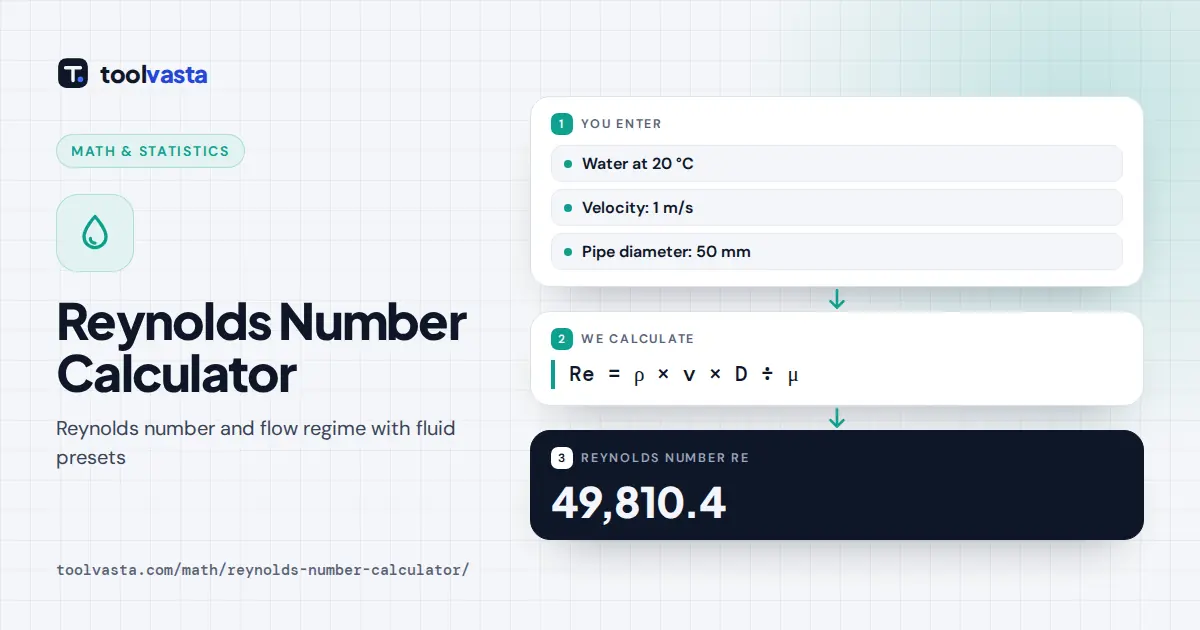
Water at 20 °C (ρ = 998.2 kg/m³, μ = 1.002 mPa·s) flows at 1 m/s through a pipe with a 50 mm inside diameter.
- Re = 998.2 × 1 × 0.05 ÷ 0.001002 = 49,810.
- That is well above 4,000, so the flow is turbulent.
- The flow would only be laminar below v = 2,300 × 1.00381 × 10⁻⁶ ÷ 0.05 = 0.0462 m/s, about 4.6 cm/s.
If you know the flow rate instead, 2 L/s in the same pipe gives a mean velocity of 0.002 ÷ (π × 0.025²) = 1.0186 m/s and Re = 50,736. Air at 20 °C moving at 10 m/s over a plate, 0.1 m from the leading edge, gives Re = 1.204 × 10 × 0.1 ÷ 1.825 × 10⁻⁵ = 65,973, which is still a laminar boundary layer.
Why the Reynolds Number Matters
The flow regime changes how a fluid behaves in practice. In laminar pipe flow the Darcy friction factor is simply f = 64 ÷ Re, so at Re = 1,500 it is 0.0427, and pressure drop rises in proportion to velocity. In turbulent flow the friction factor also depends on pipe roughness and is read from a Moody chart or the Colebrook equation, and pressure drop rises roughly with the square of velocity. Turbulence also mixes the fluid, which greatly improves heat transfer, so heat exchangers are usually designed to run turbulent.
Engineers also use the Reynolds number for scale models. A model tested in a wind tunnel or water channel behaves like the full-size object only if both have the same Reynolds number.
Typical Fluid Properties
| Fluid at 1 atm | Density (kg/m³) | Viscosity (mPa·s) |
|---|---|---|
| Water, 10 °C | 999.7 | 1.307 |
| Water, 20 °C | 998.2 | 1.002 |
| Water, 40 °C | 992.2 | 0.653 |
| Air, 20 °C | 1.204 | 0.01825 |
| Glycerin, 20 °C | 1,261 | about 1,412 |
Viscosity changes strongly with temperature, especially for liquids such as oils and glycerin, so use values for your actual temperature when accuracy matters. The presets are typical published values and can be edited.
Critical Reynolds Numbers
- Pipe flow: laminar below about 2,300 and fully turbulent above about 4,000, with a transitional range between. Very smooth, disturbance-free pipes can stay laminar to higher values.
- Flat plate: the boundary layer usually turns turbulent near Reₓ = 5 × 10⁵, based on the distance from the leading edge.
- Other shapes: spheres, cylinders and channels have their own critical values. Choose Other to get Re and compare it with the value for your geometry.
- For non-circular ducts, use the hydraulic diameter Dₕ = 4A ÷ P, where A is the flow area and P the wetted perimeter.
Frequently asked questions
What is the Reynolds number?
It is a dimensionless number, Re = ρvD ÷ μ, that compares inertial forces with viscous forces in a flowing fluid. It predicts whether flow will be smooth and laminar or chaotic and turbulent.
What Reynolds number is turbulent in a pipe?
Pipe flow is usually laminar below about 2,300, transitional between 2,300 and 4,000, and turbulent above about 4,000. The exact transition depends on pipe roughness and disturbances at the inlet.
What is the difference between dynamic and kinematic viscosity?
Dynamic viscosity μ, in Pa·s, measures a fluid's resistance to shearing. Kinematic viscosity ν = μ ÷ ρ, in m²/s, divides that by density. Use either one in the calculator; it converts automatically.
How do I calculate the Reynolds number from flow rate?
Find the mean velocity from v = Q ÷ (πD²/4), using the pipe's inside diameter, then use Re = ρvD ÷ μ. Choose Volumetric flow rate and the calculator does both steps.
What length should I use for the Reynolds number?
For a full circular pipe use the inside diameter. For a flat plate use the distance from the leading edge. For non-circular ducts use the hydraulic diameter, 4 × area ÷ wetted perimeter.
What is the Reynolds number of water in a typical pipe?
Household water at about 1 m/s in a pipe of 15 to 50 mm diameter has a Reynolds number of roughly 15,000 to 50,000, so the flow is turbulent in almost all practical plumbing.