How to Use the G Force Calculator
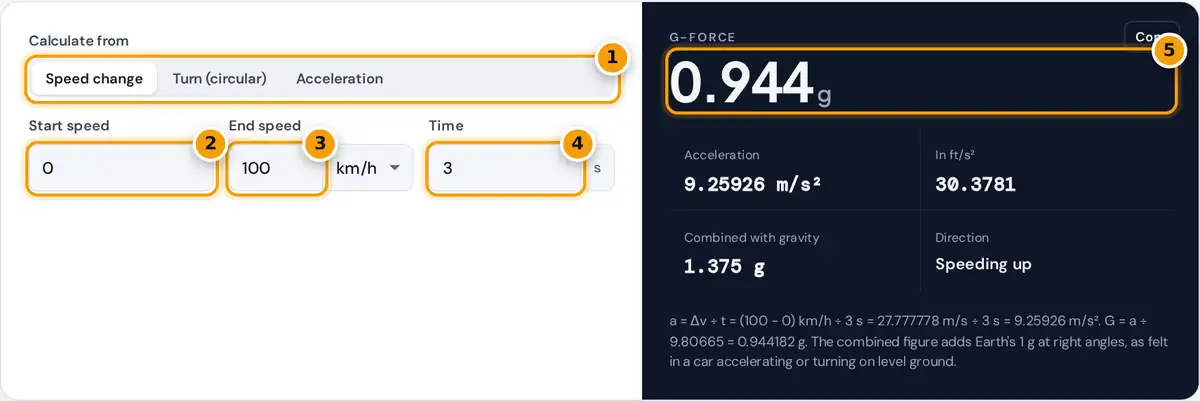
- Choose speed change, turn or acceleration.
- Enter the start speed.
- Enter the end speed and pick the unit.
- Enter the time in seconds.
- Read the g-force, the acceleration and the combined load.
Choose how you want to describe the motion. Speed change takes a start speed, an end speed and the time between them, which is ideal for car acceleration and braking figures such as 0 to 100 km/h or 60 to 0 mph. Turn calculates the sideways g-force in a curve from the speed and the radius of the turn. Acceleration converts a value you already know in m/s² or ft/s².
The result shows the g-force, the acceleration in metric and imperial units, the direction, and the combined load you would feel with Earth’s gravity added at right angles. That last figure is what a driver or passenger actually experiences on level ground.
G-Force Formulas
Speed change: a = (v₂ − v₁) ÷ t
Turning: a = v² ÷ r
Combined with gravity (horizontal a): √(1 + G²)
One g is the acceleration of standard gravity, 9.80665 m/s², or about 32.174 ft/s². An acceleration of 2 g pushes on you with twice your body weight. Speeds must be in meters per second for the formulas, so the calculator converts km/h, mph, ft/s and knots for you.
Worked Examples
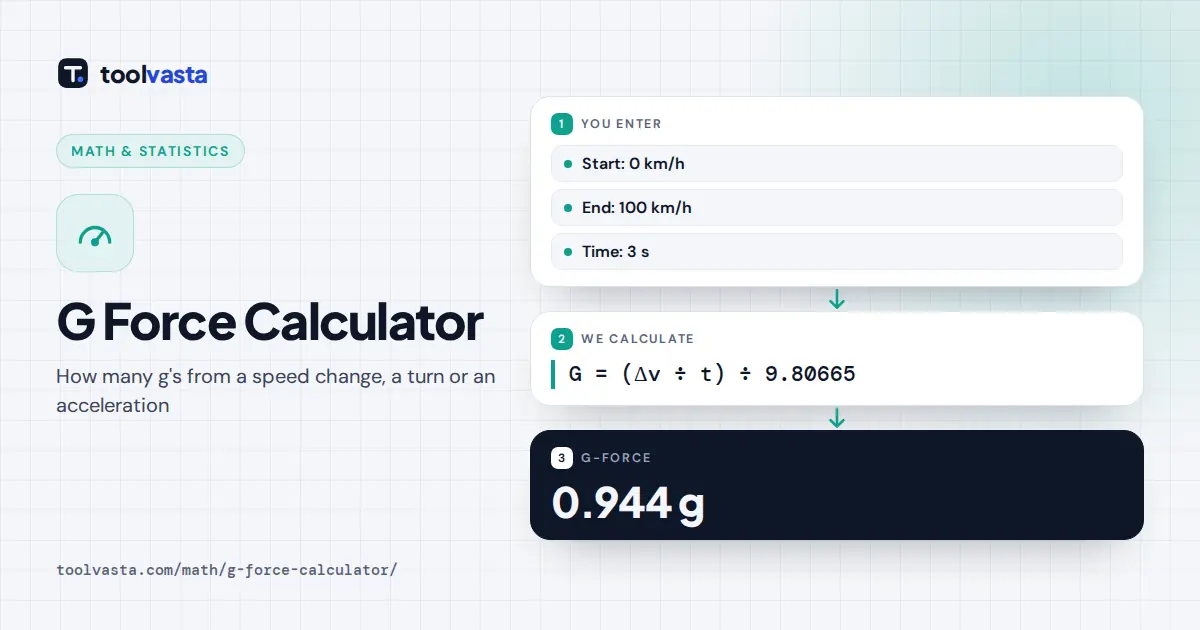
- Car launch: 0 to 100 km/h in 3.0 s. 100 km/h = 27.7778 m/s, so a = 27.7778 ÷ 3 = 9.25926 m/s² and G = 9.25926 ÷ 9.80665 = 0.944 g. Combined with gravity, the seat pushes on the driver with about 1.375 g.
- Hard braking: 60 mph to 0 in 2.5 s. 60 mph = 26.8224 m/s, so a = −10.729 m/s² and the deceleration is 1.094 g.
- Turn: 50 km/h (13.8889 m/s) around a 20 m radius curve gives a = 13.8889² ÷ 20 = 9.645 m/s², which is 0.984 g sideways.
Speeds in the turn formula must be converted to meters per second, and the radius to meters, before dividing.
Reference Accelerations
| Situation | Acceleration | G-force |
|---|---|---|
| Standard gravity | 9.80665 m/s² | 1 g |
| 0 to 100 km/h in 10 s | 2.778 m/s² | 0.283 g |
| 0 to 100 km/h in 5 s | 5.556 m/s² | 0.566 g |
| 0 to 100 km/h in 3 s | 9.259 m/s² | 0.944 g |
| 50 km/h turn, 20 m radius | 9.645 m/s² | 0.984 g |
All rows are calculated directly from the formulas above. Tire grip on dry pavement usually limits ordinary cars to roughly 1 g of braking or cornering, which is why the turning example is close to the edge.
Direction Matters
G-force is a vector. Forward acceleration presses you back into the seat, braking pushes you forward against the belt, and turning pushes you outward. Vertical accelerations combine directly with gravity: a lift accelerating upward at 0.2 g makes you feel 1.2 g, and one accelerating downward at 0.2 g makes you feel 0.8 g. The combined figure here assumes the acceleration is horizontal.
Converting Between Units
To turn a speed change into g-force by hand, first convert the speeds to meters per second: divide km/h by 3.6, or multiply mph by 0.44704. Divide the change in speed by the time in seconds to get m/s², then divide by 9.80665. In imperial units, use feet per second and divide by 32.174 instead. A useful shortcut: going from 0 to 100 km/h takes about 2.83 seconds at an average of exactly 1 g, and 0 to 60 mph takes about 2.74 seconds. Anything quicker than that means the average acceleration was above 1 g.
Limits
- The speed change method gives the average acceleration over the time. Peak values during the event are usually higher.
- The turn formula assumes a constant speed on a circular path.
- Human tolerance depends strongly on direction and duration, so this tool reports the physics only. Standard gravity follows the value listed by NIST.
Frequently asked questions
How do you calculate g-force?
Divide the acceleration in m/s² by standard gravity, 9.80665 m/s². An acceleration of 19.6 m/s² is about 2 g. For a speed change, first find the acceleration as change in speed divided by time.
How many g's is 0 to 60 mph in 3 seconds?
60 mph is 26.82 m/s, so the average acceleration is 26.82 ÷ 3 = 8.94 m/s². Dividing by standard gravity, 9.80665 m/s², gives about 0.91 g on average.
How do I calculate g-force in a turn?
Use centripetal acceleration, a = v² ÷ r, with the speed in m/s and the radius in meters, then divide by 9.80665. At 50 km/h on a 20 m radius, that is about 0.98 g.
What is 1 g in m/s²?
Standard gravity, 1 g, is defined as exactly 9.80665 m/s², which is about 32.174 ft/s². It is the reference value used for converting any acceleration into g's.
What does combined with gravity mean?
When a car accelerates or turns on level ground, Earth's 1 g still acts downward. The total load you feel is the square root of 1 plus G squared, which is always at least 1 g.
Is braking g-force negative?
Braking is a negative acceleration in the direction of travel, also called deceleration. The calculator reports its size as a positive g value and labels the direction as slowing down.