How to Use the Triangle Calculator
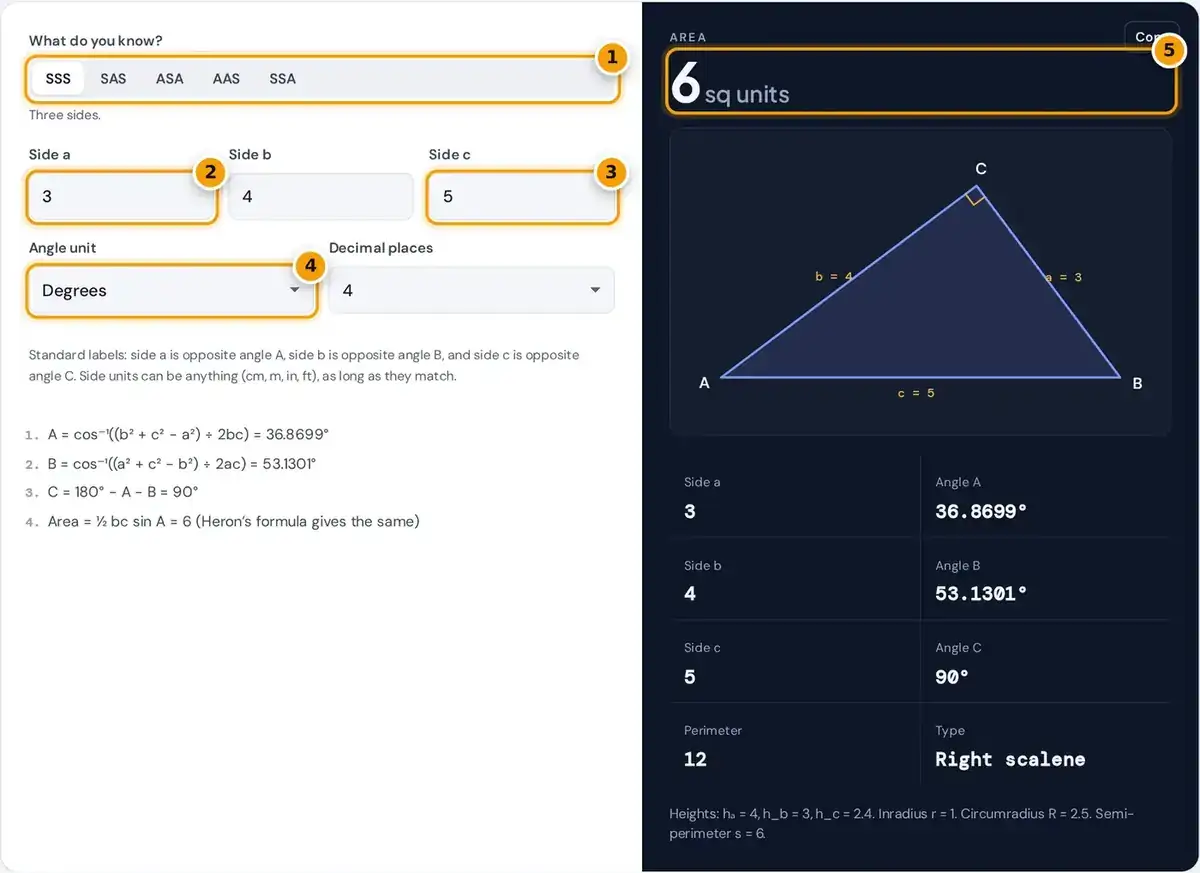
- Choose what you know: SSS, SAS, ASA, AAS or SSA.
- Enter the first known value. Side a sits opposite angle A.
- Fill in the remaining known sides or angles in the other boxes.
- Pick degrees or radians for the angles.
- Read the area, then every side, angle, perimeter, type and the steps.
Choose the combination of parts you know: SSS, SAS, ASA, AAS or SSA. Enter the three values, and the calculator solves every missing side and angle instantly, along with the total area and the perimeter.
Standard labels apply: side a is opposite angle A, side b is opposite angle B, and side c is opposite angle C. Side units can be anything, as long as all sides use one unit.
Pick degrees or radians and set the decimal places. The triangle is drawn to scale, so the tool also works as a triangle maker, and a step list shows exactly how each value was found.
| Case | You know | Method | Solutions |
|---|---|---|---|
| SSS | Three sides | Law of cosines | 0 or 1 |
| SAS | Two sides and the included angle | Law of cosines, then angles | 1 |
| ASA | Two angles and the included side | Angle sum, then law of sines | 1 |
| AAS | Two angles and a non-included side | Angle sum, then law of sines | 1 |
| SSA | Two sides and a non-included angle | Law of sines | 0, 1 or 2 |
Triangle Formulas Used
The law of cosines links all three sides with one angle. It solves SSS and SAS triangles, where no side and opposite angle pair is known yet, and the inverse cosine then returns the angle.
Law of sines: a ÷ sin A = b ÷ sin B = c ÷ sin C
Angle sum: A + B + C = 180°
Area = ½ ab sin C or Heron: √(s(s − a)(s − b)(s − c)), s = (a + b + c) ÷ 2
The law of sines says each side divided by the sine of its opposite angle gives the same ratio. It solves ASA, AAS and SSA triangles once one side and its opposite angle are known.
The angle sum rule gives the third angle, because the angles always total 180 degrees. Area comes from half of two sides times the sine of their angle, or from Heron's formula using the semiperimeter.
Worked Triangle Examples
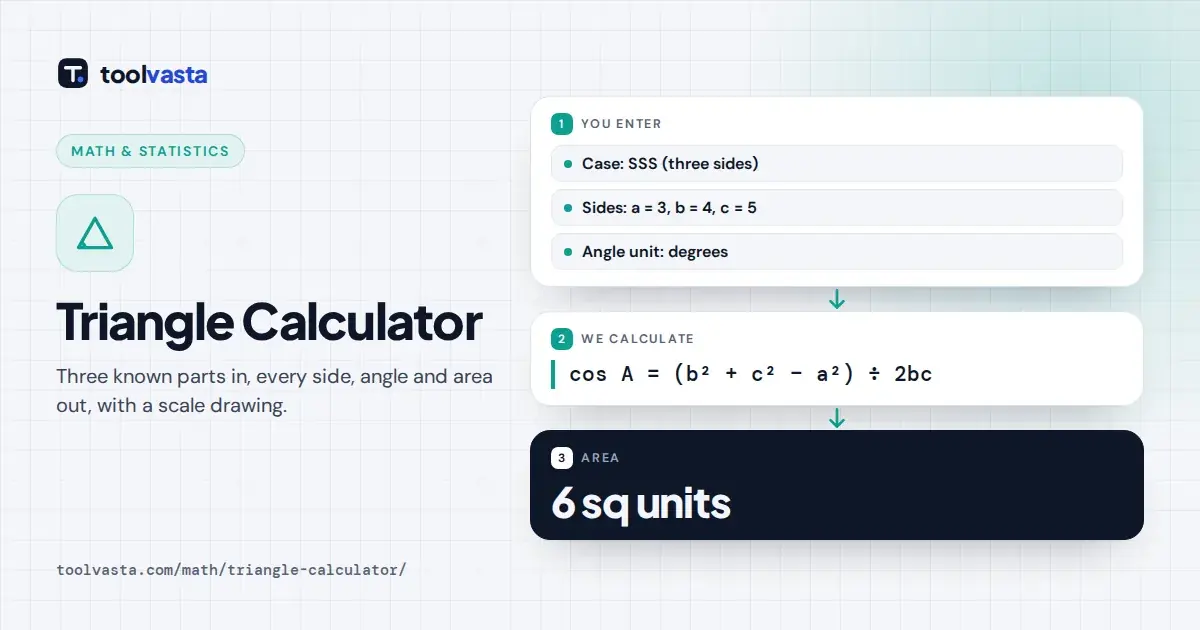
For SSS, take sides 3, 4 and 5. Angle A is the inverse cosine of 0.8, which is 36.8699°, and angle B is the inverse cosine of 0.6, which is 53.1301°. That leaves exactly 90°.
For SAS, a = 5 and b = 7 meet at C = 60°. The law of cosines gives c² = 39, so c is 6.245; the area is half of 5 times 7 times sin 60°, or 15.1554.
For ASA, angle A = 40°, side c = 10 and angle B = 60°. Angle C is 80°, the law of sines gives a = 6.527 and b = 8.7939, and the area then comes to 28.2629 square units.
The Ambiguous Case (SSA)
When you know two sides and an angle that is not between them, the data may fit no triangle, one triangle or two triangles. That is why SSA is called the ambiguous case in trigonometry.
The law of sines gives sin B, and because an acute angle and its supplement share the same sine, both can often work. The calculator checks both options and shows every valid triangle it finds.
Now take a = 6, b = 8 and A = 30°. B is 41.8103° or 138.1897°, giving c = 11.4003 or c = 2.4561. Use the Triangle 1 and Triangle 2 buttons to switch between the two valid solutions.
- If a is shorter than b sin A, no triangle exists.
- If a equals b sin A, or a is at least as long as b, there is one triangle.
- If b sin A < a < b and A is acute, there are two triangles.
Triangle Types by Angles and Sides
By angles, a triangle is acute when all angles are under 90°, a right triangle when one angle is exactly 90°, and obtuse when one angle is over 90°. The type appears in the results.
By sides, a triangle is equilateral when all three sides are equal, isosceles when two sides are equal, and scalene when no sides match. The 3, 4, 5 example is therefore a right scalene triangle.
An equilateral triangle always has three 60° angles, and an isosceles triangle has two equal angles opposite its equal sides. Checking these patterns is a quick way to confirm that a result really makes sense.
Area, Perimeter, Heights and Circles
The perimeter is simply the three sides added together. The area is shown as the headline result, and the drawing updates to match, which helps you spot input mistakes like a swapped side or angle.
Each height, also called an altitude, equals twice the area divided by the side it meets. The note under the results lists all three heights, so you do not need to compute them by hand.
The inradius is the radius of the largest circle that fits inside the triangle, equal to the area divided by the semiperimeter. The circumradius is the radius of the circle passing through all three corners.
When No Triangle Exists
The triangle inequality says any two sides must sum to more than the third. If the longest side matches or exceeds the other two sides added together, the sides cannot close and a warning appears.
Angles fail similarly. If two known angles already total 180 degrees or more, there is no room for a third, and in the SSA case side a may be too short to reach the base.
For any right triangle, the Pythagorean theorem is a quick check: the two shorter sides, each squared, add up to the hypotenuse squared. The 3-4-5 triangle is the classic whole number example of that rule.
Accuracy and Limits
The calculations use double-precision arithmetic, and results are rounded to the decimal places you choose. Very flat triangles, with one angle close to 0° or 180°, are very sensitive to small rounding in the inputs.
Three angles alone, the AAA case, fix the shape but not the size, so at least one side is always needed. Any two triangles with the same angles are similar triangles, differing only in scale.
For the full theory behind each step, see the OpenStax precalculus chapter on the law of sines and the NIST Digital Library of Mathematical Functions for the formal definitions of the sine and cosine functions.
Frequently asked questions
How do I solve a triangle with three sides?
Use the law of cosines to find one angle, for example A = inverse cosine of (b² + c² − a²) / 2bc, then find a second angle and subtract both from 180° for the third. Choose SSS to do it instantly.
What is the ambiguous case of a triangle?
It is the SSA case, where two sides and a non-included angle can produce zero, one or two different valid triangles. When two exist, the calculator shows both and lets you switch between them.
How do you find the area of a triangle without the height?
Use half of two sides times the sine of the angle between them, or Heron's formula with all three sides and the semiperimeter. The calculator applies whichever fits the parts you entered.
Why does the calculator say no triangle exists?
Either the longest side is not shorter than the other two combined, the known angles add up to 180° or more, or in the SSA case side a is too short to reach the base.
Can I use radians instead of degrees?
Yes. Switch the angle unit to radians and enter angles in radians. Results are shown in the same unit, so 60 degrees appears as 1.0472 rad with four decimal places.
Can this calculator solve right triangles?
Yes. Enter any three known parts, such as two sides and the 90 degree angle, and it solves the rest. The 3, 4, 5 example shows a right triangle with angles of 36.8699° and 53.1301°.