How to Use the Sig Fig Calculator
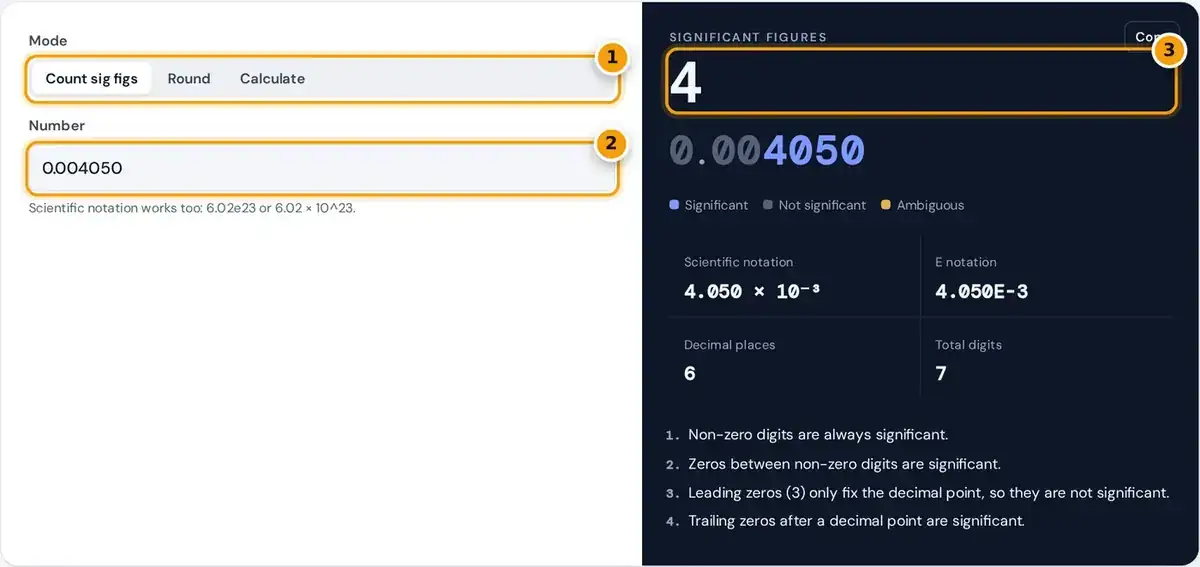
- Choose Count, Round or Calculate.
- Enter your number. Scientific notation like 6.02e23 also works.
- Read the sig fig count, with each digit colour-coded and the rule explained.
Choose a mode first. Count sig figs tells you how many significant figures a number has and colors each digit as significant, not significant or ambiguous, with a short explanation of every rule that applied.
Round shortens any number to the number of sig figs you choose, and also shows the result in scientific notation. Calculate adds, subtracts, multiplies or divides two measured values and applies the right rounding rule.
This sig figs calculator works on the digits exactly as you type them, not on a rounded copy, so trailing zeros such as the last 0 in 3.20 are never lost. Copy grabs the answer.
What Significant Figures Are
Significant figures, also called significant digits, are the digits in a measurement that carry information about its precision. A reading of 3.20 g tells you the scale was precise to the hundredth of a gram.
Writing more digits than your instrument can really measure creates false precision. If a ruler reads to the millimeter, reporting a length to the micrometer suggests an accuracy that the original measurement simply never had.
That is why science and engineering courses insist on sig figs. They keep calculated answers honest and comparable: a result can never be more precise than the least precise measurement that went into the calculation.
Significant Figures Rules
| Number | Sig figs | Why |
|---|---|---|
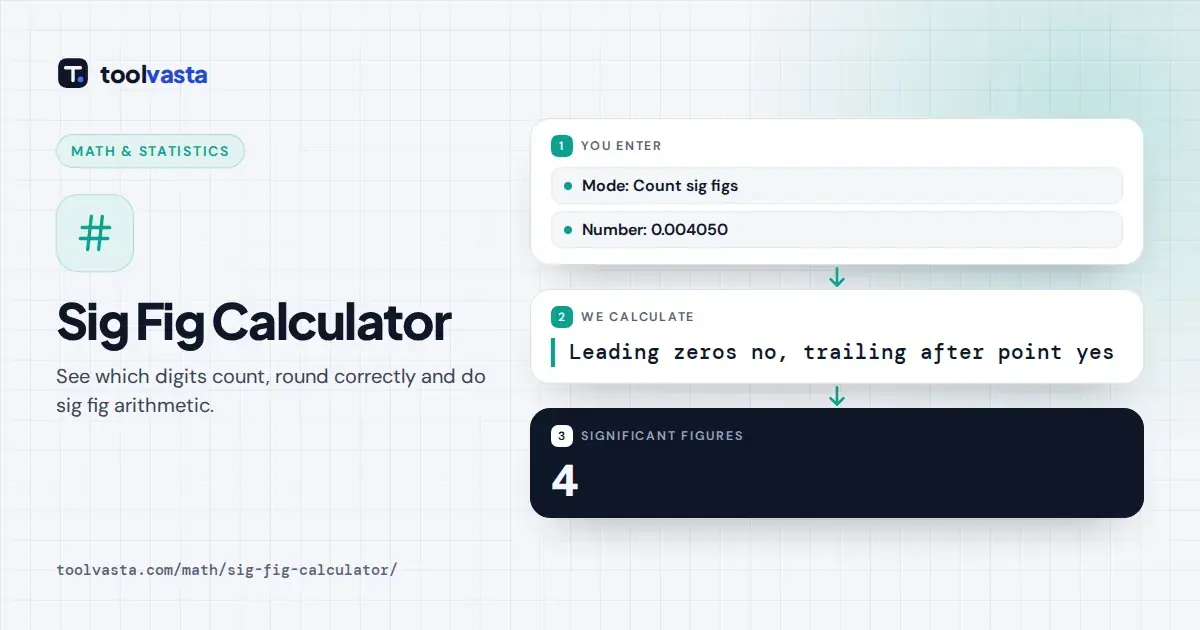
| 0.004050 | 4 | Leading zeros do not count, the trailing zero does |
| 1005 | 4 | Zeros between digits count |
| 1200 | 2 (ambiguous) | No decimal point |
| 1200. | 4 | Decimal point makes the zeros significant |
| 6.02 × 10²³ | 3 | Only the digits in front of × 10 count |
Non-zero digits are always significant, so 4.56 has 3. Trapped zeros between non-zero digits also count, so 1005 has 4. Leading zeros are never significant, because they only place the decimal point: 0.0045 has 2.
Trailing zeros after a decimal point are significant, so 3.20 has 3 and 0.004050 has 4. Trailing zeros in a whole number without a decimal point are ambiguous: 1200 could have 2, 3 or 4.
The calculator counts the minimum for ambiguous numbers and shows the range. Exact numbers, such as counted items or defined conversions (12 inches in a foot), have infinite significant figures and never limit an answer.
Scientific Notation Removes Ambiguity
In scientific notation, only the digits in the coefficient count, never the power of ten. So 6.02 × 10²³ has 3 significant figures, and you can type it as 6.02e23 or with a caret symbol.
Scientific notation is the cleanest way to show which zeros matter. Writing 1.200 × 10³ makes all four digits significant, while 1.2 × 10³ clearly has only two. The tool accepts both styles as input.
Adding a decimal point after a whole number, as in 1200., is a shortcut that also marks every zero as significant. The results panel then shows each answer in both scientific notation and E notation.
How to Round to Significant Figures
0.0045678 to 2 sig figs → 0.0046
1234 to 2 sig figs → 1200 = 1.2 × 10³
9.996 to 3 sig figs → 10.0
Find the first non-zero digit, count across the number of sig figs you need, then look at the very next digit. If it is 5 or more, round up. Otherwise leave the kept digits unchanged.
Replace dropped digits left of the decimal point with placeholder zeros so the number keeps its original size. Rounding 1234 to 2 sig figs gives 1200, which the tool also writes as 1.2 × 10³.
Watch for carries: 9.996 to 3 sig figs becomes 10.0, not 10. Rounding 3.14159 to 3 gives 3.14. Asking for more digits than exist, as with 2.5 to 3 sig figs, adds a zero: 2.50.
Sig Fig Rules for Multiplying and Dividing
When multiplying or dividing, the answer keeps as many significant figures as the measurement with the fewest significant figures. The number of decimal places in each value does not matter for this rule at all.
Take the default calculation: 12.52 times 3.1 equals 38.812 exactly. Because 3.1 has only 2 sig figs, the answer is rounded to 39. The panel shows both the exact result and the correctly rounded answer.
Dividing works the same way. For 10.0 divided by 3 the tool reports 3, since 3 has one sig fig, but 10.0 divided by 3.00 gives 3.33 because both values then carry three significant figures.
Sig Fig Rules for Adding and Subtracting
When adding or subtracting, the answer is rounded to the least precise decimal place, not to a number of sig figs. What matters is how far to the right each individual measurement is actually known.
For example, 12.52 plus 3.1 equals 15.62. The measured value 3.1 is only known to the tenths place, so the reported answer is 15.6. Subtracting 0.25 from 100.0 gives 99.75, which rounds up to 99.8.
Whole numbers with ambiguous zeros limit the result too. Subtracting 35 from 1200 gives 1165, but 1200 is only known to the hundreds place, so the calculator reports 1200 as the correctly rounded final answer.
Multi-Step Problems and Rounding Conventions
In multi-step problems, keep extra digits in the intermediate steps and round only the final answer. Rounding at every step can shift the last digit, a common source of lost marks in chemistry and physics.
This calculator rounds half up, away from zero, which is what most school courses teach. Some labs follow round half to even, described in NIST Special Publication 811, which differs only for an exact 5.
For a concise, printable summary of classroom conventions, see the Rice University significant figure rules. For exactly zero, sig figs are not defined in the usual way, so the tool reports its decimal places instead.
Frequently asked questions
How many significant figures does 0.004050 have?
Four. The leading zeros only place the decimal point. The digits 4, 0 and 5 count, and the trailing zero after the decimal point also counts, giving 4.050 times 10 to the power of minus 3.
Are trailing zeros significant?
Trailing zeros after a decimal point are significant. Trailing zeros in a whole number without a decimal point, such as 1200, are ambiguous unless you add a decimal point or use scientific notation.
How do you round to 3 significant figures?
Keep the first three digits starting from the first non-zero digit, then round using the fourth digit. 3.14159 becomes 3.14, 0.0045678 becomes 0.00457 and 9.996 becomes 10.0.
What is the sig fig rule for multiplication?
The answer keeps the same number of significant figures as the input with the fewest. For example, 12.52 times 3.1 equals 38.812, which rounds to 39 because 3.1 has only two significant figures.
What is the sig fig rule for addition?
Round the answer to the last decimal place that every number shares. For example, 12.52 plus 3.1 equals 15.62, which rounds to 15.6 because 3.1 is only known to the tenths place.
Do exact numbers affect significant figures?
No. Counted items and defined conversions, such as 12 inches in a foot or 100 centimeters in a meter, are exact and have infinite significant figures, so they never limit the precision of an answer.