How to Use the Scientific Notation Calculator
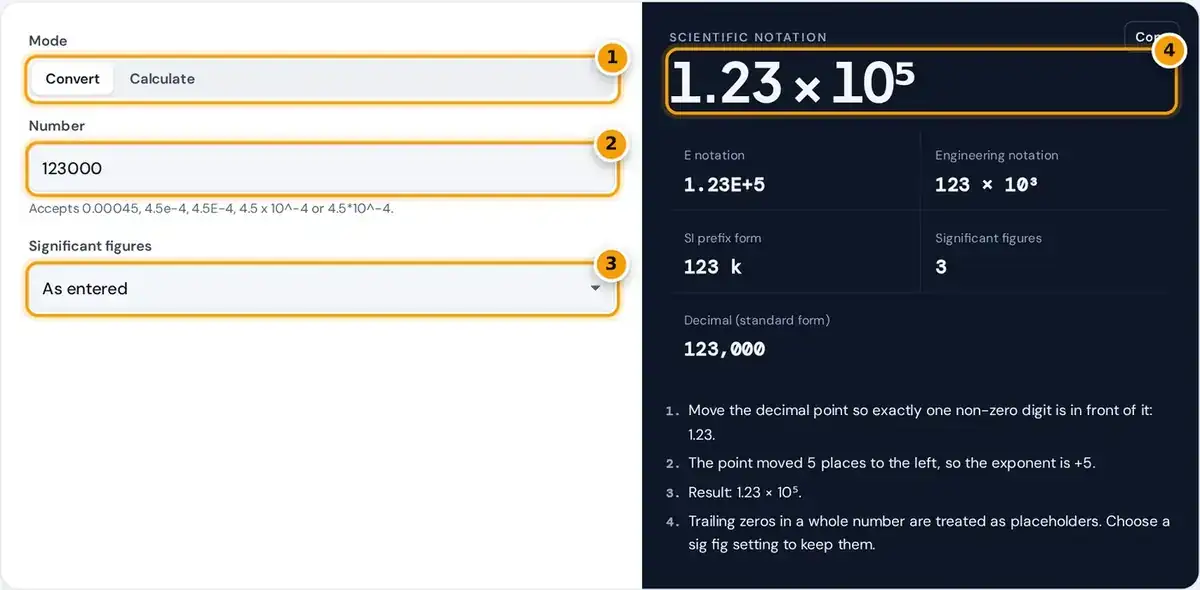
- Choose Convert to change a number's form, or Calculate to do arithmetic.
- Enter a number like 0.00045, 4.5e-4 or 4.5 x 10^-4.
- Pick how many significant figures to keep.
- Read the scientific notation, then E notation, engineering form and SI prefix.
In Convert mode, type a number in any format: an ordinary decimal such as 0.00045, E notation such as 4.5e-4, or a power of ten written as 4.5 x 10^-4. The result then updates instantly.
The calculator shows the number in scientific notation, E notation, engineering notation, SI prefix form and as a full decimal. Choose a number of significant figures to round the result, or leave it as entered.
In Calculate mode, enter two numbers and pick an operation. The steps show how the coefficients and exponents combine, the last step gives the answer rounded by the sig fig rules, and Copy grabs it.
What Is Scientific Notation?
E notation: a E n (for example 1.23E+5)
Engineering notation: n is a multiple of 3 and 1 ≤ |a| < 1000
Scientific notation writes a number as a coefficient multiplied by a power of ten. In normalized form the coefficient sits between 1 and 10, and the exponent is a whole number, either positive or negative.
The coefficient is also called the significand or mantissa. The format makes very large and very small numbers easy to read and compare, because the exponent immediately shows their size without counting rows of zeros.
In Canada, the UK and many classrooms the same idea is called standard form. Scientists use it daily, from the distance between stars to the size of a virus or the charge on an electron.
How to Convert to Scientific Notation
- Move the decimal point until one non-zero digit sits in front of it.
- Count how many places you moved it. That count is the exponent.
- Moving left gives a positive exponent, and moving right gives a negative one.
For example, take the number 123,000. Move the decimal point 5 places left to get 1.23, so 123,000 = 1.23 × 10⁵. Because the point moved left, the result correctly carries a positive exponent of 5.
Now take a decimal such as 0.00045. Move the decimal 4 places right to get 4.5, so 0.00045 = 4.5 × 10⁻⁴. Moving right means the original number was below 1, which gives a negative exponent.
A quick check: numbers of 10 or more have positive exponents, and numbers below 1 have negative ones. Numbers from 1 up to 10 simply use an exponent of zero, such as 7.2 × 100.
Converting Back and Reading E Notation
To return a result to standard notation, move the decimal point the number of places shown by the exponent: right for a positive exponent, left for a negative one. So 6.3 × 10⁴ becomes 63,000.
E notation, used by computers, replaces times ten to the power with the single letter E. A calculator display or spreadsheet cell showing 1.23E+5 means 1.23 × 10⁵, which is 123,000, and 4.5E-4 means 0.00045.
The exponent is often called the order of magnitude. Two values with exponents of 5 and 8 differ by roughly three orders of magnitude, meaning one is about a thousand times larger than the other.
Multiplying, Dividing, Adding and Subtracting
(6 × 10⁸) ÷ (3 × 10⁻²) = 2 × 10¹⁰
For multiplication, simply multiply the coefficients and add the exponents. So 3.2 times 4.0 is 12.8, and 5 plus negative 3 is 2. Then adjust 12.8 × 10² into normalized form as 1.28 × 10³.
For division, divide the coefficients and subtract the exponents. Dividing 6 × 108 by 3 × 10−2 gives 2 for the coefficient and 8 minus negative 2, or 10, for the exponent of the answer.
Addition and subtraction work differently, because both numbers need the same power of ten first. Rewrite 4.1 × 10² as 0.41 × 10³, then add it to 2.5 × 10³ to get 2.91 × 10³.
Engineering Notation and SI Prefixes
| Power of ten | Prefix | Symbol |
|---|---|---|
| 1012 | tera | T |
| 109 | giga | G |
| 106 | mega | M |
| 103 | kilo | k |
| 10−3 | milli | m |
| 10−6 | micro | µ |
| 10−9 | nano | n |
| 10−12 | pico | p |
Engineering notation only uses exponents in multiples of 3, with a coefficient from 1 up to 1,000. That neatly lines the result up with SI prefixes such as kilo, mega, giga, milli, micro and nano.
So 123,000 becomes 123 × 103, or 123 k, and 0.00045 becomes 450 × 10−6, or 450 micro. Engineers and technicians read these values directly as kilohms, microfarads or nanoseconds without any extra conversion step.
The official prefix names and symbols are set internationally by the BIPM SI Brochure, and the NIST Guide to the SI explains how to write numbers, units and prefixes correctly in scientific and technical work.
Significant Figures, Precision and Limits
All conversions use exact decimal arithmetic on the digits you type, so Avogadro's number, 6.022e23, keeps every digit and no floating-point rounding creeps in. The full decimal output shows all 24 digits of the number.
Division results that do not terminate are shown to 15 significant figures. Rounding to fewer figures is up to you: 98,765 set to 2 significant figures becomes 9.9 × 10⁴, following the standard rounding rules.
Trailing zeros in whole numbers, such as the zeros in 123000, are treated as placeholders unless you choose a significant figure setting. Scientific notation removes that ambiguity, because every digit written in the coefficient counts.
Frequently asked questions
How do you write 123,000 in scientific notation?
Move the decimal point 5 places to the left to get 1.23, so 123,000 = 1.23 × 10⁵. In E notation that is 1.23E+5, and in engineering notation it is 123 × 10³.
How do you write 0.00045 in scientific notation?
Move the decimal point 4 places to the right to get 4.5, so 0.00045 = 4.5 × 10⁻⁴. The exponent is negative because the original number is smaller than 1.
What does E mean in a number like 1.23E+5?
E stands for exponent and means times ten to the power of. So 1.23E+5 is 1.23 × 10⁵, or 123,000. Calculators and spreadsheets use this format when numbers are too long to display.
What is the difference between scientific and engineering notation?
Scientific notation uses a coefficient from 1 to 10 and any whole-number exponent. Engineering notation uses exponents that are multiples of 3, which match SI prefixes such as kilo and micro.
How do you multiply numbers in scientific notation?
Multiply the coefficients and add the exponents, then adjust so the coefficient is between 1 and 10. For example, 3.2 × 10⁵ times 4.0 × 10⁻³ equals 1.28 × 10³.
How do you add numbers in scientific notation?
Rewrite both numbers with the same power of ten, then add the coefficients and keep that exponent. For example, 2.5 × 10³ plus 4.1 × 10² equals 2.91 × 10³.