How to Use the Ratio Calculator
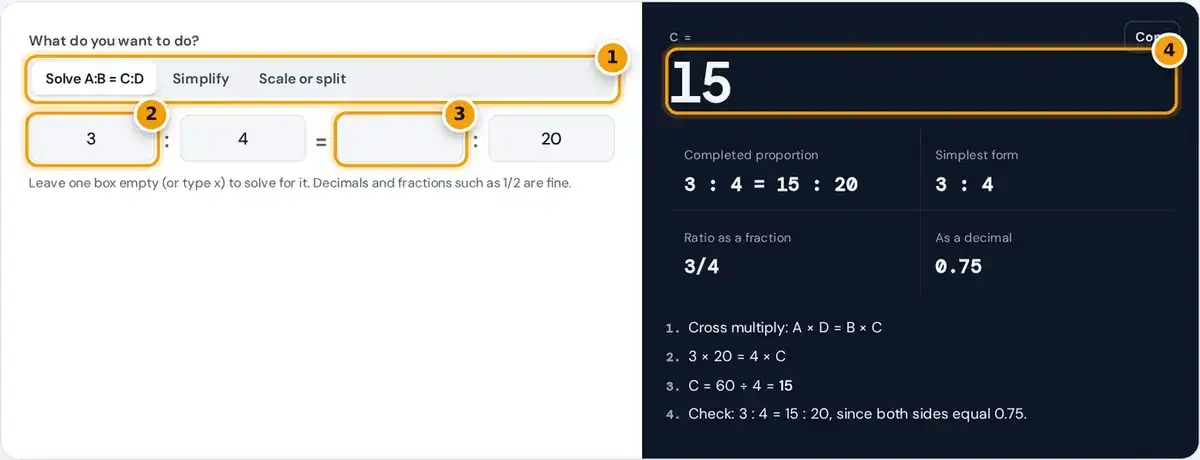
- Choose Solve, Simplify, or Scale or split.
- Enter the known terms of the proportion A:B = C:D.
- Leave the unknown box empty, or type x, to solve for it.
- Read the missing value, the completed proportion and the cross-multiply steps.
The ratio calculator has three modes: Solve A:B = C:D, Simplify, and Scale or split. Choose one at the top, type in your numbers, and the answer appears instantly with the working shown step by step.
To solve a proportion, fill in three of the four boxes and leave the missing value as an empty box, or type x. Whole numbers, decimals and fractions such as 1/2 are all accepted here.
Simplify takes a ratio with colons, such as 12:18, and accepts three or more parts. Scale or split shares a total, multiplies by a factor, or sets the first or last part to a value.
How to Solve a Proportion
A proportion says that two ratios are equal. Cross multiplication turns it into a simple equation: the product of the outer terms equals the product of the inner terms, so one unknown is found directly.
A = B × C ÷ D B = A × D ÷ C C = A × D ÷ B D = B × C ÷ A
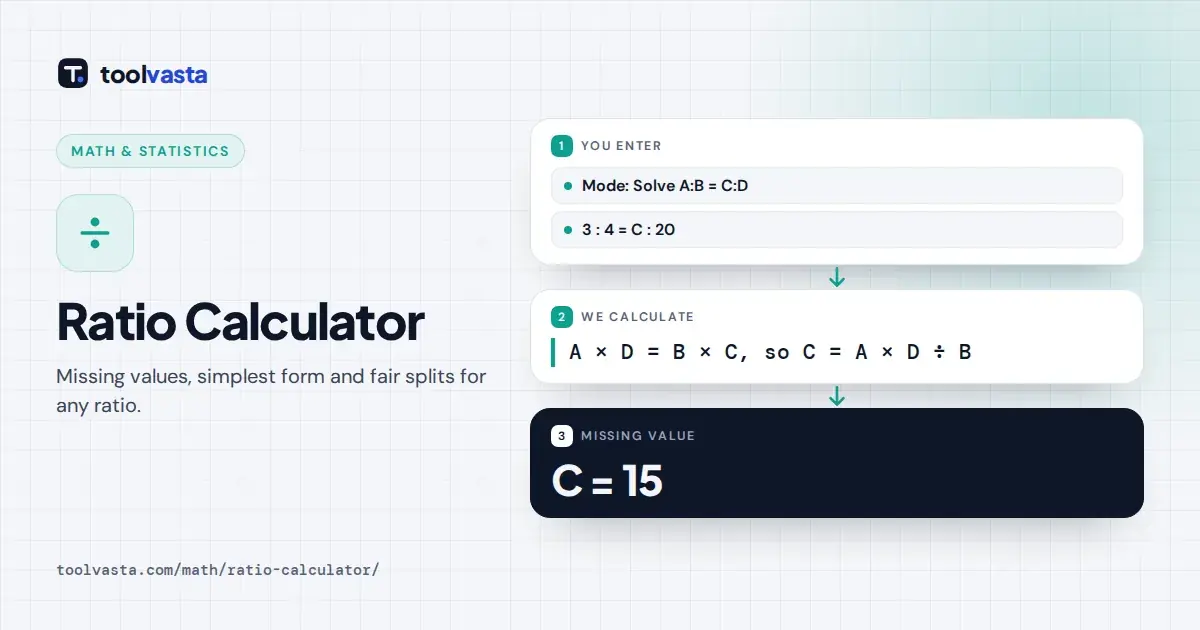
Solve 3 : 4 = x : 20. Cross multiply the terms to get 3 times 20 equals 4 times x, so 60 = 4x and x = 15. The calculator then completes the proportion as 3 : 4 = 15 : 20.
As a check, 3 divided by 4 is 0.75, and 15 divided by 20 is also 0.75, so the ratios match. The same method finds a missing side in similar shapes or a scaled drawing.
How to Simplify a Ratio
A ratio is in simplest form, or lowest terms, when its parts share no common factor other than 1. To get there, simply divide every part by the greatest common factor of all the parts.
- If any part is a decimal or fraction, multiply every part by the same number to make them all whole numbers.
- Find the greatest common factor (GCF) of all the parts.
- Divide every part by the GCF.
For 12 : 18 the greatest common factor is 6, so it simplifies to 2 : 3. For 1.5 : 2.5, multiply by 10 to get whole numbers, 15 : 25, then divide by 5 to get 3 : 5.
The result panel also shows the 1 : n form, where the first part is scaled to 1. For 2 : 3 that is 1 : 1.5, which is handy for comparing several ratios with different sizes quickly.
How to Divide a Quantity in a Ratio
To split a total in a ratio, first find the sum of the parts. Divide the total by that sum to find the value of one part, then multiply each ratio part by that value.
To split 40 at 3 : 5, there are 3 + 5 = 8 parts, so one part is 40 divided by 8, which is 5. The shares are 3 times 5 = 15 and 5 times 5 = 25.
The same steps work with three parts or more. Dividing a $900 bill in the ratio 2 : 3 : 4 gives 9 parts of $100, so each person pays a share of $200, $300 and $400.
Scaling a Ratio Up or Down
Scaling multiplies every part by the same scale factor, which always produces an equivalent ratio. For example, 3 : 5 multiplied by 4 becomes 12 : 20, and both describe exactly the same relationship between the parts.
To scale a recipe, set the first part to the amount you have. If a dough uses flour and water at 5 : 3 and you have 750 g of flour, the water is 450 g.
The calculator reports the scale factor, the new total and the simplest form of the original ratio. You can also set the last part instead, which suits problems where only the second quantity is known.
Everyday Uses of Ratios
Ratios appear in screens, maps, building and shared bills. The table lists common situations with a sample question for each one below, and every answer can be found with one of the three calculator modes.
| Situation | Ratio | Example question |
|---|---|---|
| Recipes | Flour : water | How much water for 750 g of flour at 5 : 3? |
| Screens and photos | Width : height | Height of a 1920 pixel wide 16 : 9 image? |
| Maps and models | Map : real distance | Real length of 4 cm at 1 : 50,000? |
| Mixing | Concentrate : water | Split 2 L of drink at 1 : 4 |
| Sharing costs | Person A : person B | Divide a $900 bill at 2 : 3 : 4 |
A 16 : 9 aspect ratio with a width of 1920 pixels gives a height of 1080. On a map scale of 1 : 50,000, used by Canada's National Topographic System maps, 4 cm equals 2 km.
Splitting 2 L at 1 : 4 gives 0.4 L of concentrate and 1.6 L of water. A concrete mix is often given as three parts, such as 1 : 2 : 3 for cement, sand and gravel.
Ratios, Fractions and Percentages
A ratio can be written three ways: 2 : 3, as the fraction 2/3, or in words as 2 to 3. The fraction form compares the first part with the second, not with the total amount.
A ratio like 2 : 3 is part-to-part. For a part-to-whole view, divide each part by the total of 5, which gives 2/5 and 3/5. Simplify mode then shows this as the share of the whole.
That share is also a percentage: 2 : 3 means 40% and 60%. Statistics Canada's guide to proportions, ratios and rates explains how a rate differs, comparing quantities with different units, such as kilometers per hour.
Notes and Limits
All results use exact fraction arithmetic, so a missing value like 10/3 is shown as a fraction with its decimal, instead of being rounded silently. Very long decimals are shown with six places for readability.
Ratio parts in Simplify and Scale or split modes must be positive, because a negative share of something has no practical meaning. Solve mode accepts any numbers, as long as division by zero is avoided.
A ratio compares parts to parts, so always check which kind of comparison your question needs. For example, a 1 : 4 drink mix means one fifth concentrate, not one quarter, of the total drink volume.
Frequently asked questions
How do you solve a ratio with a missing number?
Cross multiply. For 3 : 4 = x : 20, multiply 3 by 20 to get 60, then divide by 4 to get x = 15. Check that both ratios give the same decimal, 0.75.
How do you simplify a ratio?
Divide every part by their greatest common factor. For 12 : 18, the greatest common factor is 6, so dividing both parts by 6 gives the simplest form, 2 : 3.
How do you simplify a ratio with decimals?
Multiply all parts by 10, 100 or another power of ten until they are whole numbers, then divide by the greatest common factor. 1.5 : 2.5 becomes 15 : 25, then 3 : 5.
How do I divide an amount in a ratio?
Add the parts, divide the amount by the sum, and multiply each part by the result. Splitting 40 in the ratio 3 : 5 gives one part of 5, so the shares are 15 and 25.
What is an equivalent ratio?
Equivalent ratios describe the same relationship with different numbers, such as 2 : 3 and 4 : 6. You get one by multiplying or dividing every part of a ratio by the same nonzero number.
Can a ratio have more than two parts?
Yes. A ratio like 2 : 3 : 4 compares three quantities at once. The Simplify and Scale or split modes both accept any number of parts separated by colons.