How to Use the Integral Calculator
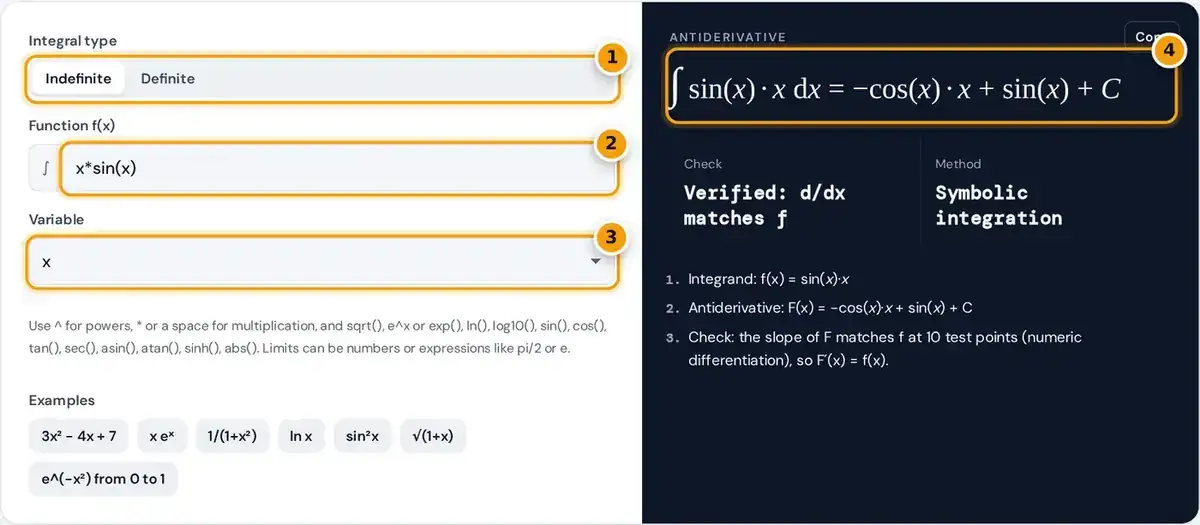
- Choose Indefinite for an antiderivative or Definite to integrate between two limits.
- Type the function using ^ for powers and sin(), ln(), sqrt() and similar.
- Pick the variable of integration.
- Read the result, plus the check that its derivative matches your function.
Type the function you want to integrate and choose Indefinite for an antiderivative or Definite for a value between limits. Pick the variable from the list if your function uses t, u, y or z.
Use ^ for powers, * or a space for multiplication, and functions such as sqrt(), exp(), ln(), sin(), sec(), abs() and atan(). The lower limit and upper limit can be numbers or expressions like pi/2 or e.
Tap any of the built-in examples, such as 3x² − 4x + 7 or ln x, to load it at once. The result shows the answer, a check, the method used and a short list of steps.
Basic Integration Rules
Most textbook integrals reduce to a handful of rules. Linearity lets you split a sum into separate terms and pull constants outside, then each piece is integrated with a standard formula from the list below.
∫ 1/x dx = ln|x| + C
∫ ex dx = ex + C ∫ sin x dx = −cos x + C ∫ cos x dx = sin x + C
∫ 1/(1 + x²) dx = arctan x + C
Integration by parts: ∫ u dv = uv − ∫ v du
| Function | Antiderivative |
|---|---|
| xn | xn+1/(n+1) + C |
| 1/x | ln|x| + C |
| eax | eax/a + C |
| sin(ax) | −cos(ax)/a + C |
| sec²(x) | tan(x) + C |
| ln(x) | x ln(x) − x + C |
| 1/√(1 − x²) | arcsin(x) + C |
The power rule covers every exponent except minus one, where the answer becomes the natural logarithm of the absolute value. The exponential is its own antiderivative, and arctan handles one over one plus x squared.
Every indefinite answer ends with the constant of integration, C, because any constant term disappears completely when you differentiate the result. The table of common integrals above covers most first-year calculus homework problems in practice.
Worked Example: Integration by Parts
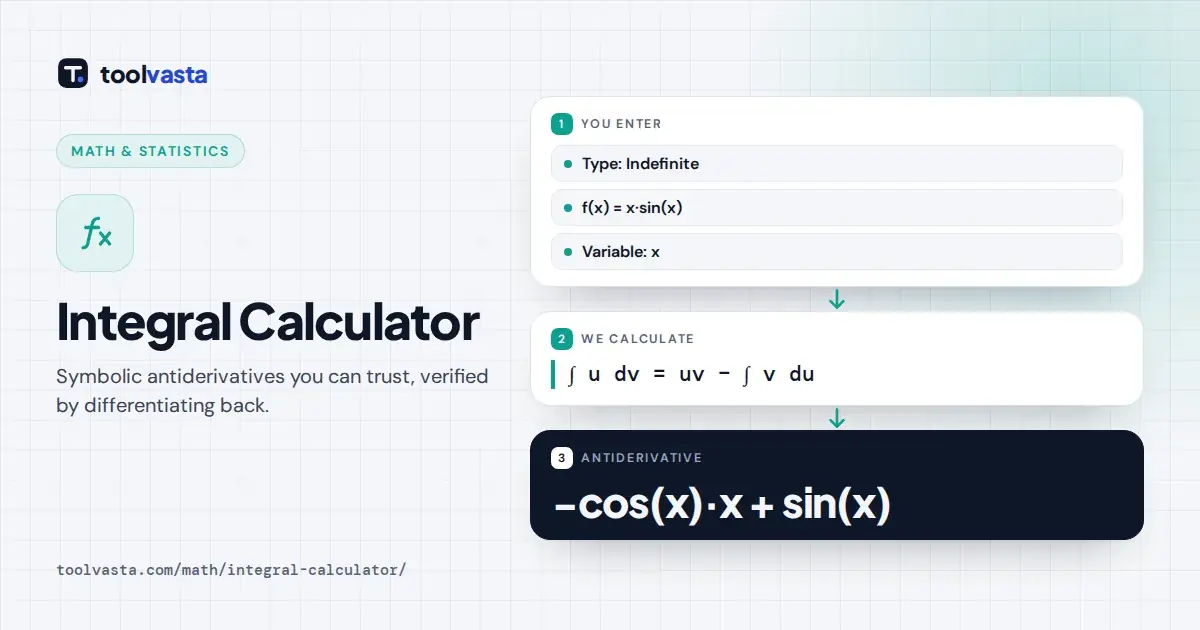
Take the default, x sin(x). Integration by parts fits because it mixes a polynomial and a trigonometric function. Choose u and dv: here u = x and dv = sin(x) dx, so du = dx and v = −cos(x).
Then the original integral equals −x cos(x) plus the integral of cos(x), which gives −x cos(x) + sin(x) + C. Differentiating that result returns x sin(x), so the calculator marks this antiderivative as verified before showing it.
Switch to Definite with limits 0 and pi. F(pi) = pi and F(0) = 0, so the value is pi, about 3.141592654. The simple polynomial x² from 0 to 3 gives exactly 9 in the same way.
Definite Integrals and the Fundamental Theorem
A definite integral measures the signed area between the curve and the x-axis from a to b. Area under the curve and above the axis counts as positive, while area below it counts as negative.
The fundamental theorem of calculus links the two kinds of integral. Once an antiderivative F is known, the exact value is F(b) minus F(a), because the constant C cancels out automatically in the final subtraction.
For another example, 1/(1 + x²) from 0 to 1 equals arctan(1) minus arctan(0), which is pi divided by 4, or 0.7853981634. A zero result can simply mean that the positive and negative areas balance exactly.
Integration Techniques
Integration is essentially the inverse of differentiation, but it has no single recipe. A computer algebra system tries several techniques in turn and returns the first result it can fully confirm by differentiating it back.
- u-substitution: replace an inner expression, such as 1 + x in sqrt(1 + x), with a single variable.
- Integration by parts: for products like x ex or x sin(x).
- Partial fractions: split rational functions into simpler fractions.
- Trigonometric identities: rewrite sin²(x) as (1 − cos 2x)/2 before integrating.
Learning which technique suits which shape of integrand is the real skill in calculus, and it comes with practice. The MIT OpenCourseWare single variable calculus course teaches each technique with free lectures and problem sets.
Use the calculator to check your own working by hand rather than replace it entirely. If your answer differs, differentiate both versions: when the derivatives match, the two antiderivatives differ only by a constant value.
Simpson's Rule Cross-Check
As an independent check, every definite integral is also computed by numerical integration with composite Simpson's rule, which fits parabolas through the function over many small subintervals and then adds up all the small areas.
It runs with 2,000 and 4,000 subintervals and combines the two results to cancel most remaining error. When the symbolic and numerical answers agree, the calculator reports a match and the value is very reliable.
Some integrands have no elementary antiderivative at all, so symbolic methods fail. For e−x² from 0 to 1, tied to the error function defined by NIST, the numerical route still gives an accurate 0.7468241328.
Limits of This Calculator
Symbolic work uses the open-source nerdamer library, version 1.1.13, running entirely in your browser, so nothing is ever sent anywhere. It handles polynomials, rational functions, exponentials, logarithms, trigonometric functions and many products of these functions.
No computer algebra system can integrate everything. When no verified antiderivative can be found, the tool says so instead of guessing. Improper integrals with infinite limits are not supported in this version of the tool.
If the integrand is undefined inside the interval, such as 1/x from −1 to 1, you get a warning, not a misleading number. Answers may also appear in equivalent forms to a textbook's step-by-step solution.
Frequently asked questions
How do I calculate an integral?
Find a function F whose derivative is your integrand, then add a constant C for an indefinite integral. For a definite integral from a to b, compute F(b) − F(a) using the fundamental theorem of calculus.
What is the difference between a definite and an indefinite integral?
An indefinite integral is a family of functions, the antiderivative plus C. A definite integral is a single number: the signed area between the curve and the x-axis from one limit to the other.
Why does my answer look different from the textbook?
Antiderivatives can differ by a constant and can be written in many equivalent ways. For example, −cos²(x)/2 and sin²(x)/2 differ only by a constant, so both answers are correct.
What is Simpson's rule?
A numerical method that approximates an integral by fitting parabolas through the function over many small intervals. It is very accurate for smooth functions and is used here to cross-check every definite integral.
Can every function be integrated?
Every continuous function has an antiderivative, but some, such as e−x² and sin(x)/x, cannot be written with elementary functions. Their definite integrals can still be computed numerically to high accuracy.
Why can a definite integral be negative or zero?
A definite integral measures signed area, so any region below the x-axis subtracts from the total. For example, sin(x) from 0 to 2π is zero because the two halves cancel exactly.