How to Use the Dilution Calculator
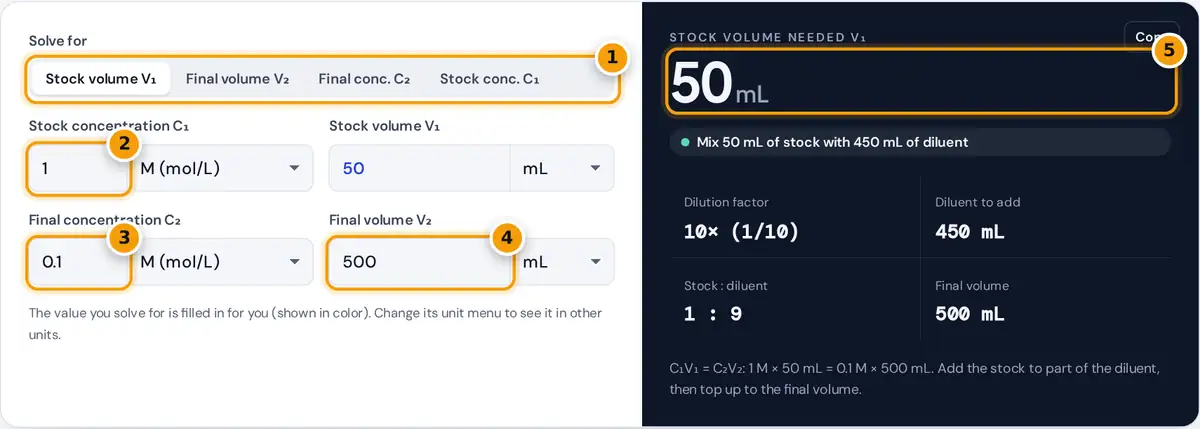
- Choose which value to solve for.
- Enter the stock concentration and its unit.
- Enter the target concentration in a matching kind of unit.
- Enter the final volume you want.
- Read the stock volume and the mix recipe with diluent amount.
Choose what you need to find. The most common question is the stock volume: how much of a concentrated solution to measure out. Enter the stock concentration C₁, the target concentration C₂ and the final volume V₂, and the calculator fills in V₁. You can also solve for the final volume, the final concentration or the stock concentration.
Each concentration and volume has its own unit menu, so you can mix units such as a 1 M stock and a 250 mM target, or microliters and milliliters. The two concentrations must be the same kind of unit: both molar, both mass per volume, both percent or both stock strength. The result shows the dilution factor, the volume of diluent to add and a plain mixing recipe.
The Dilution Equation
V₁ = C₂V₂ ÷ C₁ V₂ = C₁V₁ ÷ C₂
Dilution factor = C₁ ÷ C₂ = V₂ ÷ V₁ Diluent = V₂ − V₁
The equation works because diluting adds solvent but not solute. The amount of solute, concentration times volume, is the same before and after. It applies to any concentration unit that measures solute per unit of volume, provided both sides use the same unit.
Worked Examples
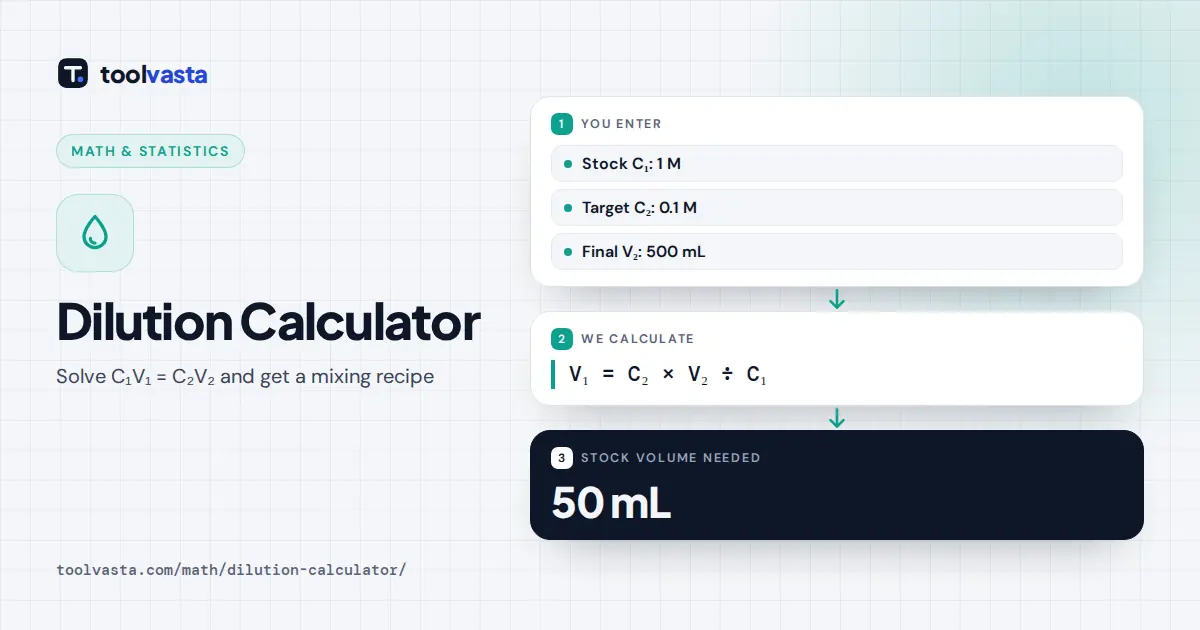
- Molar stock: to make 500 mL of 0.1 M solution from a 1 M stock, V₁ = 0.1 × 500 ÷ 1 = 50 mL. Mix 50 mL of stock with 450 mL of water. The dilution factor is 10.
- Mixed units: to make 2 mL of 50 µM from a 10 mM stock, V₁ = 0.05 mM × 2 mL ÷ 10 mM = 0.01 mL, which is 10 µL. Add 10 µL of stock to 1,990 µL of buffer.
- 10X buffer: to make 1 L of 1X buffer from a 10X stock, use 100 mL of stock and 900 mL of water.
- Percent: to make 250 mL of 70% ethanol from 95%, V₁ = 70 × 250 ÷ 95 = 184.211 mL, topped up to 250 mL. Ethanol and water shrink slightly when mixed, so always top up to the final volume rather than adding a calculated amount of water.
For a quick mental check, the dilution factor must equal both C₁ ÷ C₂ and V₂ ÷ V₁. In the first example both ratios are 10, so the answer is consistent.
Dilution Factors and Ratios
| Dilution factor | Stock in 100 mL final | Stock : diluent |
|---|---|---|
| 2 (1/2) | 50 mL | 1 : 1 |
| 5 (1/5) | 20 mL | 1 : 4 |
| 10 (1/10) | 10 mL | 1 : 9 |
| 100 (1/100) | 1 mL | 1 : 99 |
| 1,000 (1/1,000) | 0.1 mL | 1 : 999 |
Notice the difference between a 1/10 dilution and a 1 : 10 ratio. A 1/10 dilution is one part stock in ten parts total, which is one part stock to nine parts diluent. Labs and protocols are not always consistent, so check which convention is meant.
Serial Dilutions
A serial dilution repeats the same step several times. Diluting 1/10 three times in a row gives an overall factor of 10 × 10 × 10 = 1,000. Use this calculator for each step, taking the final concentration of one step as the stock concentration of the next.
Good Laboratory Practice
- For very large dilution factors, such as 1/10,000, use two or more serial steps. Measuring a tiny volume accurately is hard.
- Add concentrated acid to water, never water to acid.
- Use volumetric glassware or calibrated pipettes for accurate work, and mix thoroughly after topping up.
- The equation cannot convert between molar and mass units. Use the molar mass to convert first.
Limits
C₁V₁ = C₂V₂ assumes volumes add and the solute does not react. That is accurate for most dilute aqueous solutions but only approximate for concentrated solutions and solvent mixtures. Weight per weight (w/w) percentages are not volume based, so they need densities for an exact answer.
Frequently asked questions
What is the C1V1 = C2V2 formula?
It is the dilution equation. Stock concentration times stock volume equals final concentration times final volume, because the amount of solute stays the same when you add solvent.
How do I calculate how much stock solution I need?
Multiply the final concentration by the final volume and divide by the stock concentration: V1 = C2V2 ÷ C1. Then add solvent until you reach the final volume V2.
How much water do I add when diluting?
Subtract the stock volume from the final volume. For 50 mL of stock in a 500 mL final volume, add 450 mL. For accuracy, top up to the final volume mark.
What is a dilution factor?
It is how many times weaker the final solution is than the stock, C1 ÷ C2, which also equals V2 ÷ V1. A dilution factor of 10 means one part stock in ten parts total.
Can I use different units for C1 and C2?
Yes, as long as both are the same kind, such as M and mM, or g/L and mg/mL. You cannot mix molar with mass units without first converting using the molar mass.
How do I dilute a 10X buffer to 1X?
Use one part 10X stock and nine parts water. For 500 mL of 1X buffer, mix 50 mL of the 10X stock with 450 mL of water, then mix well.