How to Use the Implicit Differentiation Calculator
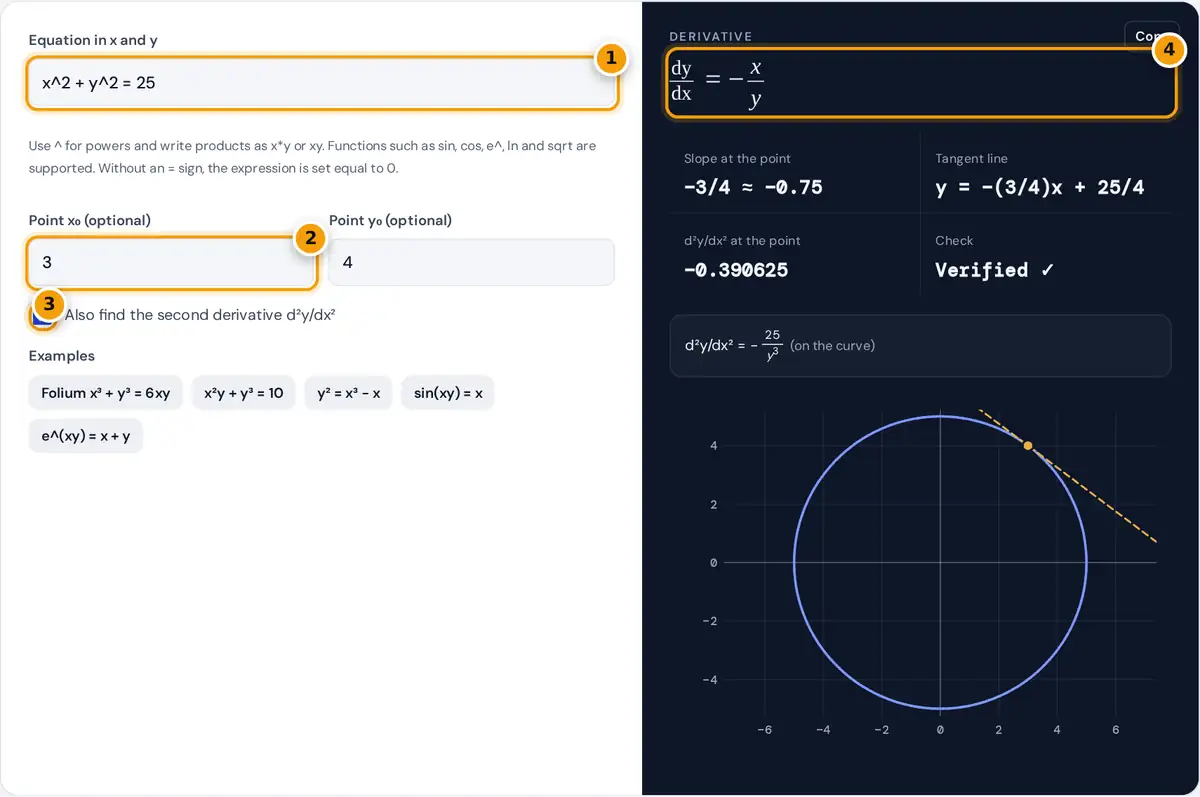
- Type the equation in x and y, such as x^2 + y^2 = 25. No need to solve for y.
- Optionally enter a point on the curve to get the slope there.
- Keep this ticked to also get the second derivative.
- Read dy/dx, the slope, the tangent line and the graph, then the term-by-term steps.
Type an equation that mixes x and y, such as x^2 + y^2 = 25 or x^3 + y^3 = 6xy. You do not need to solve it for y first. Products can be written as x*y or simply xy, and functions such as sin, cos, e^, ln and sqrt are supported. Optionally enter a point (x₀, y₀) on the curve to get the slope and the tangent line there, and keep the box ticked to see the second derivative as well.
The result panel shows dy/dx, the slope and tangent line at your point, the value of d²y/dx² and a numerical check of the derivative. A graph draws the curve and the tangent line. Below the tool, every term on both sides is differentiated separately with the rule used, then the dy/dx terms are collected and solved.
The Method of Implicit Differentiation
When y is defined by an equation rather than a formula, differentiate both sides with respect to x and treat y as an unknown function of x. Any term containing y needs the chain rule, so it gets multiplied by dy/dx, often written y′.
For F(x, y) = 0: dy/dx = −Fx ÷ Fy
- Differentiate every term on both sides with respect to x.
- Move all terms containing y′ to one side and everything else to the other.
- Factor out y′ and divide to solve for it.
The shortcut dy/dx = −Fx/Fy uses partial derivatives of F = left side minus right side and gives the same result in one step.
Worked Examples
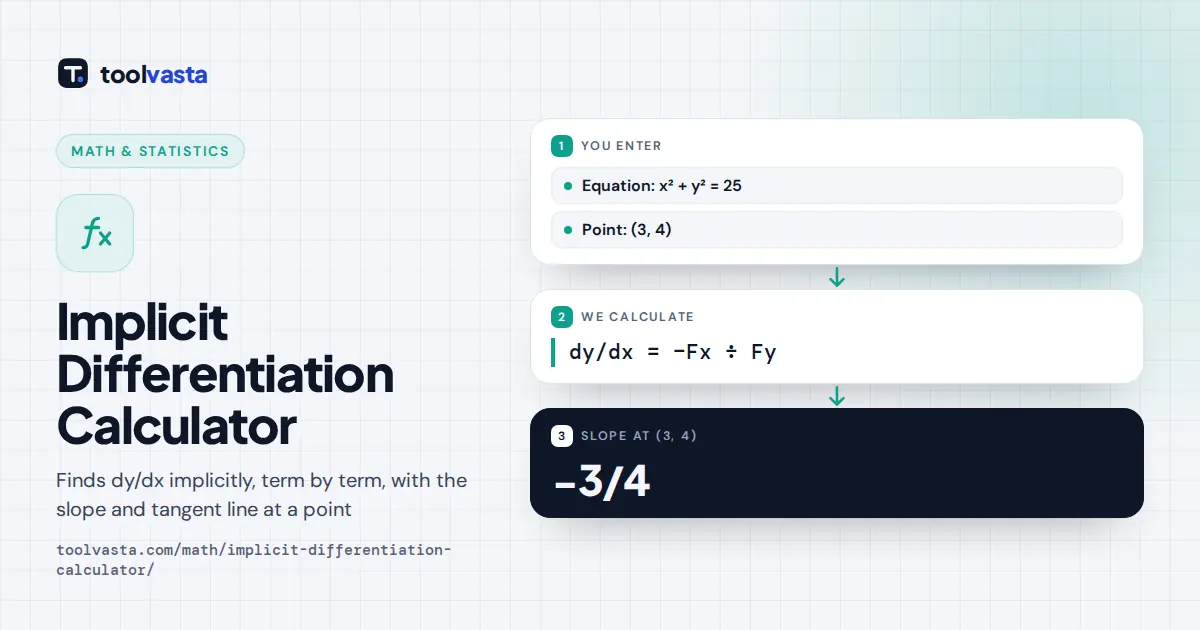
Circle: x² + y² = 25. Differentiating gives 2x + 2y·y′ = 0, so y′ = −x/y. At (3, 4) the slope is −3/4, and the tangent line is y = −(3/4)x + 25/4. Differentiating y′ = −x/y again gives y″ = −(x² + y²)/y³, and since x² + y² = 25 on the circle, y″ = −25/y³. At (3, 4) that is −25/64 = −0.390625.
Folium of Descartes: x³ + y³ = 6xy. Differentiating gives 3x² + 3y²y′ = 6y + 6x·y′ by the product rule. Collecting terms, (3y² − 6x)y′ = 6y − 3x², so y′ = (2y − x²)/(y² − 2x). At (3, 3) the slope is (6 − 9)/(9 − 6) = −1.
Derivatives of Common Terms
| Term | d/dx | Rule |
|---|---|---|
| y² | 2y·y′ | Chain rule |
| x²y | 2xy + x²y′ | Product rule |
| sin(y) | cos(y)·y′ | Chain rule |
| exy | exy(y + x·y′) | Chain and product rules |
| ln(y) | y′/y | Chain rule |
The Second Derivative and Tangent Lines
To find d²y/dx², differentiate the expression for dy/dx again with the quotient rule, then replace every y′ with the formula you already have. For polynomial equations the calculator also tries to shorten the result with the original equation, as in the circle example. At a point (x₀, y₀) on the curve, the tangent line is y − y₀ = m(x − x₀) with m the value of dy/dx, and the normal line has slope −1/m. Where the denominator of dy/dx is zero, the tangent is vertical.
Implicit Differentiation in Related Rates
The same idea works when x and y both change with time t. Differentiate with respect to t instead of x. For a 5 m ladder sliding down a wall, x² + y² = 25 gives 2x·dx/dt + 2y·dy/dt = 0. When x = 3, y = 4 and the foot moves out at dx/dt = 2 m/s, the top moves at dy/dt = −(3 × 2)/4 = −1.5 m/s, so it slides down.
Tips and Limits
- Polynomial equations are handled with exact rational arithmetic, so slopes at rational points are exact fractions.
- Equations with trigonometric, exponential or logarithmic terms use the open-source nerdamer library in your browser. Their results are verified numerically against −Fx/Fy at several points before they are shown.
- Check that your point is really on the curve. The calculator warns you if it is not.
- Only x and y can be variables. Replace constants such as a or r with numbers.
Frequently asked questions
What is implicit differentiation?
A way to find dy/dx when y is not written as a formula in x. You differentiate both sides of the equation with respect to x, multiplying every y term's derivative by dy/dx, then solve for dy/dx.
Why do y terms get multiplied by dy/dx?
Because y is treated as a function of x. By the chain rule, the derivative of g(y) with respect to x is g′(y) times dy/dx. For example, the derivative of y² is 2y·dy/dx.
How do you find the tangent line using implicit differentiation?
Find dy/dx, substitute the point to get the slope m, then use y − y₀ = m(x − x₀). For x² + y² = 25 at (3, 4), m = −3/4 and the tangent is y = −(3/4)x + 25/4.
How do you find the second derivative implicitly?
Differentiate dy/dx again with respect to x, using the quotient rule, and replace every dy/dx that appears with its formula. Simplifying with the original equation often shortens the result.
What does it mean if dy/dx has 0 in the denominator?
At points where the denominator is zero and the numerator is not, the curve has a vertical tangent line. If both are zero, the point is singular, such as a cusp or a self-crossing.
Is dy/dx = −Fx/Fy the same as implicit differentiation?
Yes. Writing the equation as F(x, y) = 0, the formula −F_x ÷ F_y with partial derivatives gives exactly the same dy/dx as differentiating term by term and solving.