How to use the circumference calculator
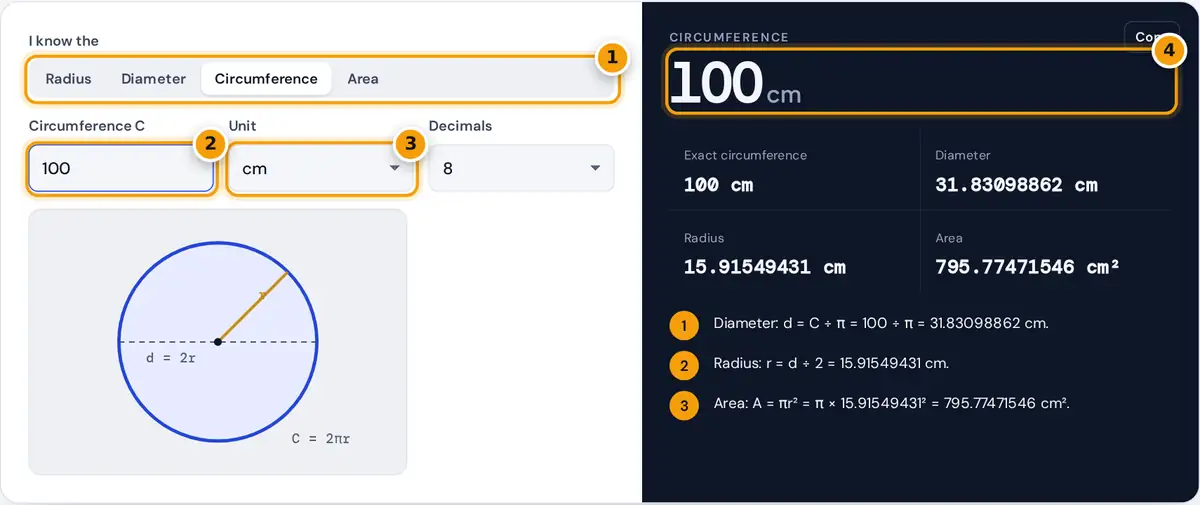
- Choose what you know: radius, diameter, circumference or area.
- Enter the measurement, such as a circumference you measured with a tape.
- Pick the unit, then choose how many decimals to show.
- Read the result, then check diameter, radius, area and the worked steps.
Choose which measurement you know: the radius, the diameter, the circumference or the area. Enter the value and pick a unit if you want it shown in the results. The calculator returns the circumference, diameter, radius and area together, with the exact form in terms of π where the input allows it. To convert a circumference to a diameter, choose Circumference and read the diameter.
Circle formulas
d = 2r = C ÷ π
r = C ÷ 2π = √(A ÷ π)
A = πr² = πd² ÷ 4 = C² ÷ 4π
π is the ratio of every circle's circumference to its diameter, about 3.14159265. The calculator uses the full double-precision value.
Worked examples
- From the radius: a circle with r = 5 cm has C = 2 × π × 5 = 10π ≈ 31.41592654 cm, d = 10 cm and A = 25π ≈ 78.53981634 cm².
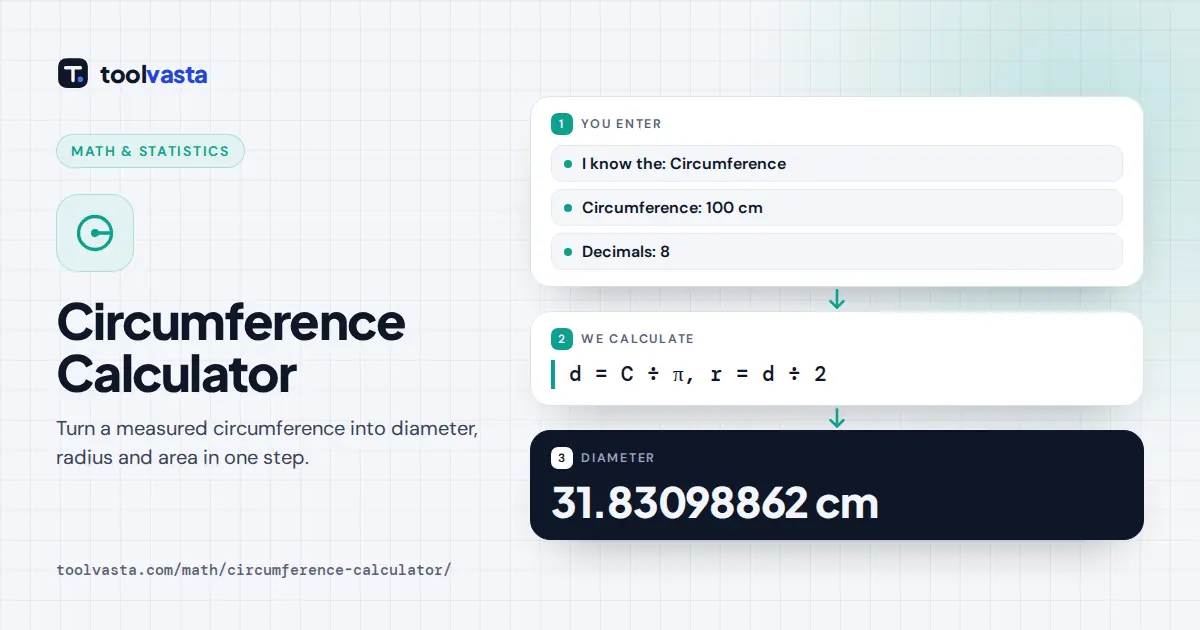
- Circumference to diameter: a tree trunk measures 100 cm around. Its diameter is 100 ÷ π ≈ 31.83098862 cm and its radius is 15.91549431 cm.
- From the area: a circle of area 50 m² has r = √(50 ÷ π) ≈ 3.98942280 m and C ≈ 25.06628275 m.
Quick reference
| Diameter | Circumference | Area |
|---|---|---|
| 1 | 3.1416 | 0.7854 |
| 2 | 6.2832 | 3.1416 |
| 5 | 15.7080 | 19.6350 |
| 10 | 31.4159 | 78.5398 |
| 12 | 37.6991 | 113.0973 |
| 24 | 75.3982 | 452.3893 |
Everyday uses
Circumference comes up whenever something is round: the distance a wheel travels in one turn, the length of trim around a circular table, the size of a pipe from a tape wrapped around it, or a tree's diameter at breast height for forestry. For a bike wheel of 700 mm diameter, one revolution covers about 2.2 m.
Notes
Why the ratio is always π
Every circle is a scaled copy of every other circle. If you double the radius, the distance around doubles too, so the ratio of circumference to diameter never changes. That fixed ratio is the number π. It is irrational, so its decimal digits never end or repeat, and fractions such as 22/7 (3.142857) or 355/113 (3.14159292) are only approximations. For most practical measurements, 3.1416 is more than accurate enough, because a tape measure or ruler is far less precise than that. When you need the exact value for algebra, leave the answer in terms of π, such as 10π cm, which is why the calculator shows that form as well.
All lengths are in the same unit you choose, and the area is in that unit squared. The circumference of a circle is also called its perimeter. For an ellipse there is no simple exact formula, so this calculator applies only to circles.
Frequently asked questions
How do you find the circumference of a circle?
Multiply the diameter by π, or the radius by 2π. A circle with radius 3 cm has a circumference of 6π ≈ 18.85 cm.
How do you find the diameter from the circumference?
Divide the circumference by π. A circumference of 50 cm gives a diameter of 50 ÷ 3.14159 ≈ 15.92 cm.
How do you get the circumference from the area?
Find the radius first with r = √(A ÷ π), then use C = 2πr. In one step, C = 2√(πA).
Is circumference the same as perimeter?
Yes. Circumference is the special name for the perimeter of a circle.
What value of π does the calculator use?
It uses JavaScript's double-precision π, 3.141592653589793, which is accurate to about 16 significant digits.