How to Use the Resonant Frequency Calculator
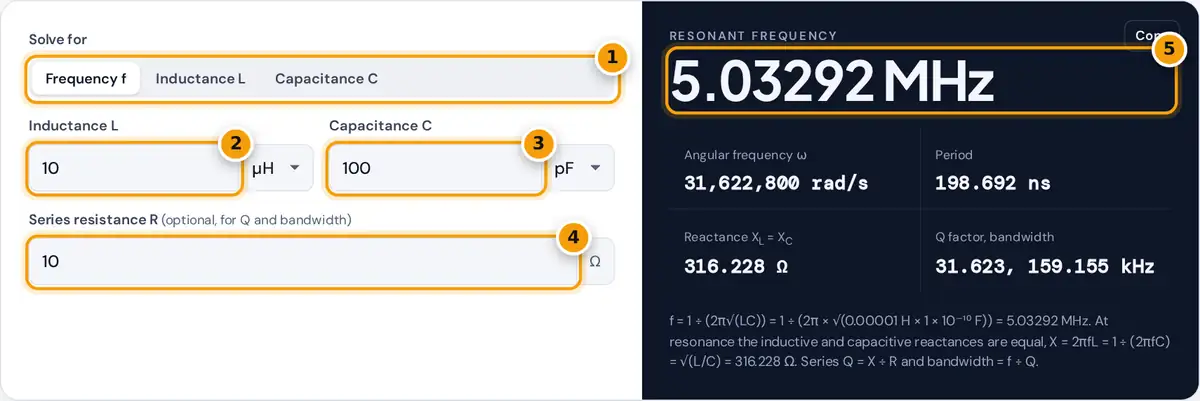
- Choose to solve for frequency, inductance or capacitance.
- Enter the inductance and pick its unit.
- Enter the capacitance and pick its unit.
- Optionally enter series resistance for Q and bandwidth.
- Read the result with reactance, period, Q and bandwidth.
Choose what you want to find. To get the resonant frequency, enter the inductance and the capacitance, each with its own unit menu from henries to nanohenries and farads to picofarads. To design a circuit for a target frequency, choose Inductance or Capacitance and enter the frequency with the other component value.
The result shows the answer with a sensible unit prefix, along with the angular frequency, the period of one cycle and the reactance of each component at resonance. Add the series resistance of the circuit, for example the resistance of the inductor winding, to get the quality factor Q and the bandwidth.
LC Resonant Frequency Formula
L = 1 ÷ ((2πf)²C) C = 1 ÷ ((2πf)²L)
At resonance XL = XC = √(L/C)
Series RLC: Q = X ÷ R bandwidth = f ÷ Q
An inductor’s reactance rises with frequency, XL = 2πfL, while a capacitor’s falls, XC = 1 ÷ (2πfC). Resonance is the one frequency where the two are equal. In a series circuit their effects cancel and the impedance drops to just R. In an ideal parallel tank circuit the impedance becomes very high instead.
Worked Examples
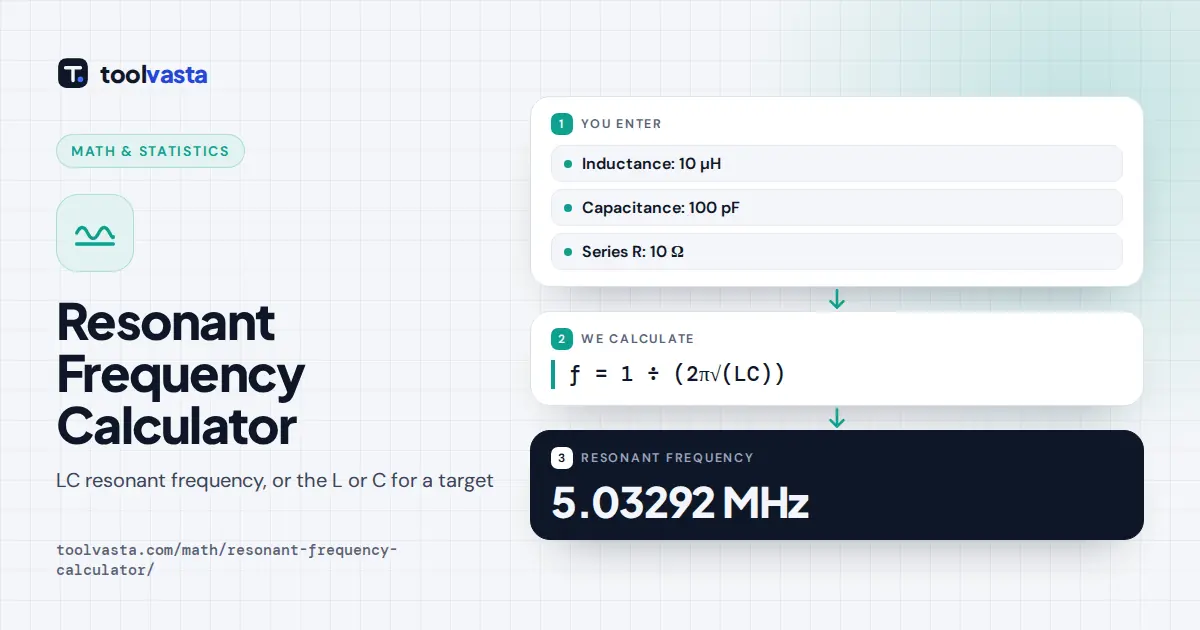
- Frequency: L = 10 µH and C = 100 pF. LC = 10⁻⁵ × 10⁻¹² = 10⁻¹⁵, √(LC) = 3.16228 × 10⁻⁸, so f = 1 ÷ (2π × 3.16228 × 10⁻⁸) = 5.03292 MHz. The reactance at resonance is √(L/C) = 316.228 Ω, and with R = 10 Ω the Q factor is 31.6228 with a bandwidth of 159.155 kHz.
- Inductance: to resonate at 1 MHz with 100 pF you need L = 1 ÷ ((2π × 10⁶)² × 10⁻¹₀) = 253.303 µH.
- Capacitance: for 1 kHz with a 10 mH inductor, C = 2.53303 µF.
Remember that the frequency in the formula is in hertz, cycles per second. Engineers often work with the angular frequency ω = 2πf, in radians per second, because it simplifies the reactance formulas to XL = ωL and XC = 1 ÷ ωC. The calculator shows both values, so you can use whichever your textbook or simulator expects.
Quick Reference Values
| L | C | Resonant frequency |
|---|---|---|
| 10 mH | 2.53303 µF | 1 kHz |
| 0.5 mH | 2 µF | 5.03292 kHz |
| 253.303 µH | 100 pF | 1 MHz |
| 10 µH | 100 pF | 5.03292 MHz |
| 1 µH | 10 pF | 50.3292 MHz |
Because f depends on the square root of LC, quadrupling either component halves the frequency, and making both ten times smaller raises the frequency tenfold.
Where LC Resonance Is Used
LC circuits select one frequency from many. They tune radio receivers, set the frequency of oscillators, form the matching networks between antennas and amplifiers, and make band-pass and notch filters. Wireless charging pads and RFID tags also use resonant coils so that energy transfers efficiently at one chosen frequency.
Working With Unit Prefixes
Most mistakes in resonance calculations come from unit prefixes. Inductors are usually rated in microhenries (µH, 10⁻⁶ H) or millihenries (mH, 10⁻³ H), and small capacitors in picofarads (pF, 10⁻¹² F) or nanofarads (nF, 10⁻⁹ F). Convert everything to henries, farads and hertz before using the formula by hand, or use the unit menus here, which do the conversion for you. The answer is shown with an automatic prefix, so 5,032,921 Hz appears as 5.03292 MHz. A quick sanity check: a few microhenries with tens of picofarads gives tens of megahertz, while millihenries with microfarads gives a few kilohertz.
Practical Limits
- Real components have tolerances, often 5% to 20%, so the actual frequency can shift. A trimmer capacitor is commonly used for fine tuning.
- Stray capacitance from wiring and the parasitic capacitance of the inductor itself lower the frequency, especially above a few megahertz.
- The Q and bandwidth here are for a series RLC circuit with the resistance you enter. Parallel circuits use a different expression for Q.
Frequently asked questions
What is the formula for resonant frequency?
For an LC circuit, f = 1 ÷ (2π√(LC)), with L in henries and C in farads giving f in hertz. It is the frequency at which the inductive and capacitive reactances are equal.
How do I find the capacitor for a given frequency?
Rearrange the formula: C = 1 ÷ ((2πf)² × L). For 1 kHz with a 10 mH inductor, C is about 2.533 µF. Choose Capacitance in the calculator to do this directly.
What happens at resonance?
The inductor and capacitor reactances cancel. In a series circuit the impedance falls to the resistance and current peaks. In a parallel tank circuit the impedance rises sharply instead.
What is the Q factor?
Q measures how sharp the resonance is. For a series RLC circuit, Q equals the reactance at resonance divided by the resistance. A higher Q gives a narrower bandwidth, f ÷ Q.
Does resistance change the resonant frequency?
In an ideal series RLC circuit, no. Resistance only widens the peak and lowers Q. In practical parallel circuits with a lossy inductor, the frequency of maximum impedance shifts slightly.
Why does my circuit resonate at a different frequency?
Component tolerances, stray wiring capacitance and the inductor's own capacitance all change the effective L and C. Measured frequencies are often a few percent lower than the calculated value.