How to Use the Box Volume Calculator
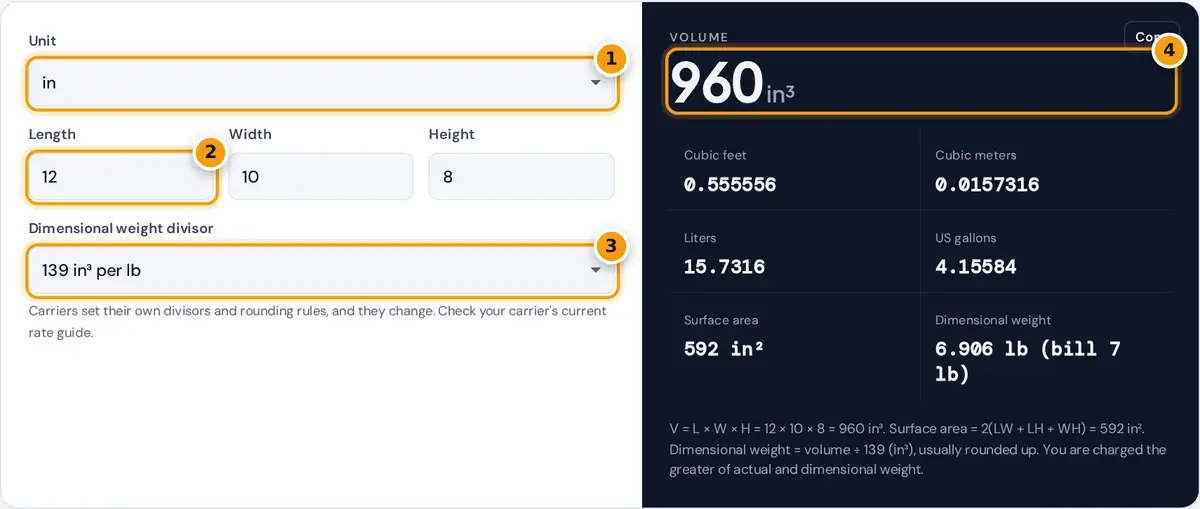
- Choose the unit for all three dimensions.
- Enter the length, width and height.
- Pick your carrier's dimensional weight divisor.
- Read the volume in every unit, surface area and dim weight.
Choose a unit, then enter the length, width and height of the box. All three must use the same unit. The volume appears in that unit cubed and is converted to cubic feet, cubic meters, liters and US gallons, so you can compare it with a storage space, a moving truck or a container capacity listed in another unit.
The surface area tells you how much material covers the outside of a closed box, ignoring overlapping flaps. For shipping, choose a dimensional weight divisor; switching between metric and imperial units picks a matching one automatically. The calculator shows the dimensional weight and the rounded figure a carrier would typically bill.
Box Volume Formula
Surface area = 2(LW + LH + WH)
Dimensional weight = V ÷ divisor (for example in³ ÷ 139 = lb, or cm³ ÷ 5,000 = kg)
1 ft³ = 1,728 in³ ≈ 28.3168 L 1 m³ = 1,000 L
A box is a rectangular prism, so its volume is simply the product of its three dimensions. Measure the inside of a box when you care about what fits in it, and the outside when you are shipping it, because carriers measure the outside.
Worked Examples
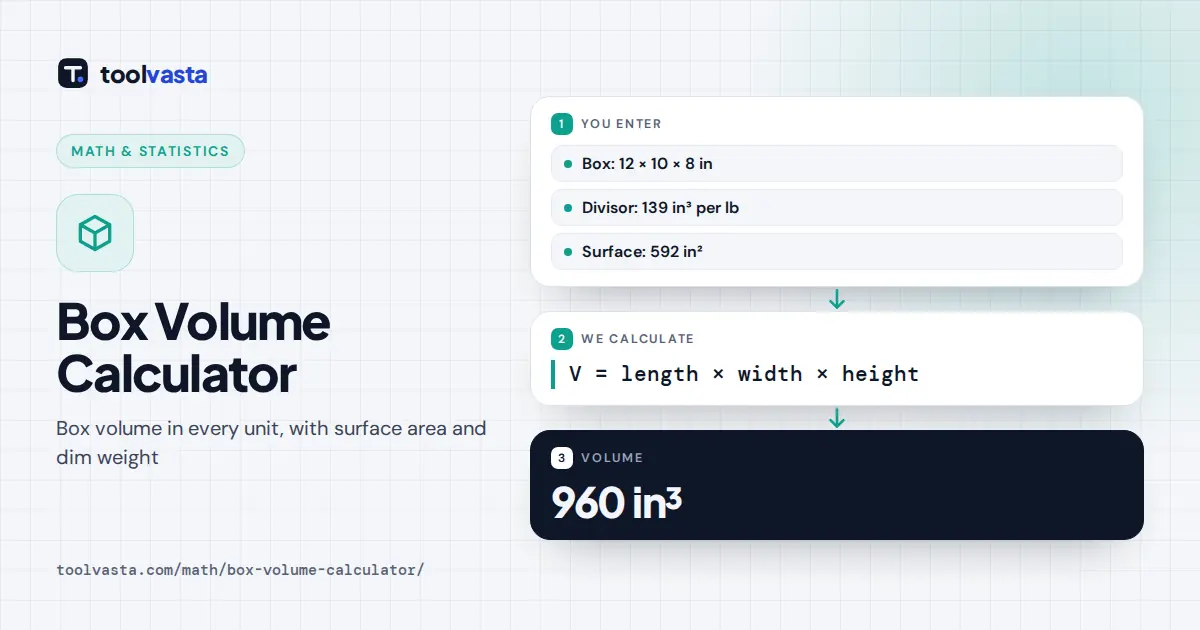
- Shipping box: 12 × 10 × 8 in. V = 960 in³. Divide by 1,728 to get 0.555556 ft³, which is 15.7316 L or 4.15584 US gallons. The surface area is 2(120 + 96 + 80) = 592 in². With a divisor of 139, the dimensional weight is 960 ÷ 139 = 6.9065 lb, usually billed as 7 lb.
- Metric box: 40 × 30 × 20 cm = 24,000 cm³ = 24 L. With a divisor of 5,000 cm³/kg, the dimensional weight is 4.8 kg, billed as 5 kg.
- Storage unit: 10 × 10 × 8 ft = 800 ft³, about 22.65 m³.
If you know the volume and two sides, divide to find the third: height = volume ÷ (length × width).
Volume Unit Conversions
| Unit | Cubic inches | Liters |
|---|---|---|
| 1 cubic inch | 1 | 0.0163871 |
| 1 liter | 61.0237 | 1 |
| 1 US gallon | 231 | 3.78541 |
| 1 cubic foot | 1,728 | 28.3168 |
| 1 cubic meter | 61,023.7 | 1,000 |
What Is Dimensional Weight?
Large but light parcels take up space in a truck or aircraft without adding much weight, so carriers charge by whichever is greater: the actual weight or the dimensional (volumetric) weight. Dimensional weight is the box volume divided by a divisor the carrier sets. A smaller divisor makes the dimensional weight larger. Divisors and rounding rules differ between carriers and services and change from time to time, so treat the result here as an estimate and confirm with your carrier’s current rate guide.
Packing and Capacity
The volume of a box is an upper limit on what it can hold. Loose items rarely fill more than part of the space, because of gaps between them, so leave room for padding. When planning a move, add up the volume of each box and compare it with the cargo volume listed for the truck or container. The cubic feet figure is the one most moving companies and storage units use in North America, while cubic meters and liters are standard elsewhere. Remember that a box twice as long, wide and tall holds eight times as much, because volume grows with the cube of size.
Tips
- Round each measurement up to the next whole unit when estimating shipping, because many carriers do.
- To fit items, use inside dimensions. Corrugated cardboard walls are often 3 to 7 mm thick, so the inside is smaller than the outside.
- Reducing a box by an inch in each direction can cut dimensional weight noticeably, since volume depends on all three dimensions.
- For a cube, all three sides are equal, so V = s³.
Unit definitions follow the NIST guide to SI units.
Frequently asked questions
How do you calculate the volume of a box?
Multiply the length, width and height, all in the same unit. A box 12 by 10 by 8 inches has a volume of 960 cubic inches. The answer is in that unit cubed.
How do I convert cubic inches to cubic feet?
Divide by 1,728, because one cubic foot is 12 × 12 × 12 inches. So a box of 960 cubic inches holds 960 ÷ 1,728 = 0.556 cubic feet.
How many liters are in a box?
Measure in centimeters, multiply the three sides and divide by 1,000. A 40 by 30 by 20 cm box holds 24,000 cm³, which is 24 liters.
What is dimensional weight?
It is a pricing weight based on size: the box volume divided by the carrier's divisor. Carriers charge for whichever is greater, the actual weight or the dimensional weight.
What dimensional weight divisor should I use?
It depends on the carrier and service. Divisors of 139 in³ per lb and 5,000 cm³ per kg are common examples, but rates change, so check your carrier's current guide.
How do I find the surface area of a box?
Add the areas of the three different faces and double the total: 2(LW + LH + WH). For 12 by 10 by 8 inches, that is 2(120 + 96 + 80) = 592 square inches.