![Eigenvector calculator diagram: the 2x2 matrix [[4, 1], [2, 3]] has eigenvalues 5 and 2](/assets/img/eigenvalue-and-eigenvector-calculator-diagram.webp)
How to use the eigenvalue and eigenvector calculator
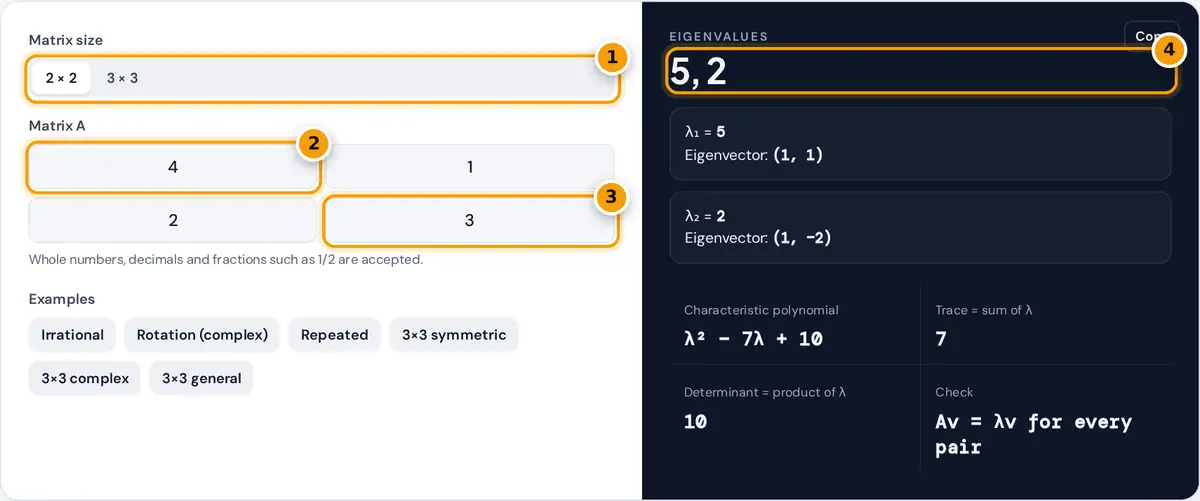
- Choose a 2 × 2 or 3 × 3 matrix.
- Type the matrix entries. Whole numbers, decimals and fractions like 1/2 all work.
- Fill every cell, or load an example such as a rotation or repeated eigenvalue.
- Read the eigenvalues, then the eigenvector for each one and the characteristic polynomial.
Choose 2×2 or 3×3 and type the entries of your matrix. Whole numbers, decimals and fractions are all accepted. The calculator finds the characteristic polynomial, its roots (the eigenvalues), and a basis of eigenvectors for each eigenvalue. Repeated eigenvalues show their algebraic and geometric multiplicity, and complex eigenvalues come with complex eigenvectors.
Rational eigenvalues and their eigenvectors are computed exactly with fractions, and the eigenvectors are scaled to the smallest whole numbers. Irrational eigenvalues of a quadratic factor are given in square-root form, such as (5 + √33)/2, and their eigenvectors are given as decimals. Every eigenvector is checked by multiplying it by A and comparing with λv.
What eigenvalues and eigenvectors are
An eigenvector of a square matrix A is a nonzero vector v that A only stretches or flips, without changing its direction. The stretch factor is the eigenvalue λ.
Characteristic equation: det(A − λI) = 0
2×2: λ² − (a + d)λ + (ad − bc) = 0
Because v must be nonzero, A − λI must be singular, which is why its determinant is zero. Solve that polynomial for λ, then solve (A − λI)v = 0 for each λ to get the eigenvectors.
Worked example
Take A = [[4, 1], [2, 3]]. The trace is 7 and the determinant is 4 × 3 − 1 × 2 = 10, so the characteristic equation is λ² − 7λ + 10 = 0, which factors as (λ − 5)(λ − 2) = 0.
- λ = 5: A − 5I = [[−1, 1], [2, −2]], so −x + y = 0 and v = (1, 1). Check: A(1, 1) = (5, 5) = 5(1, 1).
- λ = 2: A − 2I = [[2, 1], [2, 1]], so 2x + y = 0 and v = (1, −2). Check: A(1, −2) = (2, −4) = 2(1, −2).
The eigenvalues add up to the trace (5 + 2 = 7) and multiply to the determinant (5 × 2 = 10), a quick way to check your work.
Special cases
| Case | Example | What happens |
|---|---|---|
| Complex eigenvalues | [[0, −1], [1, 0]] | λ = ±i, a rotation has no real eigenvector |
| Repeated, defective | [[2, 1], [0, 2]] | λ = 2 twice but only one eigenvector |
| Repeated, full | Identity matrix | Every nonzero vector is an eigenvector |
| Symmetric matrix | [[2, 0, 0], [0, 3, 4], [0, 4, 9]] | Real eigenvalues 11, 2 and 1, with orthogonal eigenvectors |
Where eigenvalues are used
Eigenvalues describe stability in differential equations and control systems, the principal axes in principal component analysis, natural frequencies of vibrating structures, long-run behavior of Markov chains, and energy levels in quantum mechanics. Diagonalizing a matrix with its eigenvectors makes powers such as A100 easy to compute.
Notes
Eigenvectors are only defined up to a nonzero scale factor, so your textbook may show a multiple of the vector given here, such as (−1, 2) instead of (1, −2). A 3×3 matrix whose characteristic cubic has no rational root gets numerical eigenvalues accurate to about 10 significant digits. Entries are limited to 12 digits.
Frequently asked questions
How do you find eigenvalues of a 2x2 matrix?
Solve λ² − (a + d)λ + (ad − bc) = 0, where a and d are the diagonal entries and ad − bc is the determinant. The two roots are the eigenvalues.
How do you find an eigenvector?
For each eigenvalue λ, solve (A − λI)v = 0. Row-reduce A − λI, set a free variable to 1 and read off the other entries. Any nonzero multiple of the result is also an eigenvector.
Can eigenvalues be complex?
Yes. A real matrix can have complex eigenvalues, and they always come in conjugate pairs a ± bi. Rotation matrices are the classic example.
What is a defective matrix?
A matrix with a repeated eigenvalue that has fewer independent eigenvectors than its multiplicity, such as [[2, 1], [0, 2]]. It cannot be diagonalized.
Why is my eigenvector different from the textbook?
Eigenvectors are only unique up to scaling. If your vector is a nonzero multiple of the one shown, both are correct.