How to Use the Vertex Form Calculator
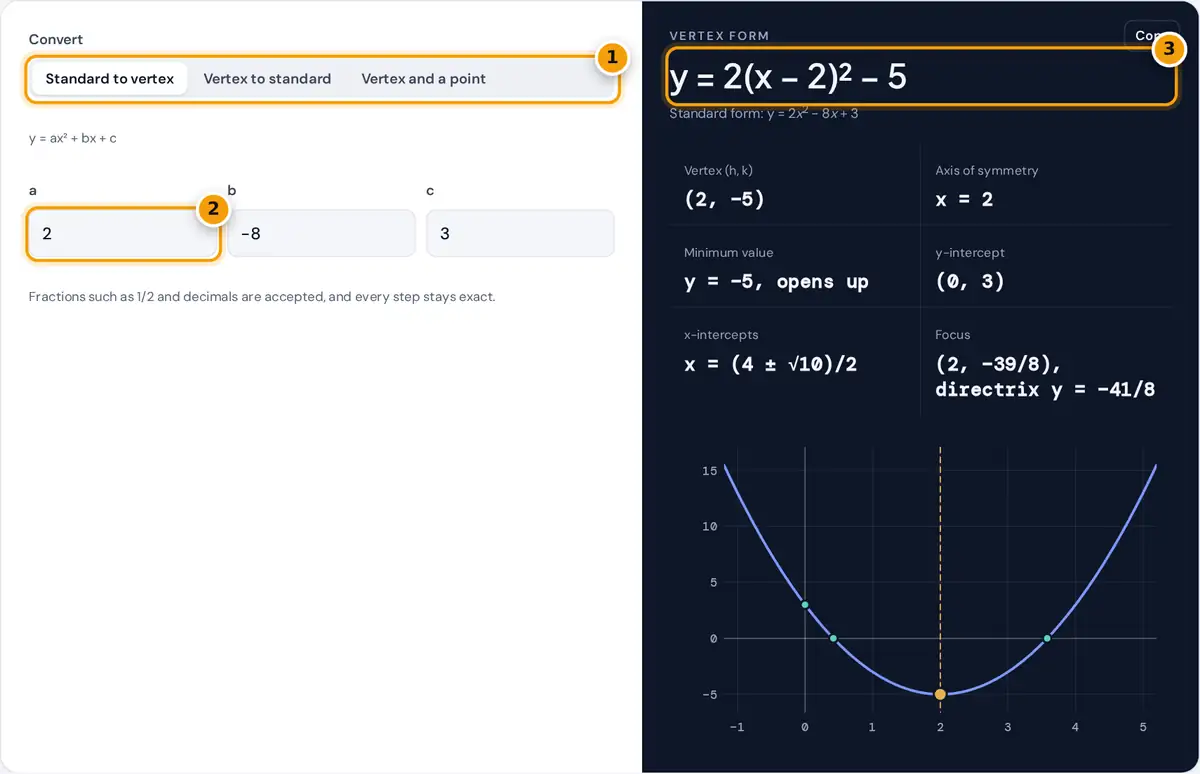
- Choose standard to vertex, vertex to standard, or vertex and a point.
- Enter a, b and c from y = ax² + bx + c. Fractions are fine.
- Read the vertex form, then the vertex, axis, intercepts, focus and graph.
Choose what you have. Standard to vertex takes a, b and c from y = ax² + bx + c and completes the square. Vertex to standard takes a, h and k from y = a(x − h)² + k and expands it. Vertex and a point finds the equation of a parabola from its vertex and any other point on it, which is a common textbook task. Fractions and decimals are accepted.
The result panel shows the converted equation and the other form beneath it, then the vertex, axis of symmetry, minimum or maximum value, intercepts and focus, with a graph of the parabola. The steps below write out completing the square line by line with exact fractions.
Vertex Form and the Vertex Formula
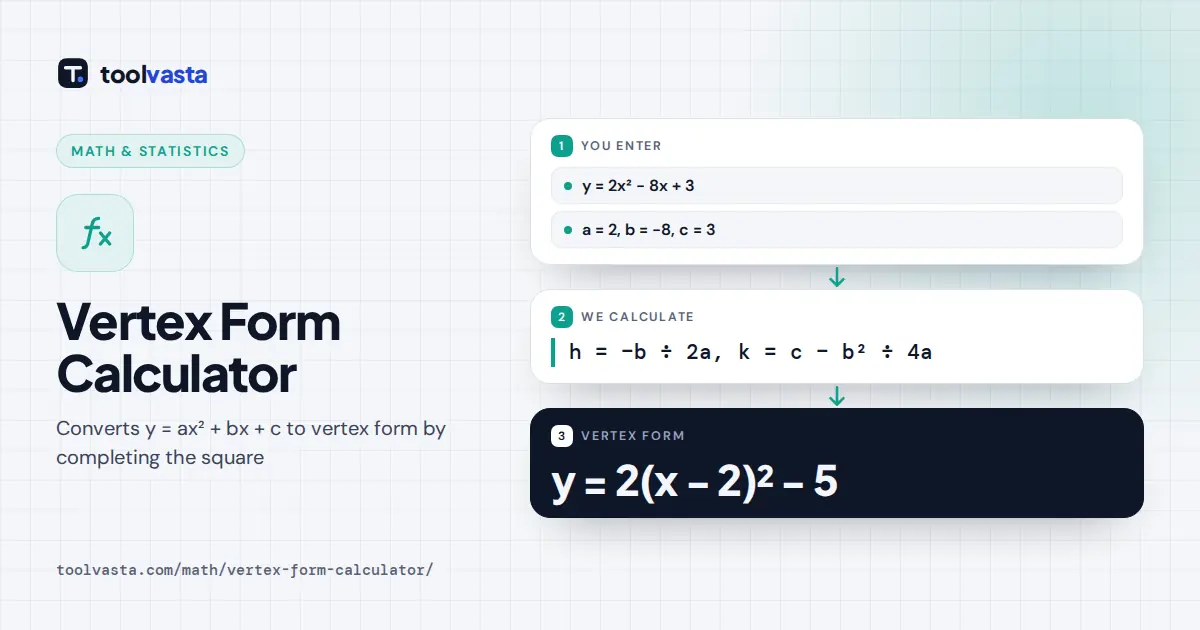
From standard form: h = −b ÷ 2a k = c − b² ÷ 4a
Focus: (h, k + 1/(4a)) Directrix: y = k − 1/(4a)
The value of a is the same in both forms. It sets the width of the parabola and its direction: a > 0 opens up with a minimum at the vertex, and a < 0 opens down with a maximum. The vertex form makes the vertex visible at a glance, while the standard form makes the y-intercept, c, visible.
Worked Example: Completing the Square
Convert y = 2x² − 8x + 3 to vertex form.
- Factor 2 out of the x terms: y = 2(x² − 4x) + 3.
- Halve the x coefficient and square it: (−4 ÷ 2)² = 4. Add and subtract 4 inside the bracket: y = 2(x² − 4x + 4 − 4) + 3.
- The first three terms form a perfect square: y = 2(x − 2)² − 8 + 3, because the −4 is multiplied by 2 when it leaves the bracket.
- Combine the constants: y = 2(x − 2)² − 5.
The vertex is (2, −5), the axis of symmetry is x = 2, and since a = 2 > 0 the minimum value is −5. The x-intercepts solve 2(x − 2)² = 5, giving x = 2 ± √(5/2) = (4 ± √10)/2, about 0.419 and 3.581. The focus is (2, −5 + 1/8) = (2, −39/8).
Standard Form and Vertex Form Compared
| Standard form | Vertex form | Vertex |
|---|---|---|
| y = x² + 6x + 5 | y = (x + 3)² − 4 | (−3, −4) |
| y = 2x² − 8x + 3 | y = 2(x − 2)² − 5 | (2, −5) |
| y = −x² + 4x | y = −(x − 2)² + 4 | (2, 4) |
| y = 3x² + 2x + 1 | y = 3(x + 1/3)² + 2/3 | (−1/3, 2/3) |
Finding the Equation From the Vertex and a Point
Substitute the vertex into y = a(x − h)² + k, then use the other point to solve for a. For a vertex of (2, −5) through (0, 3): 3 = a(0 − 2)² − 5, so 4a = 8 and a = 2, giving y = 2(x − 2)² − 5 again.
Why Completing the Square Works
A perfect square trinomial has the pattern (x + p)² = x² + 2px + p². So for x² + bx to become a perfect square, p must be b ÷ 2 and the missing constant is (b ÷ 2)². Adding and subtracting that constant changes nothing, but it lets you rewrite the first three terms as a square. The leftover constants become k.
Tips and Limits
- Watch the sign of h: y = a(x − h)² + k means y = 2(x + 3)² has h = −3, not 3.
- When you factor a out of the x terms, remember that the square you subtract is multiplied by a when it comes out of the bracket.
- a must not be zero, because then the equation is a line rather than a parabola.
Frequently asked questions
How do you convert standard form to vertex form?
Complete the square. Factor a out of the x terms, add and subtract the square of half the x coefficient, write the perfect square as (x − h)², and combine the constants into k.
What is the vertex formula?
For y = ax² + bx + c, the vertex is at h = −b ÷ 2a and k = c − b² ÷ 4a. You can also find k by substituting h into the equation.
How do you find the axis of symmetry from vertex form?
It is the vertical line through the vertex, x = h. For y = 2(x − 2)² − 5, the axis of symmetry is x = 2.
How do you convert vertex form to standard form?
Expand the square and multiply by a, then add k. For y = 2(x − 2)² − 5: 2(x² − 4x + 4) − 5 = 2x² − 8x + 3.
How do you know if the vertex is a maximum or a minimum?
Look at the sign of a. If a is positive the parabola opens up and the vertex is a minimum. If a is negative it opens down and the vertex is a maximum.
How do you write the equation with a vertex and a point?
Put the vertex into y = a(x − h)² + k, then substitute the point's x and y and solve for a. Finally write the equation with that value of a.