How to Use the Inequality Calculator
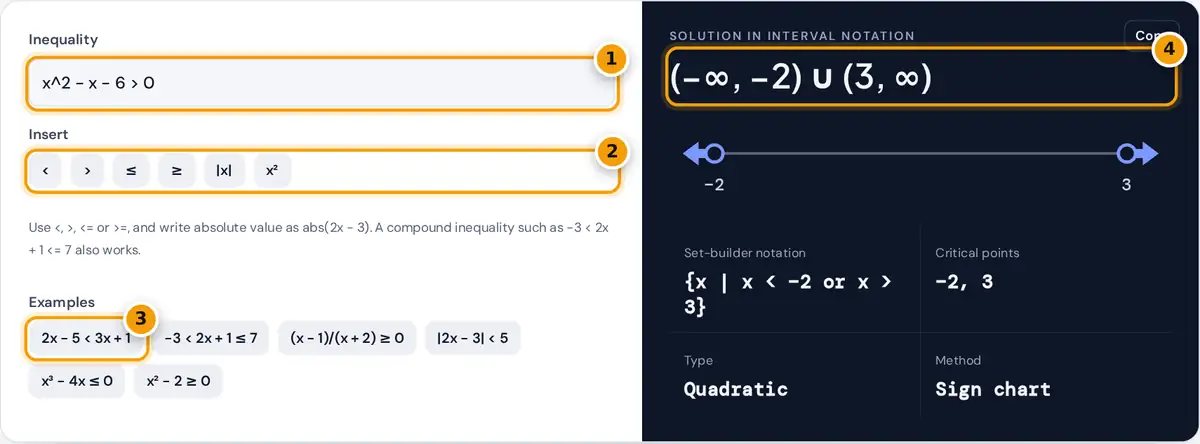
- Type the inequality with <, >, <= or >=. Compound and absolute value forms work.
- Use these buttons to insert inequality signs, absolute value or a square.
- Or load an example of each type: linear, compound, rational, absolute value.
- Read the interval notation, the number line and set-builder form, then the sign chart.
Type the inequality with <, >, <= or >=, using x or any other single letter as the variable. Write absolute values as abs(2x - 3), or with vertical bars, and type compound inequalities in one line, such as -3 < 2x + 1 <= 7. The insert buttons add the symbols for you, and the examples cover each type of inequality the tool can solve.
The result panel gives the solution in interval notation, draws it on a number line with open and closed circles, and repeats it in set-builder notation with the critical points. Below the tool, linear inequalities are solved with the algebra written out, and polynomial, rational and absolute value inequalities are solved with a sign chart that tests one value in every interval.
Rules for Solving Inequalities
Multiplying or dividing by a positive number keeps the sign.
Multiplying or dividing by a negative number reverses the sign: −2x < 6 → x > −3
|u| < c → −c < u < c |u| > c → u < −c or u > c
For anything other than a linear inequality, move every term to one side so the other side is 0, then find the critical points: the zeros of the expression and, for fractions, the values that make the denominator zero. Between critical points the expression cannot change sign, so testing a single value in each interval tells you where it is positive or negative.
Worked Examples
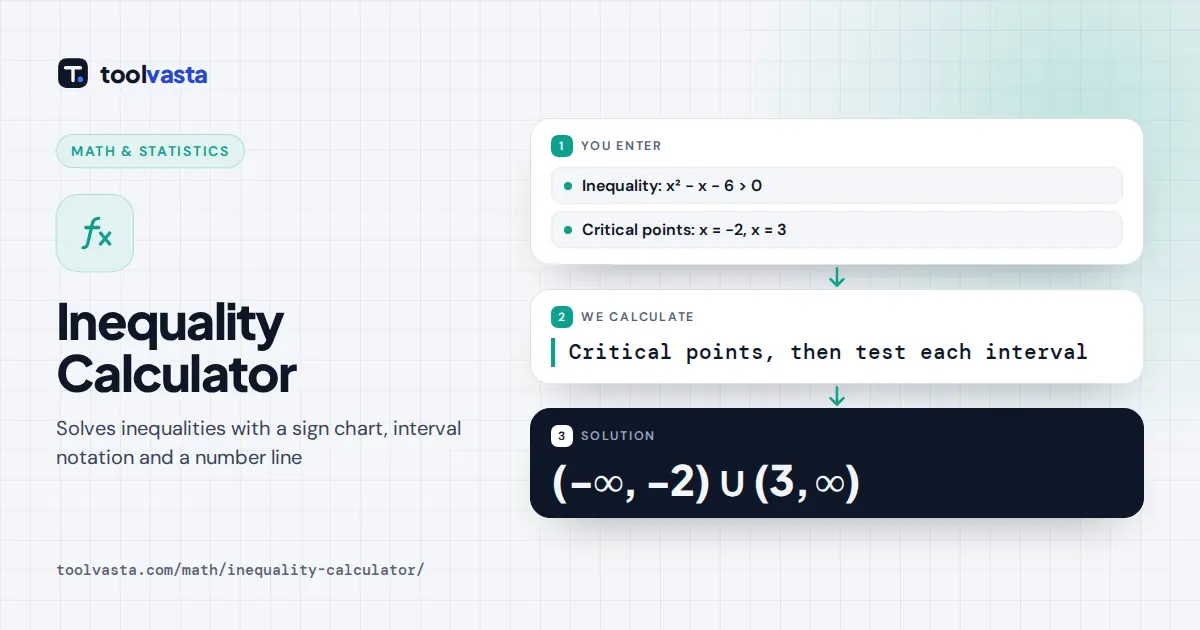
Quadratic: solve x² − x − 6 > 0. Factor: (x + 2)(x − 3) > 0, so the critical points are −2 and 3. Testing x = −3 gives 6 (positive), x = 0 gives −6 (negative) and x = 4 gives 6 (positive). The answer is (−∞, −2) ∪ (3, ∞). The endpoints are excluded because the inequality is strict.
Linear: solve 2x − 5 < 3x + 1. Subtract 3x and add 5: −x < 6. Divide by −1 and reverse the sign: x > −6, or (−6, ∞).
Compound: solve −3 < 2x + 1 ≤ 7. Subtract 1 from all three parts: −4 < 2x ≤ 6. Divide by 2: −2 < x ≤ 3, or (−2, 3].
Interval Notation at a Glance
| Inequality | Interval notation | Number line |
|---|---|---|
| x > 3 | (3, ∞) | Open circle at 3, shaded right |
| x ≤ −1 | (−∞, −1] | Closed circle at −1, shaded left |
| −2 < x ≤ 3 | (−2, 3] | Open at −2, closed at 3, shaded between |
| x < −2 or x > 3 | (−∞, −2) ∪ (3, ∞) | Two rays pointing outward |
Rational and Absolute Value Inequalities
For a fraction such as (x − 1)/(x + 2) ≥ 0, never multiply both sides by the denominator, because its sign is unknown. Use the sign chart instead: the zero x = 1 is included, the excluded value x = −2 never is, and the answer is (−∞, −2) ∪ [1, ∞). For |2x − 3| < 5, the rule gives −5 < 2x − 3 < 5, so −1 < x < 4.
Checking Your Answer
Pick a number inside your solution and one outside it, and substitute both into the original inequality. For x² − x − 6 > 0, x = 4 gives 16 − 4 − 6 = 6 > 0, which is true, and x = 0 gives −6 > 0, which is false. Also test each endpoint to confirm whether it belongs with a bracket or a parenthesis.
Tips and Limits
- Polynomial and rational inequalities with rational coefficients are solved exactly, including square roots such as √2 from quadratics. Roots of higher-degree factors that are not rational are shown as decimals.
- Absolute value, square root and other function inequalities are solved with a numerical sign chart on −1,000 ≤ x ≤ 1,000, and endpoints are shown as exact fractions when they check exactly.
- Only one variable is allowed, and not-equal (≠) statements are not supported.
Frequently asked questions
When do you flip the inequality sign?
Whenever you multiply or divide both sides by a negative number. For example, −3x > 12 becomes x < −4. Adding or subtracting never flips the sign.
How do you solve a quadratic inequality?
Move everything to one side, find the roots of the quadratic, and test a value in each interval they create. Keep the intervals where the sign matches the inequality.
What is interval notation?
A compact way to write a solution set. Parentheses exclude an endpoint and square brackets include it, so (−2, 3] means −2 < x ≤ 3. Infinity always gets a parenthesis.
How do you solve an absolute value inequality?
For |u| < c, solve −c < u < c. For |u| > c, solve u < −c or u > c. For example, |2x − 3| < 5 becomes −5 < 2x − 3 < 5, so −1 < x < 4.
How do you show an inequality on a number line?
Mark each endpoint with a closed circle if it is included (≤ or ≥) or an open circle if not (< or >), then shade the part of the line that satisfies the inequality.
How do you solve a compound inequality?
Apply each step to all three parts at once, as in −3 < 2x + 1 ≤ 7 → −2 < x ≤ 3. For an 'or' statement, solve each part and combine the solutions.