How to Use the pH Calculator
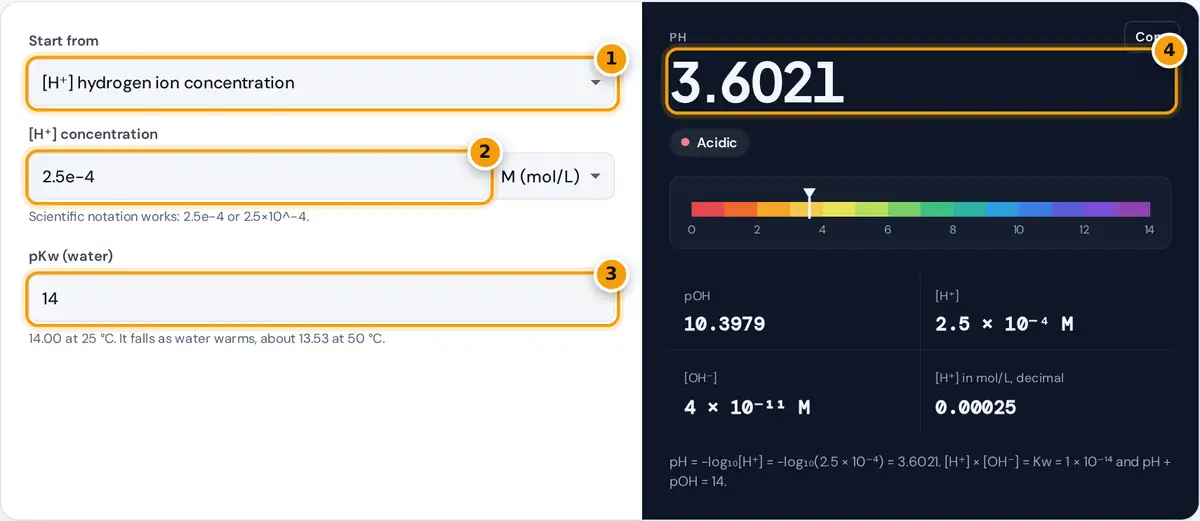
- Choose what you know: [H⁺], [OH⁻], pOH, pH, or a weak acid or base.
- Enter the concentration. Scientific notation such as 2.5e-4 works.
- Keep pKw at 14 for 25 °C, or change it for another temperature.
- Read the pH, pOH and both ion concentrations on the pH scale.
Choose what you know from the Start from menu. Enter a hydrogen ion concentration [H⁺] or hydroxide ion concentration [OH⁻] in mol/L, millimolar or micromolar, or type a pOH or a pH value. Scientific notation works, so 2.5e-4 and 2.5×10^-4 both mean 0.00025.
For a weak acid or weak base, enter its starting concentration and pick a compound or type its Ka (or Kb). Switch the menu to pKa to enter the logarithmic form instead. The calculator solves the equilibrium exactly, shows the percent ionization, and compares the answer with the common square root shortcut.
The result gives the pH, the pOH, both ion concentrations and a marker on the pH scale. The pKw box is 14 for water at 25 °C. Change it only if your problem uses a different temperature.
pH Formulas
[H⁺] = 10⁻ᵖᴴ pH + pOH = pKw = 14.00 at 25 °C
[H⁺][OH⁻] = Kw = 1.0 × 10⁻¹⁴
Weak acid: Ka = x² ÷ (C − x), shortcut x ≈ √(Ka × C)
Each pH unit is a factor of ten in hydrogen ion concentration, so pH 3 is ten times more acidic than pH 4. For a weak acid, x is the equilibrium [H⁺] and C is the starting concentration. The calculator solves the full equation, including the small contribution of water, so it stays accurate for dilute solutions where the shortcut fails. The IUPAC Gold Book gives the formal definition of pH.
Worked Examples
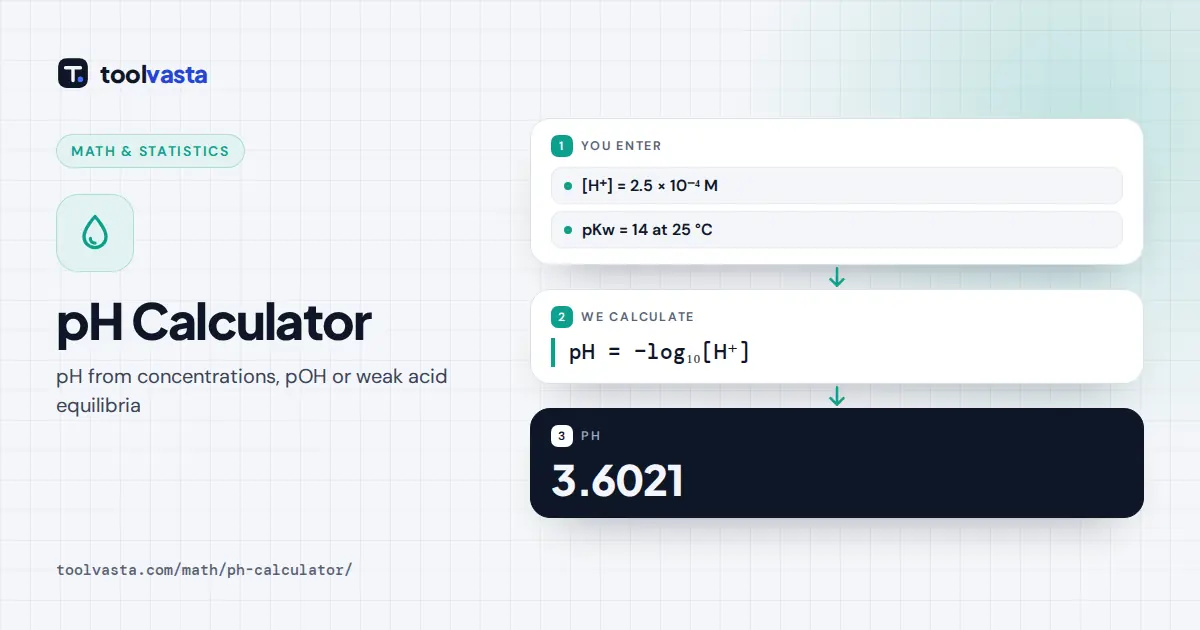
- From [H⁺]: [H⁺] = 2.5 × 10⁻⁴ M gives pH = −log(0.00025) = 3.6021. Then pOH = 14 − 3.6021 = 10.3979 and [OH⁻] = 10⁻¹⁴ ÷ 2.5 × 10⁻⁴ = 4 × 10⁻¹¹ M.
- From [OH⁻]: 0.001 M sodium hydroxide gives pOH = 3, so pH = 11.
- From pH: blood at pH 7.4 has [H⁺] = 10⁻⁷·⁴ = 3.981 × 10⁻⁸ M.
- Weak acid: 0.1 M acetic acid with Ka = 1.8 × 10⁻⁵. The exact solution is [H⁺] = 1.3327 × 10⁻³ M, so pH = 2.8753 and 1.333 percent of the acid is ionized. The shortcut √(1.8 × 10⁻⁵ × 0.1) gives pH 2.8724, very close because ionization is small.
- Weak base: 0.1 M ammonia with Kb = 1.8 × 10⁻⁵ gives pOH = 2.8753 and pH = 11.1247.
Strong and Weak Acids
A strong acid such as hydrochloric acid ionizes completely, so a 0.01 M solution has [H⁺] = 0.01 M and pH 2. A weak acid ionizes only partly, so the same concentration gives a higher pH. For example, 0.01 M hydrofluoric acid, with Ka = 6.8 × 10⁻⁴, has pH 2.64 and is 22.9 percent ionized. Here the square root shortcut is noticeably off, because the ionization is well above 5 percent, which is why the calculator solves the equilibrium exactly.
The same logic applies to bases. Sodium hydroxide is strong, so use the [OH⁻] mode, while ammonia is weak, so use the weak base mode with its Kb.
pH of Everyday Substances
| pH | [H⁺] (M) | Typical example |
|---|---|---|
| 2 | 10⁻² | Lemon juice, about 2 to 3 |
| 4 | 10⁻⁴ | Tomato juice |
| 7 | 10⁻⁷ | Pure water at 25 °C |
| 8 | 10⁻⁸ | Seawater, about 8.1 |
| 11 | 10⁻¹¹ | Household ammonia, about 11 to 12 |
Values for real products vary with brand and concentration, so treat them as rough guides.
Tips and Limits
- The calculator treats concentrations as activities, which is accurate for dilute solutions. Above about 0.1 M, real pH can differ by a few tenths.
- Strong acids such as HCl are fully ionized, so use the [H⁺] mode with the acid concentration. For a diprotic strong acid, the first proton dominates.
- Ka values in the presets are typical textbook figures at 25 °C. Use the value your course gives if it differs.
- Very dilute strong acids approach pH 7, not higher, because water supplies about 10⁻⁷ M H⁺ on its own.
Frequently asked questions
How do you calculate pH from H+ concentration?
Take the negative base 10 logarithm: pH = −log[H⁺]. For [H⁺] = 0.001 M, pH = 3. For 2.5 × 10⁻⁴ M, pH = 3.60. Each tenfold drop in concentration raises the pH by one unit.
How do I find pH from pOH?
Subtract the pOH from 14 at 25 °C: pH = 14 − pOH. A solution with pOH 4.5 has pH 9.5. At other temperatures use pKw in place of 14.
How do I calculate pH from OH- concentration?
First find pOH = −log[OH⁻], then pH = 14 − pOH. For 0.001 M hydroxide, pOH is 3 and the pH is 11. The calculator does both steps.
How do you find the pH of a weak acid?
Solve Ka = x² ÷ (C − x) for x, the equilibrium [H⁺], then take pH = −log x. When ionization is under about 5 percent, the shortcut x ≈ √(Ka × C) works well.
What is the difference between Ka and pKa?
Ka is the acid dissociation constant, and pKa = −log Ka. A smaller pKa means a stronger acid. Acetic acid has Ka = 1.8 × 10⁻⁵, which is a pKa of about 4.74.
Why is neutral pH 7?
In pure water at 25 °C, [H⁺] and [OH⁻] are both 10⁻⁷ M because their product, Kw, is 10⁻¹⁴. At higher temperatures Kw increases, so neutral pH falls below 7.