How to Use the Stoichiometry Calculator
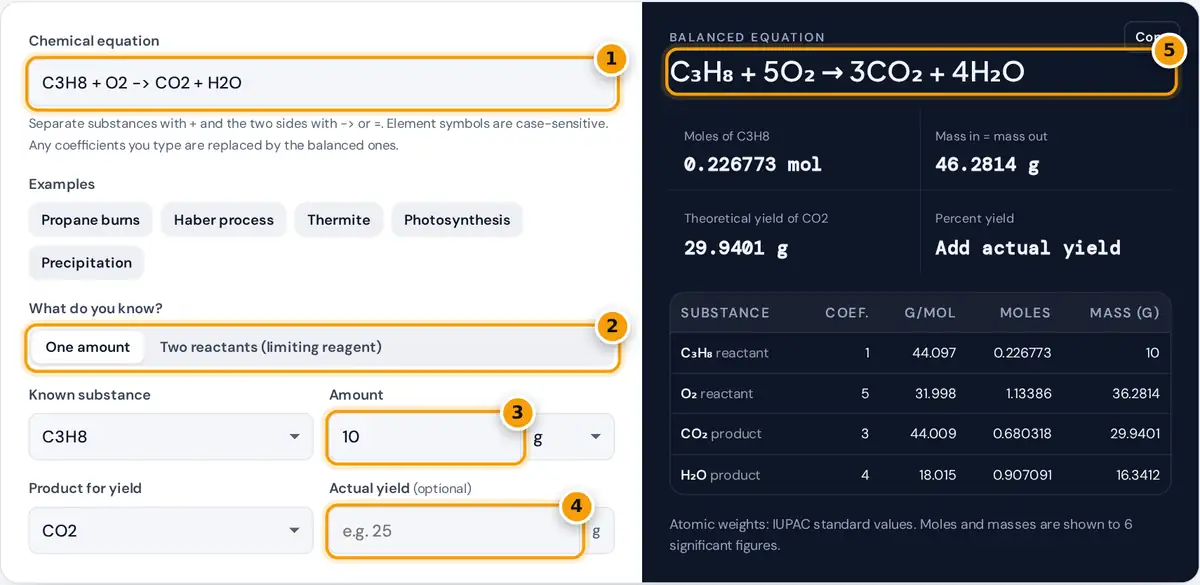
- Type the reaction with + between substances and -> between sides. It is balanced for you.
- Choose One amount, or Two reactants to find the limiting reagent.
- Pick the substance you know and enter its amount in grams or moles.
- Optionally add the actual yield to get the percent yield.
- Read the balanced equation, then the grams and moles of every substance below it.
Type the reaction with a plus sign between substances and an arrow (->) or an equals sign between reactants and products. You do not need to balance it first. The calculator finds the smallest whole-number coefficients by solving an atom balance for every element, then shows the balanced equation with an atom count check.
Choose the substance you know an amount for and enter it in grams, milligrams, kilograms, moles or millimoles. The table then lists the moles and grams of every reactant and product. For a limiting reagent problem, switch to Two reactants, enter both amounts, and the tool tells you which one runs out first and how much of the other is left. Add an actual yield to get the percent yield.
The Grams to Moles to Grams Method
Almost every stoichiometry problem follows the same three conversions. The balanced equation supplies the mole ratio, and molar masses connect moles to grams.
moles of B = moles of A × (coefficient of B ÷ coefficient of A)
grams of B = moles of B × molar mass of B
For limiting reagent problems, divide the moles of each reactant by its coefficient. The reactant with the smallest result is limiting, and that value sets how far the reaction can go. Percent yield compares what you actually collected with the theoretical yield: percent yield = actual ÷ theoretical × 100.
Worked Example: Burning Propane
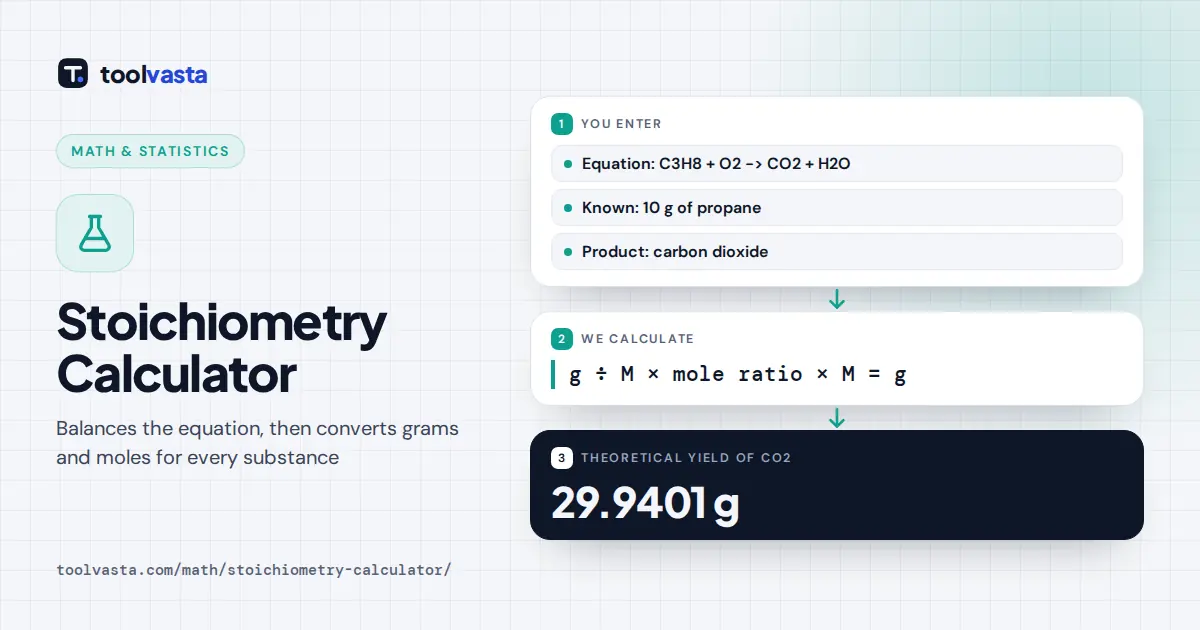
How much carbon dioxide forms when 10 g of propane burns completely? The balanced equation is C3H8 + 5 O2 → 3 CO2 + 4 H2O.
- Molar mass of C3H8 = 3 × 12.011 + 8 × 1.008 = 44.097 g/mol.
- Moles of propane = 10 ÷ 44.097 = 0.226773 mol.
- Moles of CO2 = 0.226773 × 3/1 = 0.680318 mol.
- Mass of CO2 = 0.680318 × 44.009 = 29.9401 g.
The same steps give 36.2814 g of oxygen consumed and 16.3412 g of water formed. Reactants (10 + 36.2814 = 46.2814 g) and products (29.9401 + 16.3412 = 46.2813 g, or 46.2814 g before rounding) have the same total mass, which is a quick way to check your work.
Limiting reagent example
Mix 10 g of propane with 40 g of oxygen. Propane gives 0.226773 ÷ 1 = 0.226773, while oxygen gives (40 ÷ 31.998) ÷ 5 = 0.250016. Propane has the smaller value, so it is the limiting reagent and the theoretical yield of CO2 is still 29.9401 g. About 3.719 g of oxygen is left over.
Common Stoichiometry Conversions
| You know | You want | Path |
|---|---|---|
| Grams of A | Grams of B | ÷ MA, × mole ratio, × MB |
| Moles of A | Grams of B | × mole ratio, × MB |
| Grams of A | Moles of B | ÷ MA, × mole ratio |
| Two reactant masses | Theoretical yield | Find the limiting reagent first |
| Actual and theoretical yield | Percent yield | actual ÷ theoretical × 100 |
Tips for Accurate Answers
- Write formulas with correct capitals: Co is cobalt, while CO is carbon monoxide.
- Groups in brackets and hydrates such as CuSO4·5H2O are supported. State symbols like (aq) or (g) are ignored.
- Always find the limiting reagent before you calculate a yield from two given amounts. Using the reactant in excess gives a yield that is too high.
- Round only at the end. The calculator keeps full precision and displays six significant figures.
Limits and Assumptions
The tool assumes the reaction goes to completion exactly as written, which is what textbook stoichiometry means by the theoretical yield. Ionic equations with charges, redox half-reactions and equations that can be balanced in more than one independent way are not supported, so enter one overall reaction at a time. Atomic weights are the IUPAC standard values published by the Commission on Isotopic Abundances and Atomic Weights, and gases are handled as masses or moles rather than volumes.
Frequently asked questions
What is stoichiometry?
Stoichiometry is the part of chemistry that uses a balanced equation to relate the amounts of reactants and products. The coefficients give mole ratios, and molar masses convert between moles and grams.
How do you do grams to grams stoichiometry?
Convert the known mass to moles by dividing by its molar mass, multiply by the mole ratio from the balanced equation, then multiply by the molar mass of the substance you want.
How do I find the limiting reagent?
Convert each reactant to moles and divide by its coefficient in the balanced equation. The reactant with the smallest result runs out first. It limits how much product can form.
What is theoretical yield?
Theoretical yield is the maximum mass of product that the limiting reagent can make if the reaction goes to completion with no losses. It is calculated from the limiting reagent, never the excess one.
How is percent yield calculated?
Divide the actual yield you collected by the theoretical yield and multiply by 100. A result of 85% means you recovered 85% of the product that the reaction could make in theory.
Do I need to balance the equation first?
No. Type the unbalanced equation and the calculator finds the smallest whole-number coefficients by solving the atom balance. It then shows an atom count for each element so you can confirm it.