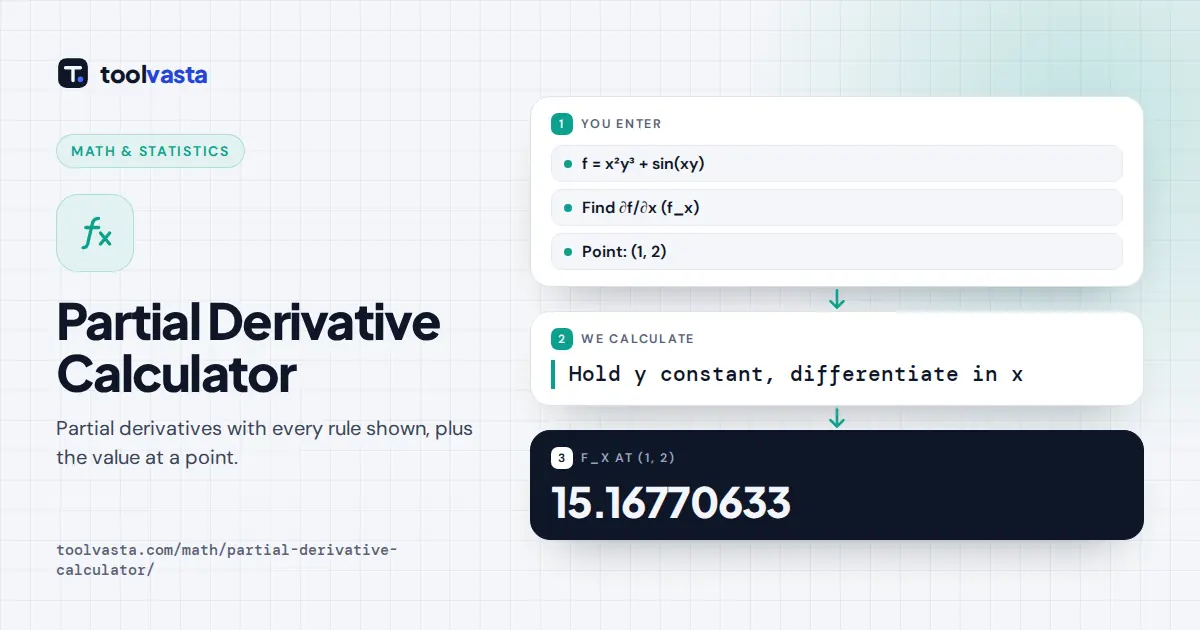
How to Use the Partial Derivative Calculator
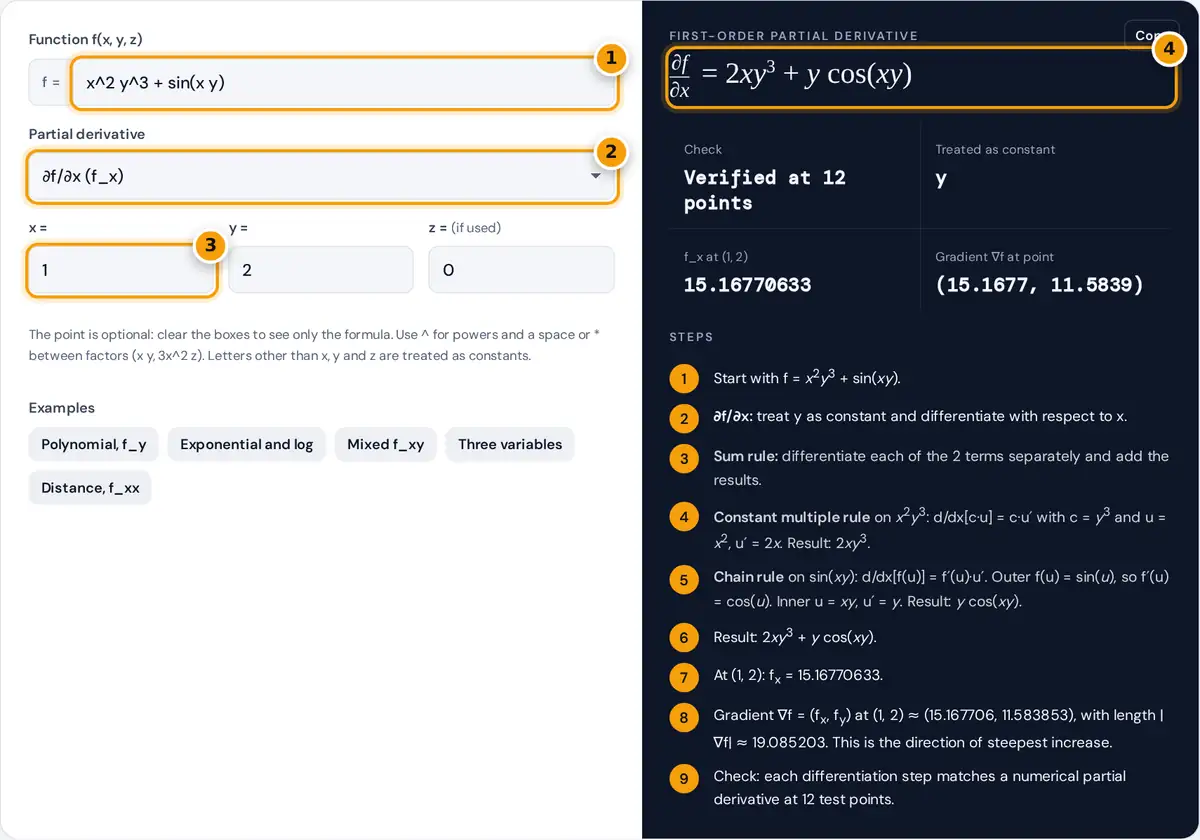
- Type your function of x, y and z. Use ^ for powers and a space or * between factors.
- Choose the partial derivative: f_x, f_y, f_z, second order or mixed such as f_xy.
- Optionally enter a point for x, y and z to evaluate the derivative and gradient.
- Read the partial derivative, then the value at your point, the gradient and each step.
Enter a function of up to three variables, x, y and z, then choose which partial derivative you want from the list. First-order, pure second-order and mixed partials such as fxy are all available.
Fill in a point to get the numerical value and the gradient vector at that point. Clear the point boxes if you only want the formula, and use the example buttons to try ready-made functions.
The steps explain which variables are held constant and which differentiation rule applies to each term. The algebra runs in your browser, and each result is compared with a numerical derivative before it is shown.
What a Partial Derivative Means
A partial derivative measures how a multivariable function changes when only one variable moves and all the others stay fixed. For f(x, y), ∂f/∂x is exactly the slope of the surface in the x direction.
fxy = ∂/∂y (∂f/∂x) = ∂²f / ∂y∂x
∇f = (fx, fy, fz)
In the same way, ∂f/∂y is the slope of the same surface in the y direction. The curly ∂ symbol tells you the function has more than one variable, unlike d in an ordinary single-variable derivative.
The formal definition is a limit, just like an ordinary derivative, except that only one variable gets the small step h. The OpenStax Calculus Volume 3 chapter covers the definition and its geometry in detail.
How to Calculate a Partial Derivative
To differentiate with respect to x alone, treat every other letter as a constant number. That golden rule, hold it constant, turns a partial derivative into an ordinary derivative you already know how to take.
Then apply the usual differentiation rules: the power rule, product rule, quotient rule and chain rule. For f = x²y, the partial with respect to x is 2xy, and with respect to y it is x².
Terms that contain only the other variables simply disappear, because the derivative of a constant is zero. For example, in x² + ey, the ey term vanishes when you differentiate with respect to x.
Worked Example: A Function of Two Variables
To find the partial derivative fx, hold y constant throughout. The first term gives 2xy³, and the chain rule applied to sin(xy) gives y cos(xy), so fx = 2xy³ + y cos(xy) for every point.
To find fy, hold x constant and let y vary. The first term gives 3x²y² and the second gives x cos(xy), so fy = 3x²y² + x cos(xy), using exactly the same chain rule step.
At the point (1, 2), fx is about 15.16771 and fy is about 11.58385, so the gradient is about (15.16771, 11.58385). The mixed partial fxy at the same point is about 21.76526.
- fxy = 6xy² + cos(xy) − xy sin(xy)
- Differentiating fy with respect to x gives the same expression, so fyx = fxy.
Mixed Partials and Clairaut's Theorem
Second-order partial derivatives come in two kinds, pure and mixed. Pure partials such as fxx differentiate twice with respect to the same variable, while mixed partials such as fxy use two different variables.
| Notation | Meaning |
|---|---|
| fx, ∂f/∂x | Differentiate once with respect to x |
| fxx, ∂²f/∂x² | Differentiate twice with respect to x |
| fxy, ∂²f/∂y∂x | First x, then y |
| ∇f | Vector of all first partial derivatives |
When the second partial derivatives are continuous, the order of differentiation does not matter, so fxy = fyx. This important result is widely known as Clairaut's theorem, or sometimes as Schwarz's theorem on symmetry.
You can test the theorem yourself by choosing fxy and then fyx for the same function. In the worked example both give about 21.76526 at the point (1, 2), as the theorem predicts.
The Gradient Vector
The gradient collects all first partial derivatives into one vector, written ∇f. At any point it points in the direction in which the function increases fastest, and its length equals that fastest rate of increase.
The gradient is used in optimization, for example gradient descent in machine learning, which repeatedly steps against the gradient to reduce an error function. It also gives tangent planes and directional derivatives on curved surfaces.
Partial derivatives appear across physics, engineering and economics, from heat flow and wave motion to marginal cost. MIT OpenCourseWare multivariable calculus is a free course that builds on these ideas, including the multivariable chain rule.
Notes and Limits
The calculator supports the variables x, y and z. Other letters, such as a or k, are treated as constants, so a value at a point needs numbers in their place before it is evaluated.
In this tool, ln and log both mean the natural logarithm, base e. Answers can look different from a textbook while being equal, because the same expression can be written in many algebraically equivalent forms.
Implicit functions and piecewise definitions are not supported, so implicit differentiation must be done by hand. If you mistype an expression, an error message appears instead of a result, so check your brackets and operators.
Frequently asked questions
How do you calculate a partial derivative?
Pick the variable you are differentiating with respect to, treat every other variable as a constant number, and apply the usual derivative rules. For f = x²y, ∂f/∂x = 2xy and ∂f/∂y = x².
What is the difference between a derivative and a partial derivative?
An ordinary derivative applies to a function of one variable. A partial derivative applies to a function of several variables and measures the change with respect to one of them while the others stay fixed.
What is the difference between fxy and fyx?
The notation fxy means differentiate with respect to x first and then y, while fyx reverses the order. For functions with continuous second partials they are equal, by Clairaut's theorem.
What is the gradient of a function?
The gradient ∇f is the vector of first partial derivatives, such as (fx, fy). It points in the direction of steepest increase, and its length is the maximum rate of change at that point.
What does the ∂ symbol mean?
The curly ∂ symbol marks a partial derivative. It shows that the function has more than one variable and that only one of them is changing while every other variable is held constant.
Can I use constants like a or k?
Yes. Any letter other than x, y and z is treated as a constant during differentiation. To evaluate the result at a point, replace those letters with numbers before you enter the function.