How to Use the Fraction to Percent Calculator
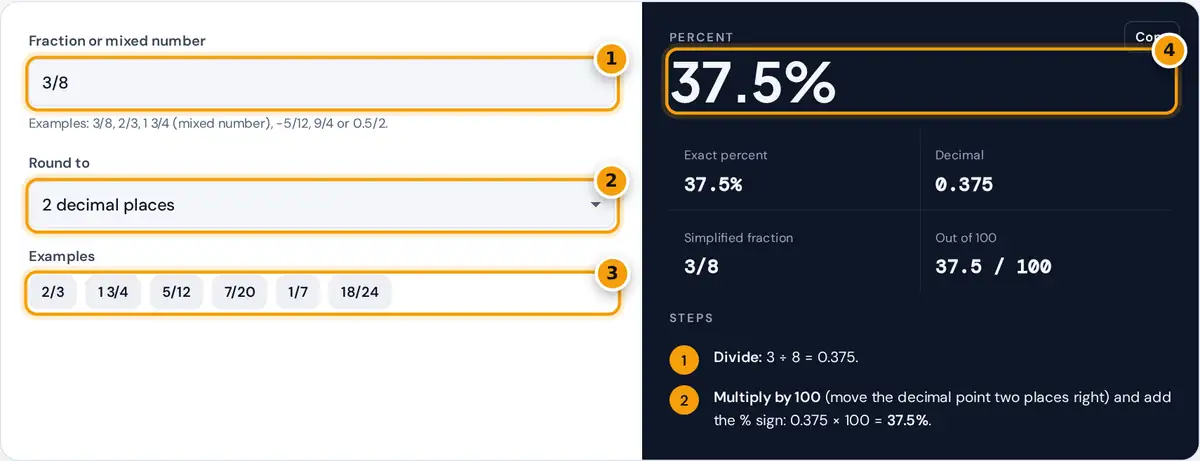
- Type a fraction such as 3/8 or a mixed number such as 1 3/4.
- Choose how many decimal places to round to.
- Or tap an example such as 2/3 or 1/7.
- Read the percent, the exact repeating value and the steps.
Type a fraction such as 3/8, a mixed number such as 1 3/4 with a space before the fraction, or an improper fraction such as 9/4. Negative fractions and decimals inside a fraction, like 0.5/2, also work. Choose how many decimal places you want in the rounded answer.
The result shows the percent, the exact percent with any repeating digits marked by a bar, the decimal, the fraction in lowest terms and the value out of 100. The steps explain the conversion in the same way a teacher would, including the shortcut of rewriting the fraction over 100 when the denominator allows it.
How to Convert a Fraction to a Percent
Shortcut: if the denominator divides 100, scale to a/100, which is a%
A percent is simply a fraction with a denominator of 100, so converting means finding the equivalent number out of 100. Dividing the numerator by the denominator gives a decimal, and multiplying by 100 moves the decimal point two places to the right. When the denominator is a factor of 100, such as 2, 4, 5, 10, 20, 25 or 50, you can scale the fraction directly instead.
Worked Examples
- 3/8: 3 ÷ 8 = 0.375, and 0.375 × 100 = 37.5%.
- 7/20: 100 ÷ 20 = 5, so 7/20 = 35/100 = 35%.
- 2/3: 2 ÷ 3 = 0.666…, a repeating decimal, so 2/3 = 66.6̅% exactly, or about 66.67% rounded to two places.
- 1 3/4: as an improper fraction this is 7/4, and 7 ÷ 4 = 1.75, so it is 175%. Mixed numbers and improper fractions are always 100% or more.
- 18/24: simplify first by dividing by 6 to get 3/4, which is 75%.
Two more examples show the method on harder fractions. For 5/12, divide 5 by 12 to get 0.41666…, with the 6 repeating, so 5/12 = 41.6̅%, or 41.67% rounded. For 9/4, an improper fraction, 9 ÷ 4 = 2.25, which is 225%. In both cases the steps are the same: divide, then multiply by 100.
Common Fractions as Percents
| Fraction | Decimal | Percent |
|---|---|---|
| 1/2 | 0.5 | 50% |
| 1/3 | 0.333… | 33.33% |
| 1/4 | 0.25 | 25% |
| 1/5 | 0.2 | 20% |
| 1/6 | 0.1666… | 16.67% |
| 1/8 | 0.125 | 12.5% |
| 1/10 | 0.1 | 10% |
| 2/3 | 0.666… | 66.67% |
| 3/4 | 0.75 | 75% |
| 5/8 | 0.625 | 62.5% |
Terminating and Repeating Percents
A fraction in lowest terms gives a terminating decimal only when its denominator has no prime factors other than 2 and 5. So 3/8 and 7/20 end neatly, while 1/3, 5/12 and 1/7 repeat forever. For 1/7 the six digits 142857 repeat, so 1/7 = 14.285714…%. The calculator finds the repeating block exactly using long division and marks it with a bar.
Converting a Percent Back to a Fraction
To reverse the process, write the percent over 100 and simplify. For example, 37.5% = 37.5/100. Multiply top and bottom by 10 to clear the decimal, giving 375/1000, then divide both by 125 to get 3/8. A repeating percent such as 66.6̅% equals 2/3, because 66.6̅ is 200/3 and (200/3) ÷ 100 = 2/3. This is a good way to check your answer: converting the percent back should return the fraction you started with, in lowest terms.
Percents are also easier to compare than fractions. Is 5/8 bigger than 7/12? As percents they are 62.5% and 58.3̅%, so 5/8 is larger. Converting several fractions to percents is a quick way to put them in order, compare test scores out of different totals, or read survey results.
Tips
- Simplifying first is optional but often makes the division easier.
- Percents above 100% are correct for fractions greater than 1.
- When rounding, keep the exact fraction for later calculations to avoid rounding errors.
- To go the other way, write the percent over 100 and simplify: 45% = 45/100 = 9/20.
Frequently asked questions
How do you convert a fraction to a percent?
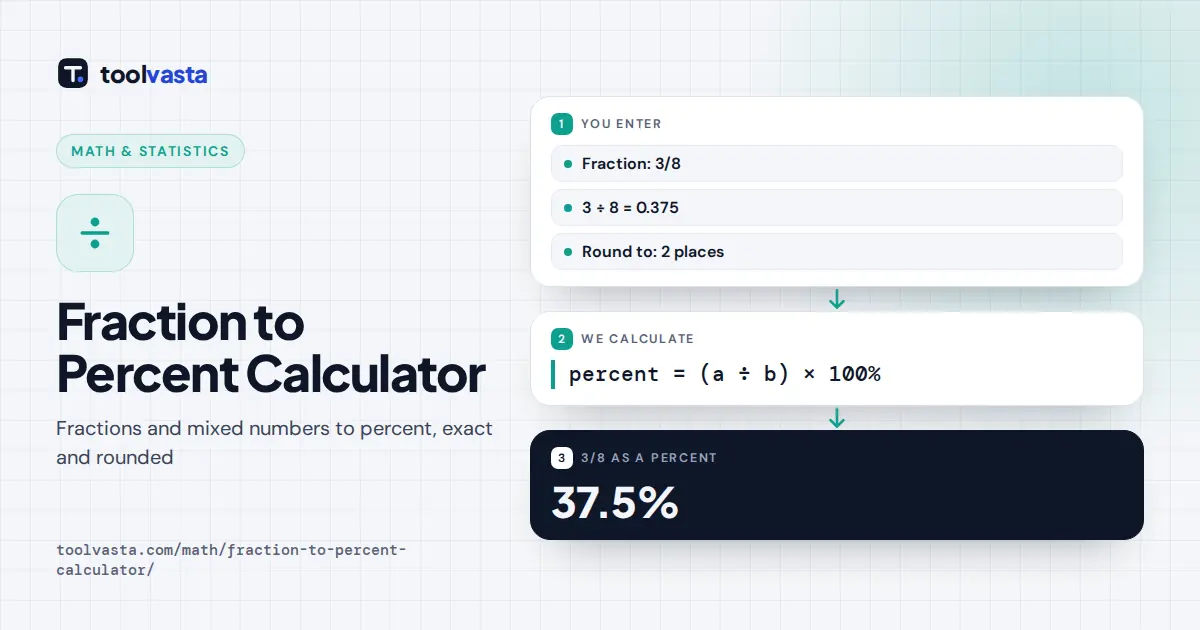
Divide the numerator by the denominator to get a decimal, then multiply by 100 and add a percent sign. For 3/8, 3 divided by 8 is 0.375, which is 37.5%.
What is 2/3 as a percent?
2/3 is 66.666...% with the 6 repeating forever. Rounded to two decimal places it is 66.67%, and rounded to a whole number it is 67%.
How do I convert a mixed number to a percent?
Change it to an improper fraction first. For 1 3/4, multiply 1 by 4 and add 3 to get 7/4. Then 7 divided by 4 is 1.75, which is 175%.
Why do some fractions give repeating percents?
In lowest terms, a fraction ends neatly only if the denominator's prime factors are 2 and 5. Denominators with other primes, such as 3 or 7, produce digits that repeat forever.
Is there a shortcut for fractions like 7/20?
Yes. If the denominator divides 100 evenly, multiply top and bottom to get a denominator of 100. For 7/20, multiply both by 5 to get 35/100, which is 35%.
Can a fraction be more than 100 percent?
Yes. Any fraction greater than 1, such as 5/4 or the mixed number 2 1/2, is more than 100%. 5/4 is 125% and 2 1/2 is 250%.