How to use the wavelength to frequency calculator
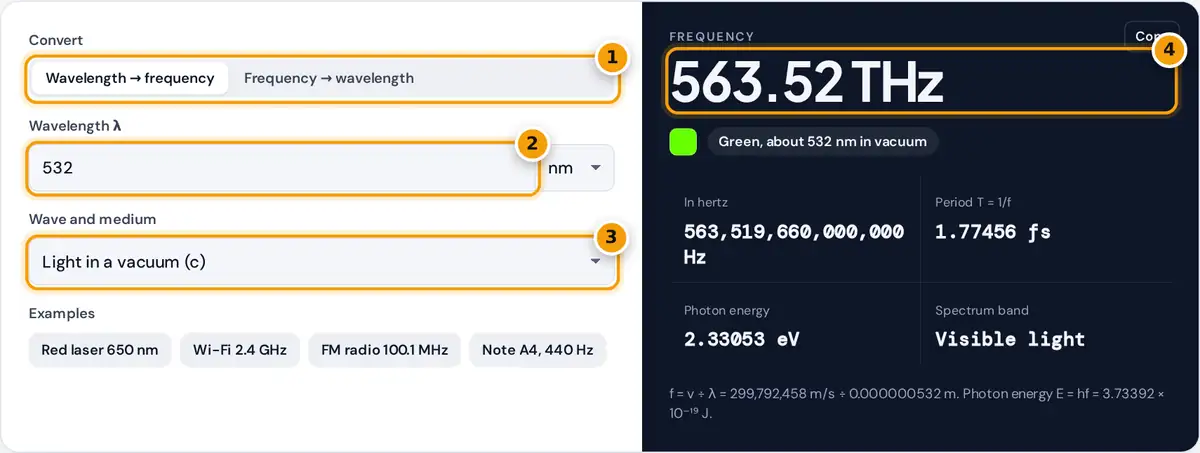
- Choose wavelength to frequency, or frequency to wavelength.
- Enter the value and pick its unit, from pm to km.
- Choose the wave and medium: light in vacuum, air, water or glass, sound, or a custom speed.
- Read the frequency, then check the period, photon energy and spectrum band.
Choose the direction, enter the value and pick its unit, from picometres to kilometres for wavelength or hertz to petahertz for frequency. Then choose the kind of wave and the medium it travels through. The result appears in the most readable unit, along with the value in base SI units, the period, the photon energy for light, and the band of the spectrum. For visible light the calculator also shows the approximate color.
The wave equation
For light in a vacuum v = c = 299,792,458 m/s (exact)
Photon energy E = h f = h c ÷ λ, h = 6.62607015 × 10⁻³⁴ J·s
Period T = 1 ÷ f
The speed of light in a vacuum and the Planck constant are exact values in the SI system. In a material, light slows to c ÷ n, where n is the refractive index. Its frequency does not change, so the wavelength inside the material is shorter by the same factor.
Worked examples
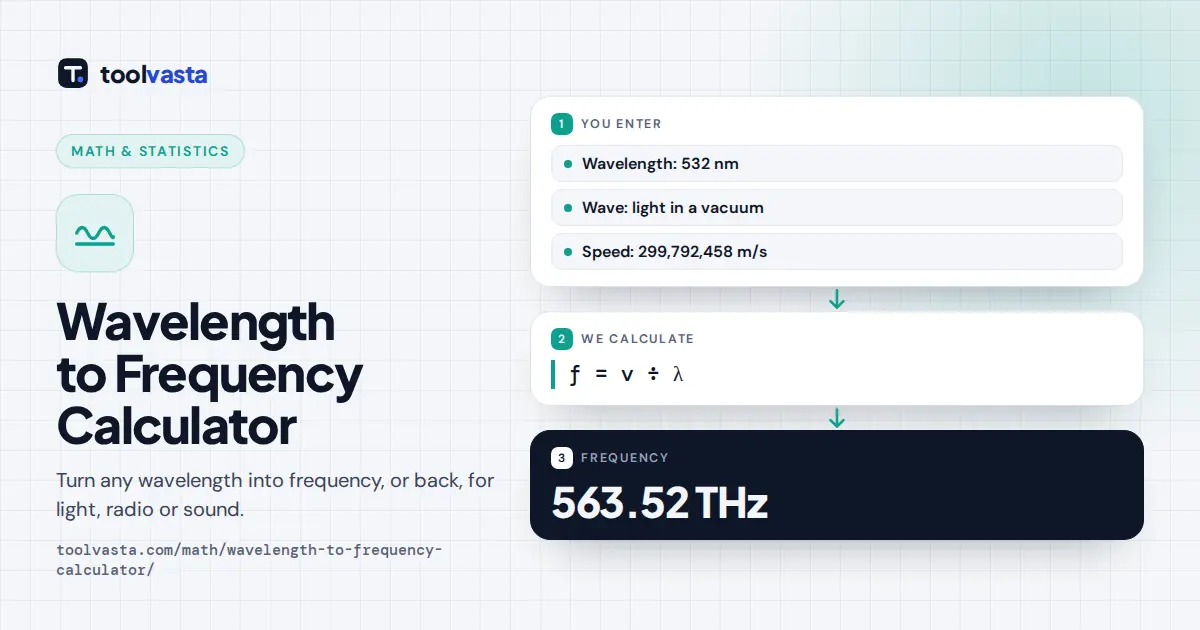
- Green laser, 532 nm: f = 299,792,458 ÷ (532 × 10−9) = 5.635 × 10¹⁴ Hz = 563.52 THz. The photon energy is about 2.3305 eV.
- Wi-Fi at 2.4 GHz: λ = 299,792,458 ÷ (2.4 × 10⁹) = 0.1249 m, or about 12.5 cm.
- Musical note A4, 440 Hz in air: with sound at 343 m/s, λ = 343 ÷ 440 = 0.780 m.
The electromagnetic spectrum
| Band | Wavelength | Frequency |
|---|---|---|
| Radio | over 1 m | under 300 MHz |
| Microwave | 1 mm to 1 m | 300 MHz to 300 GHz |
| Infrared | 750 nm to 1 mm | 300 GHz to 400 THz |
| Visible | 380 to 750 nm | 400 to 790 THz |
| Ultraviolet | 10 to 380 nm | 790 THz to 30 PHz |
| X-ray and gamma | under 10 nm | over 30 PHz |
Band edges are conventions and different sources draw them slightly differently.
Sound waves
For sound, the speed depends on the medium and its temperature: about 343 m/s in dry air at 20 °C, about 1,481 m/s in fresh water and about 5,960 m/s for compression waves in steel. Choose "Custom wave speed" for any other value, such as sound in air at a different temperature (roughly 331.3 + 0.606 × T m/s, with T in °C) or waves on a string.
Choosing units
Optical work usually quotes wavelength in nanometres, infrared in micrometres, radio in metres or by frequency in MHz and GHz, and sound by frequency in hertz. Because f and λ are inversely proportional, a smaller wavelength always means a higher frequency: halving the wavelength doubles the frequency.
Notes
The refractive indices used are typical values for visible light: 1.000293 for air, 1.333 for water and 1.5 for common glass. Real indices change slightly with wavelength (dispersion) and temperature. Visible colors are approximate, since perceived color depends on the display and the viewer.
Frequently asked questions
How do you convert wavelength to frequency?
Divide the wave speed by the wavelength: f = v ÷ λ. For light in a vacuum, use c = 299,792,458 m/s and make sure the wavelength is in metres.
What is the frequency of 500 nm light?
f = 299,792,458 ÷ (500 × 10−9) ≈ 5.996 × 10¹⁴ Hz, or about 600 THz. That is blue-green light.
Does frequency change when light enters water?
No. The frequency stays the same, but the speed drops to c ÷ n, so the wavelength gets shorter by the factor n, about 1.333 for water.
How is photon energy related to wavelength?
E = hc ÷ λ. A handy form is E (in eV) ≈ 1239.84 ÷ λ (in nm), so a 620 nm photon carries about 2 eV.
What is the wavelength of a 2.4 GHz Wi-Fi signal?
About 12.5 cm, since 299,792,458 ÷ 2.4 × 109 = 0.1249 m.