How to Use the Terminal Velocity Calculator
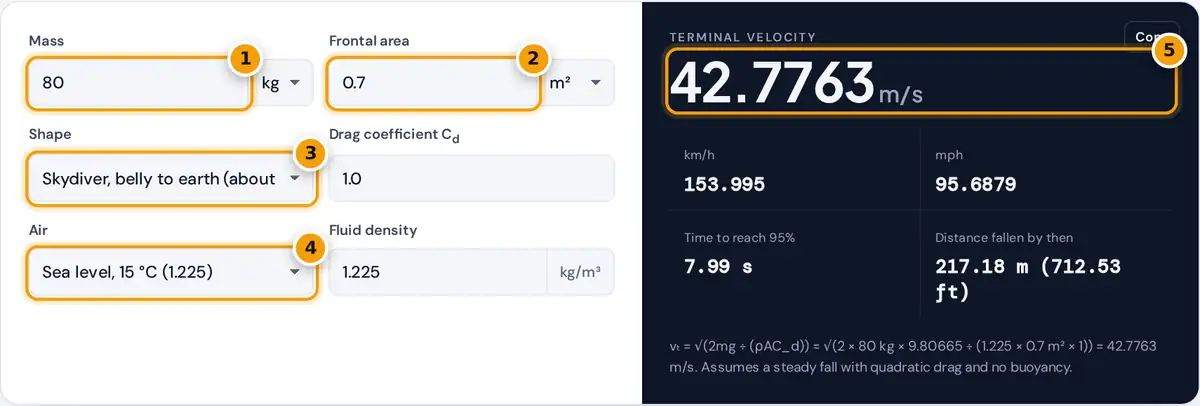
- Enter the mass and its unit.
- Enter the frontal area facing the airflow.
- Pick a shape to fill in a drag coefficient, or type your own.
- Choose the air conditions or a custom density.
- Read the terminal velocity and the time and distance to reach it.
Enter the mass of the falling object and its frontal area, which is the area it presents to the oncoming air. Choose a shape to fill in a typical drag coefficient, or type your own value. Then pick an air condition or enter any fluid density in kilograms per cubic meter.
The result shows the terminal velocity in meters per second, kilometers per hour and miles per hour. It also gives the time needed to reach 95% of that speed when dropped from rest and the distance fallen in that time, which shows how quickly the object approaches its top speed. The note repeats the formula with your numbers.
Terminal Velocity Formula
At terminal velocity, drag = weight: ½ ρ vt² A Cd = mg
vt = √(2mg ÷ (ρ A Cd))
Speed from rest: v(t) = vt tanh(gt ÷ vt)
Here m is the mass, g = 9.80665 m/s² is standard gravity, ρ is the density of the air, A is the frontal area and Cd is the drag coefficient. As the object speeds up, drag grows with the square of its speed until it equals the weight. From then on, the net force is zero and the speed stays constant.
Worked Example: A Skydiver
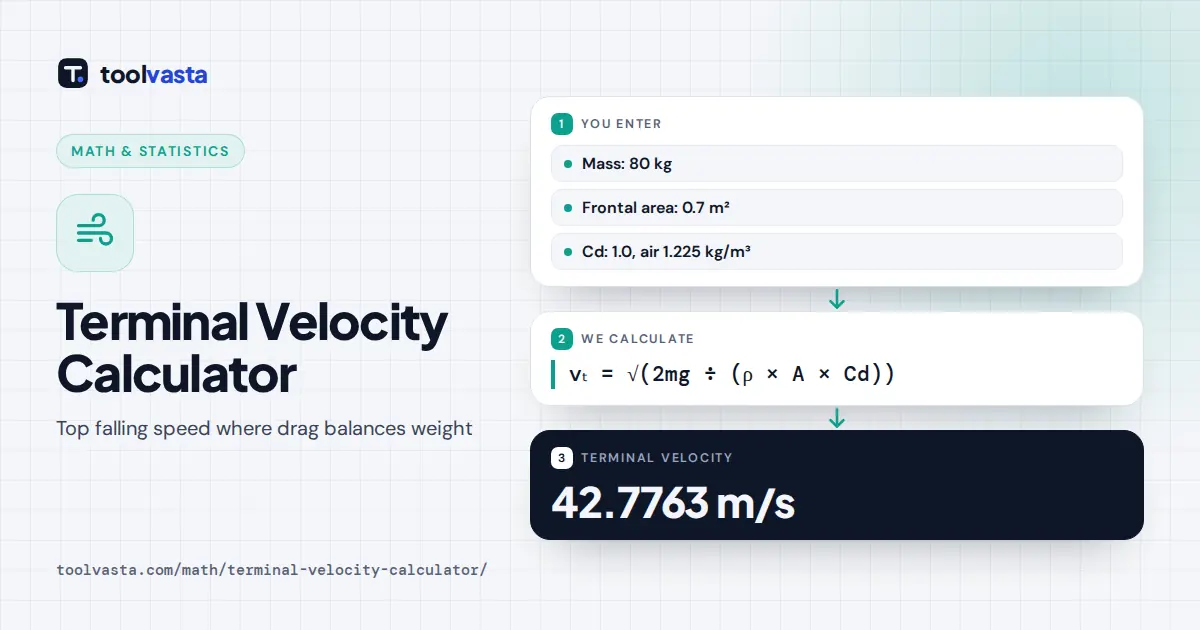
Take an 80 kg skydiver in a belly-to-earth position with a frontal area of about 0.7 m² and a drag coefficient of about 1.0, falling through sea-level air at 1.225 kg/m³.
- vt = √(2 × 80 × 9.80665 ÷ (1.225 × 0.7 × 1.0)) = √1,829.81 = 42.7763 m/s.
- That is 153.995 km/h or 95.6879 mph.
- The skydiver reaches 95% of this speed after about 7.99 seconds, having fallen about 217 m.
These inputs are rough, typical values. Body position changes the area and drag coefficient a lot, which is how skydivers speed up or slow down in free fall.
Typical Drag Coefficients
| Shape | Approximate Cd |
|---|---|
| Streamlined body | 0.04 |
| Smooth sphere | 0.47 |
| Skydiver, belly to earth | about 1.0 |
| Cube, face first | 1.05 |
| Flat plate facing the flow | 1.28 |
Drag coefficients depend on the exact shape, surface roughness and the Reynolds number of the flow, so treat these as starting points. Measured values from tests on a similar object are always better.
What Changes Terminal Velocity?
- Mass: vt grows with the square root of mass. Four times the mass doubles the speed.
- Area and shape: a larger area or a higher Cd means more drag and a lower top speed. A parachute works by increasing both enormously.
- Air density: thinner air at altitude gives less drag, so falling objects go faster high up. At 3,000 m the standard atmosphere density is about 0.909 kg/m³, which raises vt by about 16% compared with sea level.
Drag at Lower Speeds
Before terminal velocity is reached, the drag force is smaller than the weight, and the difference accelerates the object. Because drag grows with the square of speed, at half the terminal velocity the drag is only a quarter of the weight, so the object is still accelerating at three quarters of g. This is why the speed rises quickly at first and then levels off, as the tanh formula above describes.
Assumptions and Limits
The calculation assumes quadratic drag with a constant drag coefficient, a constant air density and no buoyancy. That suits most objects falling through air. For very small or slow objects, such as dust or tiny droplets, drag is closer to linear (Stokes’ law) and this formula overestimates the speed. In water, buoyancy is significant and must be subtracted from the weight. Standard gravity follows the value listed by NIST.
Frequently asked questions
What is terminal velocity?
It is the constant speed a falling object reaches when air resistance pushes up as hard as gravity pulls down. With no net force, the object stops accelerating and keeps falling at that speed.
What is the formula for terminal velocity?
vt = √(2mg ÷ (ρACd)), where m is mass, g is gravity, ρ is air density, A is frontal area and Cd is the drag coefficient. It comes from setting drag equal to weight.
What is the terminal velocity of a human?
For a skydiver falling belly to earth it is often quoted at roughly 50 to 55 m/s, about 180 to 200 km/h. Using rough inputs of 80 kg, 0.7 m² and a Cd of 1.0, this calculator gives about 43 m/s.
Do heavier objects fall faster?
In air, yes, if they have the same shape and size. Terminal velocity grows with the square root of mass, so a heavier object needs more speed before drag can balance its weight.
How long does it take to reach terminal velocity?
In theory it is approached but never quite reached. A skydiver gets to 95% of terminal velocity in about 8 seconds, after roughly 200 meters of fall, depending on the inputs.
Why does terminal velocity increase with altitude?
Air is thinner higher up, so there is less drag at a given speed. A falling object must go faster before drag balances its weight. At 3,000 m it is about 16% faster than at sea level.