How to Use the BODMAS Calculator
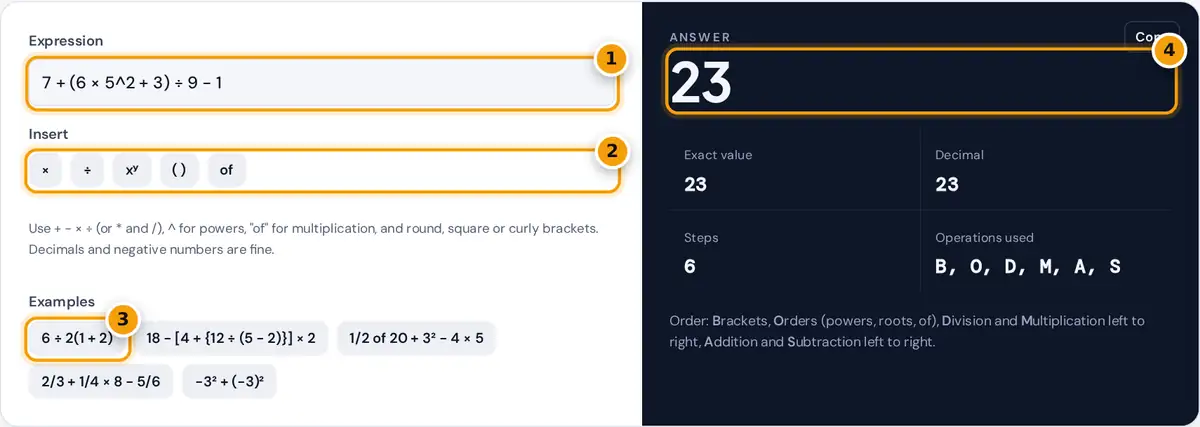
- Type the expression with + − × ÷, ^ for powers and any brackets.
- Use these buttons to insert ×, ÷, powers, brackets or of.
- Or try a tricky example such as 6 ÷ 2(1 + 2).
- Read the answer, then each step with the BODMAS letter it follows.
Type an arithmetic expression using numbers, + − × ÷ (or * and /), ^ for powers, the word "of", and round, square or curly brackets. The buttons insert the symbols that are hard to type on a phone. A number written next to a bracket, as in 2(1 + 2), means multiplication.
The answer appears at once as an exact value, a decimal and, for fractions, a mixed number. Below the tool, the expression is rewritten after every single operation, with the new value highlighted and a colored letter showing which BODMAS rule was applied. This makes it easy to compare with your own working and spot where an answer went wrong.
The BODMAS Rule
O: Orders, meaning powers and roots (and "of")
D and M: Division and Multiplication, from left to right
A and S: Addition and Subtraction, from left to right
BODMAS, BIDMAS, BEDMAS and PEMDAS are the same rule with different names: Parentheses, Exponents, Multiplication and Division, Addition and Subtraction. The most common mistake is to think multiplication always comes before division, or addition before subtraction. They do not. Each pair has equal priority and is worked from left to right.
Worked Example
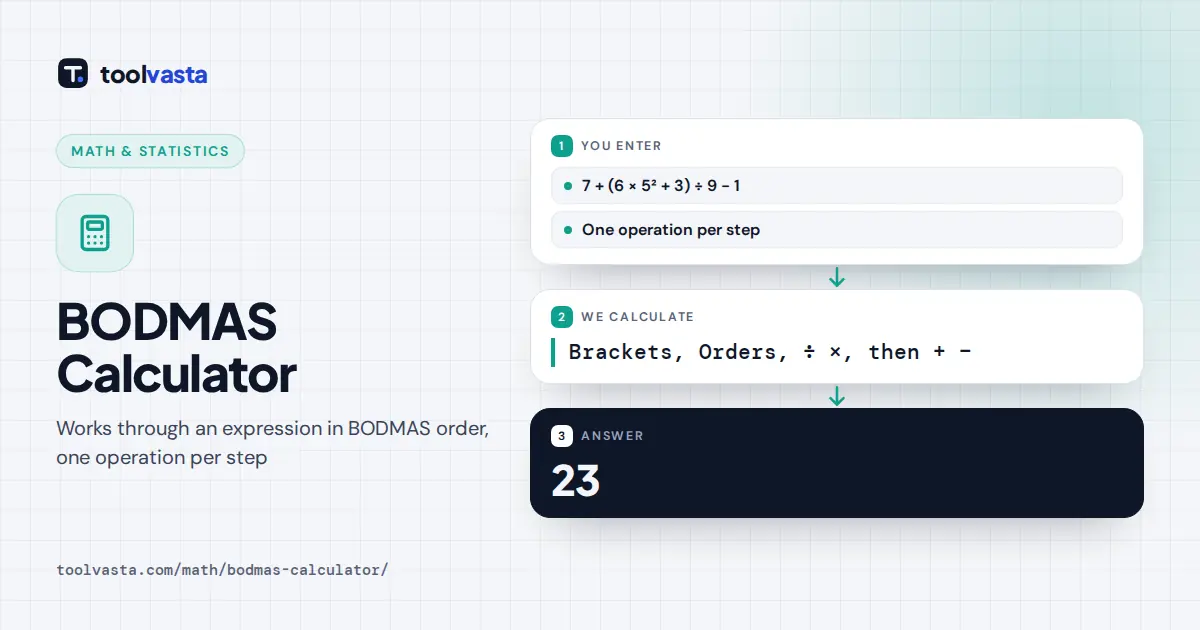
Evaluate 7 + (6 × 5² + 3) ÷ 9 − 1.
- Brackets first. Inside them, the power comes first: 5² = 25.
- Still inside the brackets, multiply: 6 × 25 = 150. Then add: 150 + 3 = 153.
- Division next: 153 ÷ 9 = 17. The expression is now 7 + 17 − 1.
- Addition and subtraction from left to right: 7 + 17 = 24, then 24 − 1 = 23.
Tricky Cases
| Expression | Answer | Why |
|---|---|---|
| 6 ÷ 2(1 + 2) | 9 | Brackets give 6 ÷ 2 × 3; division and multiplication go left to right |
| −3² | −9 | The power applies to 3 only; the minus sign is applied afterwards |
| (−3)² | 9 | The brackets make −3 the base |
| 10 − 4 + 2 | 8 | Left to right: 10 − 4 = 6, then 6 + 2 = 8 |
| 2³² (2^3^2) | 512 | Stacked powers are worked from the top down: 3² = 9, then 2⁹ |
Expressions like 6 ÷ 2(1 + 2) are deliberately ambiguous and are best avoided in real work. This calculator follows the standard convention that implied multiplication has the same priority as written multiplication, which gives 9.
The "Of" Operator
Many school textbooks treat "of" as multiplication that is done before division, as part of the O in BODMAS. So 48 ÷ 4 of 3 = 48 ÷ 12 = 4. A fraction typed directly before "of", such as 1/2 of 20, is read as a single fraction, so it gives 10.
Why the Order Matters
Without an agreed order, the same expression could have several answers. Take 3 + 4 × 2. Working strictly left to right gives 7 × 2 = 14, but BODMAS multiplies first: 3 + 8 = 11. Calculators, spreadsheets and programming languages all follow the same convention, so 11 is the answer everyone agrees on. When you want a different order, add brackets: (3 + 4) × 2 = 14.
Fractions and Decimals in BODMAS
The rule is the same for fractions. In 2/3 + 1/4 × 8 − 5/6, multiply first: 1/4 × 8 = 2. Then work left to right: 2/3 + 2 = 8/3, and 8/3 − 5/6 = 11/6, which is 1 5/6 as a mixed number. The calculator keeps fractions exact at every step, so no rounding error builds up.
Tips and Limits
- Every step uses exact fractions, so 1 ÷ 3 × 3 gives exactly 1, with no rounding.
- Powers must be whole numbers. Negative powers such as 2^(−3) = 1/8 are fine. Use a dedicated tool for roots of non-perfect powers.
- Percent signs and variables are not supported. Write 20% as 20/100.
Frequently asked questions
What does BODMAS stand for?
Brackets, Orders, Division, Multiplication, Addition, Subtraction. It is the order in which operations are carried out. Division and multiplication share a rank, as do addition and subtraction.
Is BODMAS the same as PEMDAS?
Yes. PEMDAS stands for Parentheses, Exponents, Multiplication, Division, Addition, Subtraction. Both rules give the same answer because each pair is worked from left to right.
Does multiplication come before division?
No. Multiplication and division have equal priority and are done from left to right. So 8 ÷ 4 × 2 = 2 × 2 = 4, not 8 ÷ 8 = 1.
What is 6 ÷ 2(1 + 2)?
Under the standard order of operations it is 9: the bracket gives 3, then 6 ÷ 2 × 3 is worked left to right. Some people treat 2(3) as one unit and get 1, which is why the expression is called ambiguous.
What does 'of' mean in BODMAS?
It means multiply, as in 1/2 of 20 = 10. In BODMAS it is grouped with orders, so it is done before ordinary division and multiplication.
Why is −3² equal to −9?
The power applies only to the 3, so 3² = 9 is found first and the minus sign is applied after. To square negative three, write (−3)² = 9.