How to Use the Dice Probability Calculator
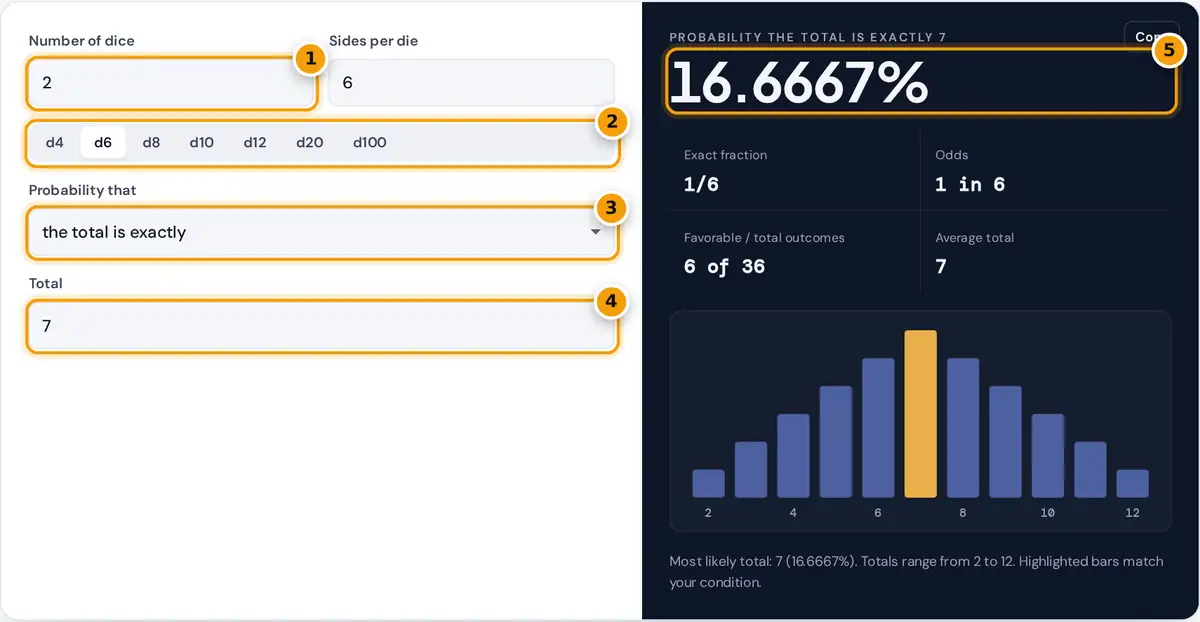
- Enter how many dice you roll.
- Pick the die type, from d4 to d100.
- Choose the condition, such as total at least or at least one six.
- Enter the target total or face value.
- Read the probability, exact fraction, odds and the chart of all totals.
Enter the number of dice and the number of sides on each die, or tap a standard die from d4 to d100. Then choose what you want to know: the chance that the total is exactly, at least, at most or between given values, that at least one die shows a particular face, or that exactly k dice show it. Type the target and the answer appears immediately.
The result gives the probability as a percentage, as an exact fraction and as odds of 1 in X, together with the number of favorable outcomes out of the total. The chart shows how likely every total is, with the totals that match your condition highlighted, and the table below lists the exact, at-least and at-most probability for each total.
How Dice Probabilities Are Calculated
Ways to roll each total: convolve the faces of one die n times
At least one die shows a face: 1 − ((s − 1) ÷ s)ⁿ
Exactly k dice show a face: C(n, k) × (s − 1)ⁿ⁻ᵏ ÷ sⁿ
With n dice of s sides there are sⁿ equally likely ordered results. To count how many of them give each total, the calculator builds the distribution one die at a time: the number of ways to reach a total with k dice is the sum of the ways to reach the s previous totals with k − 1 dice. All counting uses exact whole numbers, so even 100 dice give exact fractions.
Worked Examples
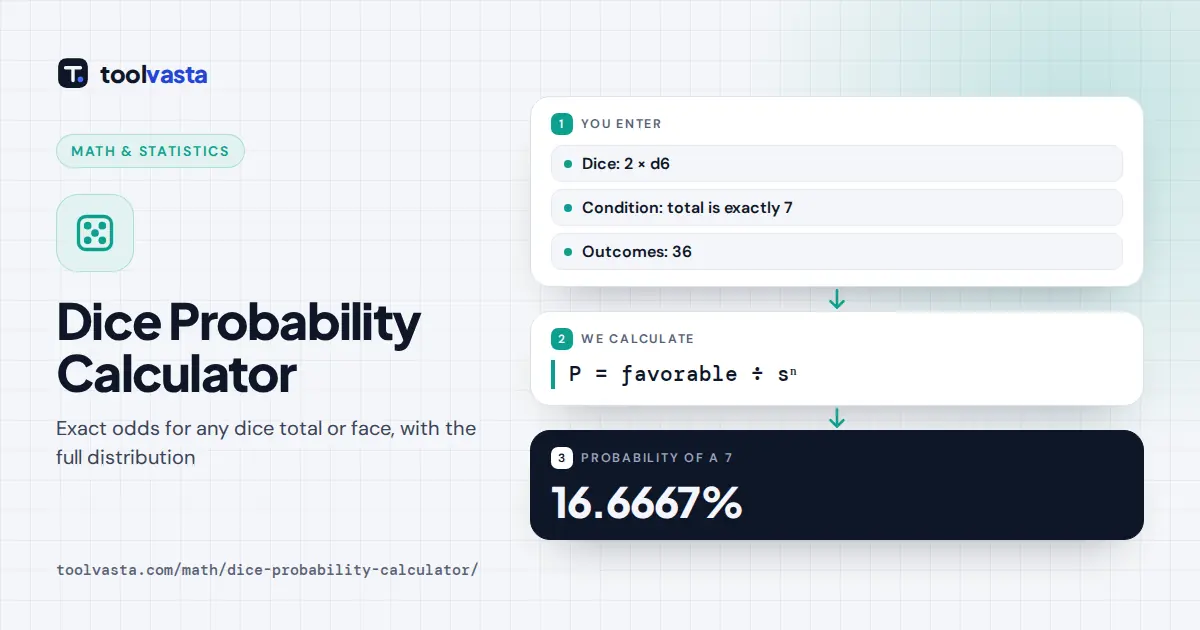
- Two six-sided dice, total of 7: six of the 36 results give 7 (1+6, 2+5, 3+4, 4+3, 5+2, 6+1), so P = 6/36 = 1/6 ≈ 16.6667%. Seven is the most likely total.
- Three dice, at least 15: totals 15, 16, 17 and 18 can be made in 10, 6, 3 and 1 ways, so P = 20/216 = 5/54 ≈ 9.2593%.
- At least one six with four dice: P = 1 − (5/6)⁴ = 671/1296 ≈ 51.7747%, slightly better than even.
- One d20, 15 or higher: six faces (15 to 20) out of 20, so P = 3/10 = 30%.
Two Dice Totals
| Total | Ways | Probability |
|---|---|---|
| 2 or 12 | 1 | 2.78% |
| 3 or 11 | 2 | 5.56% |
| 4 or 10 | 3 | 8.33% |
| 5 or 9 | 4 | 11.11% |
| 6 or 8 | 5 | 13.89% |
| 7 | 6 | 16.67% |
The pattern rises and falls in a triangle for two dice. With more dice the shape becomes a smooth bell curve centered on the average total, n(s + 1) ÷ 2.
Probability and Odds
A probability of 1/6 is the same as “1 in 6”. Gamblers often quote odds against instead, which compare failures to successes: 1/6 is 5 to 1 against. The calculator shows the “1 in X” form because it is the easiest to compare. Remember that each roll is independent: a total that has not appeared for a while is no more likely on the next roll.
Using the Odds in Games
Knowing the distribution helps with real decisions. In board games that use two dice, sixes and eights come up five times in 36 rolls, while twos and twelves come up only once, so spaces or resources tied to middle totals pay out far more often. In tabletop role-playing games, comparing 1d12 with 2d6 shows that both average about 6.5 to 7, but 2d6 is much more consistent.
Assumptions and Limits
- Dice are assumed to be fair, with every face equally likely, and all dice in a roll have the same number of sides.
- Faces are numbered 1 to s. Special dice, rerolls, advantage and dropping the lowest die are not modeled.
- Up to 100 dice with up to 100 sides are supported. The full table is listed when there are 400 totals or fewer.
Frequently asked questions
What is the probability of rolling a 7 with two dice?
Six of the 36 equally likely results add up to 7, so the probability is 6/36 = 1/6, about 16.67%. Seven is the most likely total with two six-sided dice.
How do you calculate dice probability?
Divide the number of favorable outcomes by the total number of outcomes. With n dice of s sides there are s to the power n outcomes, and the calculator counts the favorable ones exactly.
What are the odds of rolling at least one six?
With n dice the probability is 1 minus (5/6) to the power n. That is 16.67% for one die, 30.56% for two, 42.13% for three and 51.77% for four dice.
Why are middle totals more likely with several dice?
There are more combinations that produce middle totals. Only one result gives the lowest total, but many combinations add up to values near the average, so the distribution forms a bell shape.
Does this work for D&D dice like d20 and d12?
Yes. Choose any number of sides from 2 to 100, including d4, d8, d10, d12, d20 and d100. Modifiers can be handled by subtracting them from the target total before entering it.
Are dice rolls independent?
Yes. With fair dice each roll is unaffected by earlier rolls, so a total is never due. The probability of a 7 on two dice is 1/6 on every roll, whatever happened before.