How to Use the Momentum Calculator
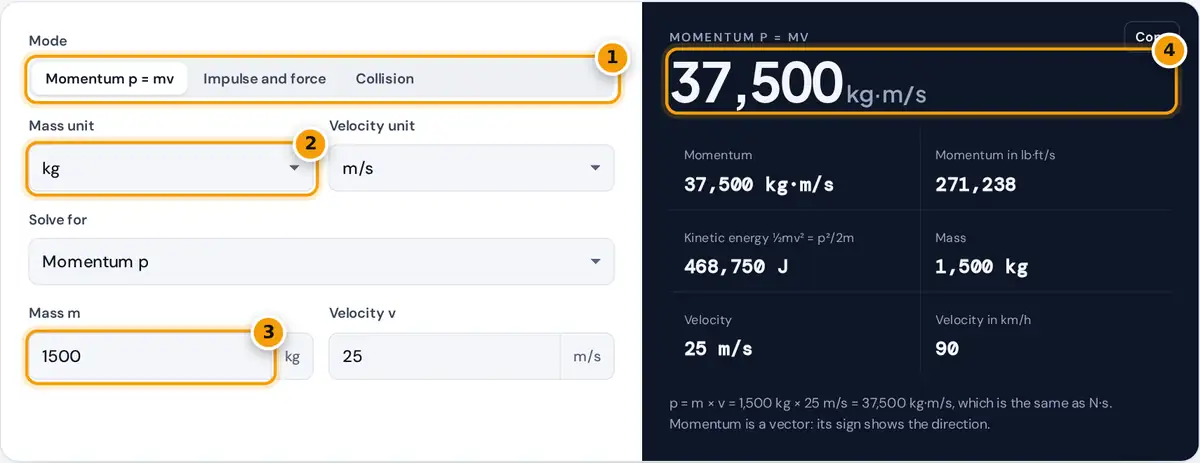
- Choose momentum, impulse and force, or a collision.
- Set the mass and velocity units you are working in.
- Enter the mass and velocity, or switch Solve for to find one of them.
- Read the momentum with kinetic energy and unit conversions.
Choose a mode. Momentum p = mv finds momentum from mass and velocity, or solves for the mass or the velocity when you know the momentum. Impulse and force finds the change in momentum when an object speeds up, slows down or bounces, and the average force if you enter the contact time. Collision gives the velocities after two objects collide head-on.
Set the mass and velocity units first: kilograms, grams, metric tons or pounds, and meters per second, kilometers per hour, miles per hour or feet per second. Results are given in SI units, kg·m/s and newton-seconds, with pound-foot per second equivalents. Use a minus sign for motion in the opposite direction.
Each mode shows its working under the result, with every value converted to SI units first. The kinetic energy is also listed, because momentum and energy problems usually appear together, and comparing the two shows how much energy a collision removes even though momentum is conserved.
Momentum and Impulse Formulas
Impulse: J = Δp = m(v₂ − v₁) = F̅ × Δt
Kinetic energy: KE = ½mv² = p² ÷ (2m)
Momentum is mass in motion. It is a vector, so direction matters: a ball moving left has negative momentum if right is positive. The units kg·m/s and N·s are identical. Impulse equals the change in momentum, which is why airbags and crumple zones reduce force: they stretch the same change in momentum over a longer time.
Worked Examples
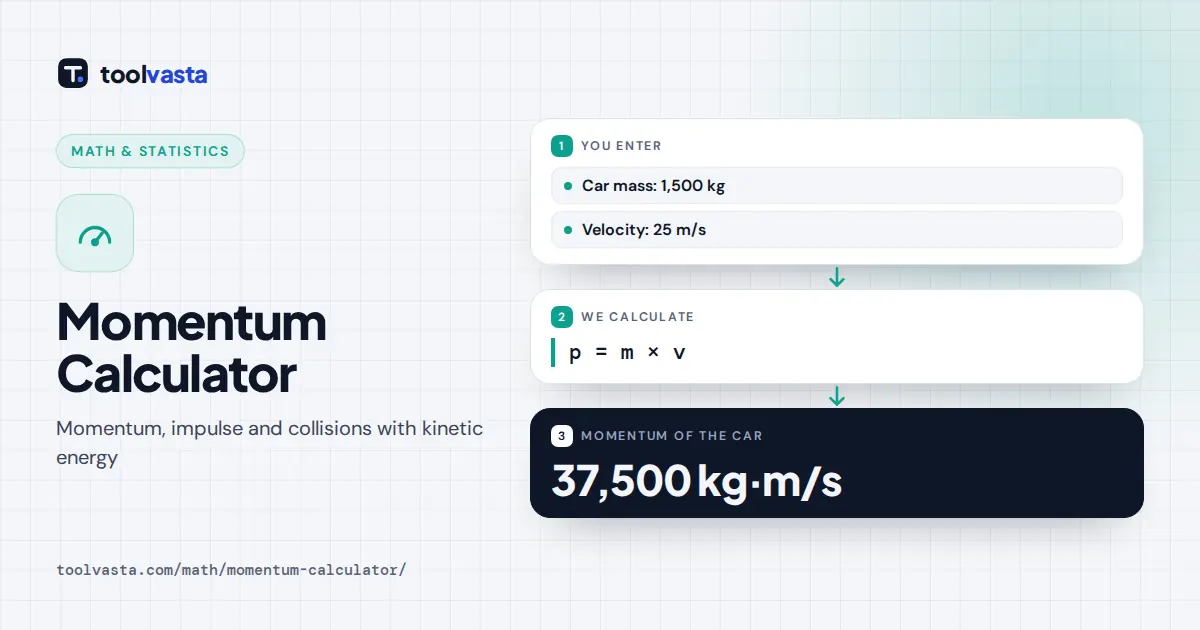
- Car: a 1,500 kg car at 25 m/s (90 km/h) has p = 1,500 × 25 = 37,500 kg·m/s and kinetic energy ½ × 1,500 × 25² = 468,750 J.
- Baseball hit: a 0.145 kg ball arrives at 40 m/s and leaves at 50 m/s in the opposite direction. Taking the outgoing direction as positive, J = 0.145 × (50 − (−40)) = 13.05 N·s. If the bat touches the ball for 0.001 s, the average force is 13,050 N.
- Elastic collision: a 2 kg cart at 3 m/s meets a 1 kg cart at −1 m/s. Total momentum is 2 × 3 + 1 × (−1) = 5 kg·m/s. Afterward the carts move at 0.3333 m/s and 4.3333 m/s, and the 9.5 J of kinetic energy is unchanged.
- Inelastic collision: if the same carts stick together, they move at 5 ÷ 3 = 1.6667 m/s. Kinetic energy falls to 4.1667 J, so 5.3333 J (56.14 percent) turns into heat, sound and deformation.
Comparing Momentum
Momentum depends on both mass and speed, so a slow heavy object can carry more momentum than a fast light one. A 10,000 kg truck at 10 m/s has 100,000 kg·m/s, while a 1,000 kg car at 100 km/h (27.78 m/s) has only 27,778 kg·m/s. Stopping the truck in the same time takes about 3.6 times the force. In imperial units, 1 lb·ft/s equals 0.138255 kg·m/s.
Types of Collisions
v₂′ = (m₁u₁ + m₂u₂ + m₁e(u₁ − u₂)) ÷ (m₁ + m₂)
| Collision | Coefficient e | Momentum | Kinetic energy |
|---|---|---|---|
| Elastic | 1 | Conserved | Conserved |
| Partly elastic | Between 0 and 1 | Conserved | Partly lost |
| Perfectly inelastic | 0 | Conserved | Largest possible loss |
The coefficient of restitution e is the ratio of the speed of separation to the speed of approach. Billiard balls are close to 1, a tennis ball on a hard court is roughly 0.7 to 0.8, and objects that stick together have e = 0. With e = 0.5, the carts above end at 1 m/s and 3 m/s, losing 4 J.
Tips and Limits
- The collision mode is one-dimensional: both objects move along the same straight line. Glancing collisions in two dimensions need vector components.
- Momentum is conserved only when no outside force, such as friction or a push, acts during the collision.
- Average force assumes the force acts over the whole contact time. The peak force is usually higher.
- All calculations are classical. At speeds near the speed of light, relativistic momentum applies.
Frequently asked questions
What is the formula for momentum?
Momentum equals mass times velocity, p = mv. With mass in kilograms and velocity in meters per second, momentum is in kg·m/s, which is the same unit as newton-seconds.
How do you calculate impulse?
Impulse is the change in momentum, J = m(v₂ − v₁). It also equals the average force multiplied by the time it acts, so dividing the impulse by the contact time gives the average force.
Is momentum conserved in a collision?
Yes, total momentum is conserved in every collision as long as no external force acts. Kinetic energy is conserved only in elastic collisions; in inelastic collisions some is converted to heat and deformation.
What is the difference between elastic and inelastic collisions?
In an elastic collision, kinetic energy is conserved and the objects bounce apart. In a perfectly inelastic collision they stick together and the largest possible amount of kinetic energy is lost.
Can momentum be negative?
Yes. Momentum is a vector, so its sign shows direction. If you choose right as positive, an object moving left has negative velocity and negative momentum, with the same magnitude rules.
How are momentum and kinetic energy related?
Kinetic energy equals momentum squared divided by twice the mass, KE = p² ÷ 2m. Two objects with equal momentum have different kinetic energies if their masses differ: the lighter one has more.