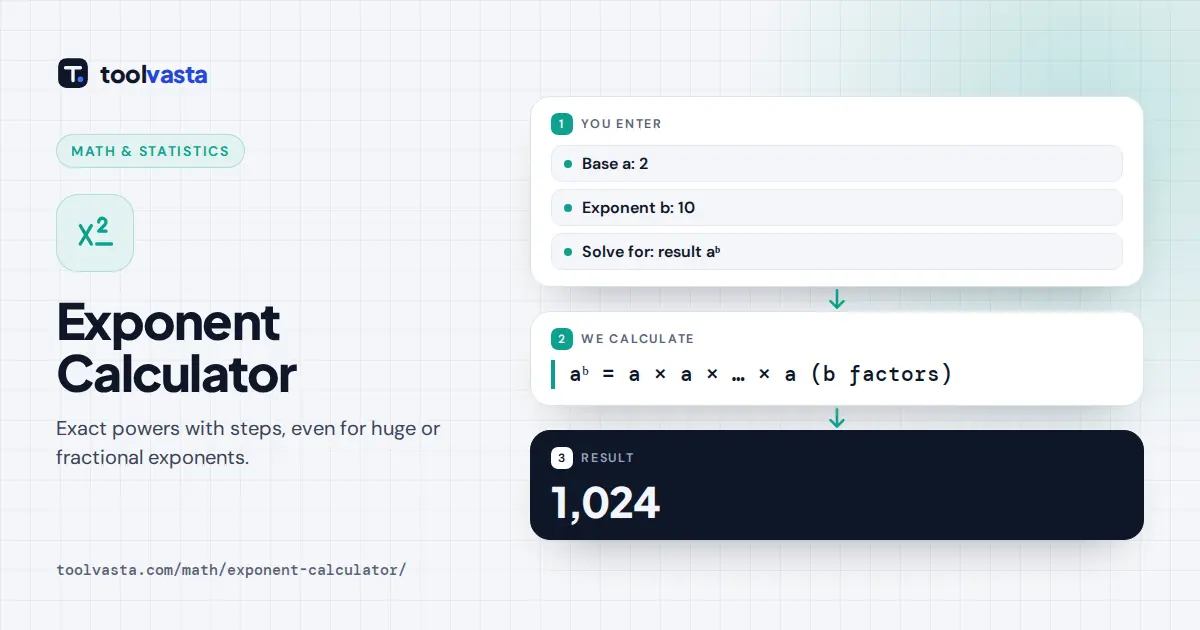
How to use the exponent calculator
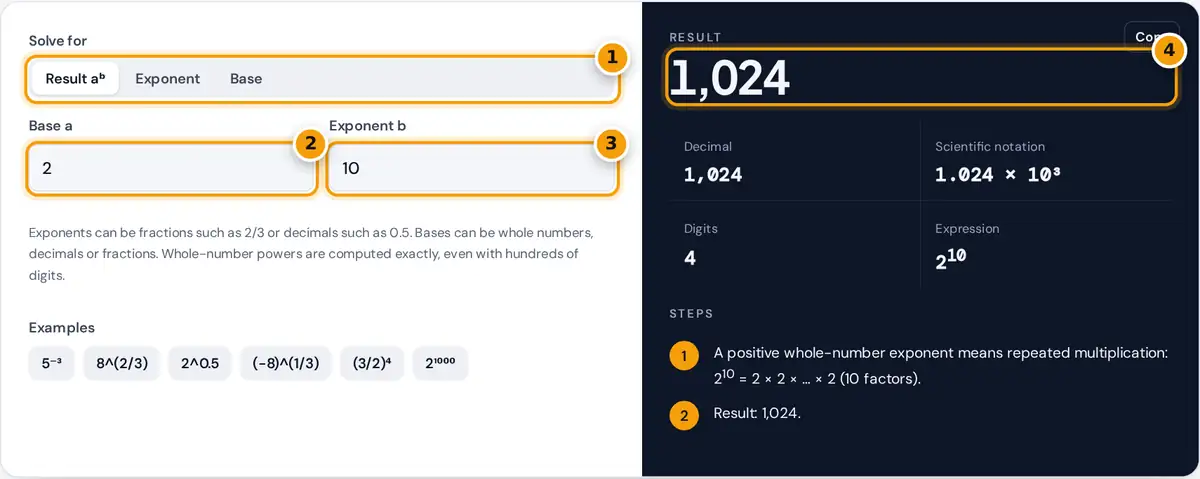
- Choose what to solve for: the result, the exponent or the base.
- Enter the base. Whole numbers, decimals and fractions all work.
- Enter the exponent, such as 10, -3, 0.5 or 2/3.
- Read the exact result, with decimal, scientific notation and steps below.
Enter a base and an exponent to calculate ab. The exponent can be a whole number, a negative number, a fraction such as 2/3 or a decimal such as 0.5, and the base can be a whole number, decimal or fraction. Whole-number powers are computed exactly with big-integer arithmetic, so 21000 gives all 302 digits. Fractional powers give an exact answer when the root is exact, such as 82/3 = 4, and a 15-digit decimal otherwise.
Use Exponent mode to solve ax = c for x, and Base mode to solve xb = c for x. The steps explain which rule is used at each stage.
Exponent rules
a−n = 1 / an a0 = 1 (a ≠ 0)
ap/q = (q√a)p
If ax = c, then x = loga c = ln c ÷ ln a
Worked examples
- Negative exponent: 5−3 = 1/53 = 1/125 = 0.008.
- Fractional exponent: 82/3 = (∛8)2 = 22 = 4.
- Negative base, odd root: (−8)1/3 = −2, because (−2)3 = −8.
- Irrational result: 20.5 = √2 ≈ 1.41421356237.
- Solve for the exponent: 7x = 2401 gives x = ln 2401 ÷ ln 7 = 4.
Powers of 2 and 10
| n | 2n | 10n |
|---|---|---|
| −2 | 0.25 | 0.01 |
| 0 | 1 | 1 |
| 8 | 256 | 100,000,000 |
| 10 | 1,024 | 10,000,000,000 |
| 16 | 65,536 | 1016 |
| 32 | 4,294,967,296 | 1032 |
Negative bases
A negative base with a whole-number exponent is fine: the result is positive for even exponents and negative for odd ones, so (−3)4 = 81 and (−3)3 = −27. With a fractional exponent, the denominator decides. An odd root of a negative number is real, but an even root is not, so (−4)1/2 has no real value. In that case the calculator shows the principal complex value instead, 2i. Note that −32 without brackets means −(32) = −9.
Exponents in everyday math
Exponents describe repeated growth and decay. Money growing at 5% a year for 10 years is multiplied by 1.0510 ≈ 1.629, a bacteria colony doubling 12 times grows by 212 = 4,096, and scientific notation such as 6.02 × 10²³ is simply a number times a power of 10.
Notes
Exact powers are calculated up to roughly 30,000 digits. Beyond that, the result is given in scientific notation using logarithms, which is accurate to about 10 significant digits. 00 is taken as 1 by convention, and 0 raised to a negative power is undefined. Bases e and pi are accepted for decimal results.
Frequently asked questions
What does a negative exponent mean?
It means the reciprocal of the positive power: a−n = 1/an. For example, 2−3 = 1/8 = 0.125.
How do you calculate a fractional exponent?
The denominator is a root and the numerator is a power: ap/q = (q-th root of a)p. So 272/3 = (∛27)2 = 32 = 9.
What is any number to the power of 0?
Any nonzero number to the power 0 equals 1, because an ÷ an = a0 = 1.
How do I solve for an exponent?
Take logarithms: if ax = c, then x = ln c ÷ ln a. For 2x = 32, x = ln 32 ÷ ln 2 = 5.
Is −3 squared 9 or −9?
(−3)2 = 9, but −32 written without brackets means −(32) = −9. In this calculator, a negative base is always treated as if it were in brackets.