How to Use the Series Calculator
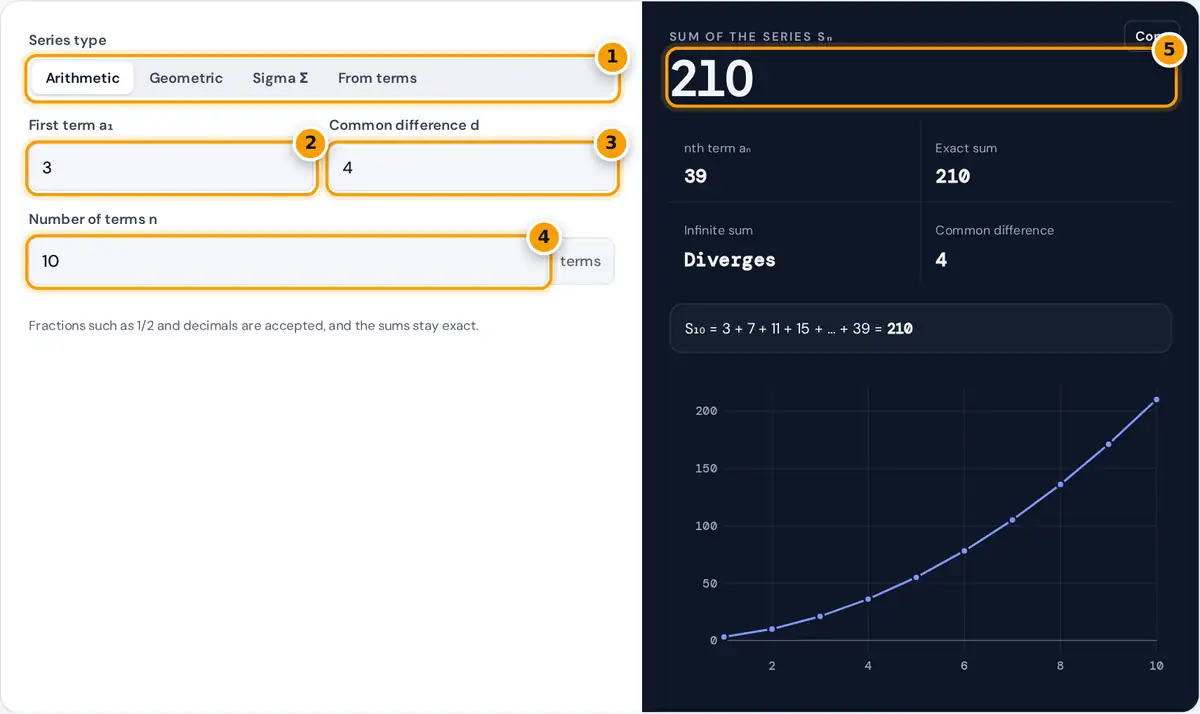
- Choose arithmetic, geometric, sigma notation, or paste the first terms of a sequence.
- Enter the first term. Fractions such as 1/2 stay exact.
- Enter the common difference, or the common ratio for a geometric series.
- Set the number of terms to add.
- Read the sum, the nth term and the infinite sum, with steps and a partial sums table.
Pick the type of series. Arithmetic needs the first term a₁, the common difference d and the number of terms n. Geometric needs the first term, the common ratio r and n. Sigma evaluates any sum written in sigma notation: type the kth term, such as k^2 or 1/(k(k+1)), and the lower and upper values of k. From terms lets you paste the start of a sequence, such as 2, 6, 18, 54, and detects whether it is arithmetic, geometric or quadratic.
The result panel shows the sum, the nth term and, for a geometric series, whether the infinite series converges and to what value. A chart plots the partial sums, and the panel below lists every formula with your numbers substituted, followed by a table of terms and running totals. Fractions are kept exact, so 1/2 + 1/4 + 1/8 is 7/8 rather than 0.875 rounded.
Series Formulas
Geometric: an = a₁rn−1 Sn = a₁(1 − rn) ÷ (1 − r), r ≠ 1
Infinite geometric: S∞ = a₁ ÷ (1 − r), only when |r| < 1
The arithmetic formula pairs the first and last terms, the second and second-to-last, and so on. Each pair has the same total, and there are n ÷ 2 pairs. The geometric formula comes from subtracting rSn from Sn, which cancels every term except the first and the one after the last.
Worked Examples
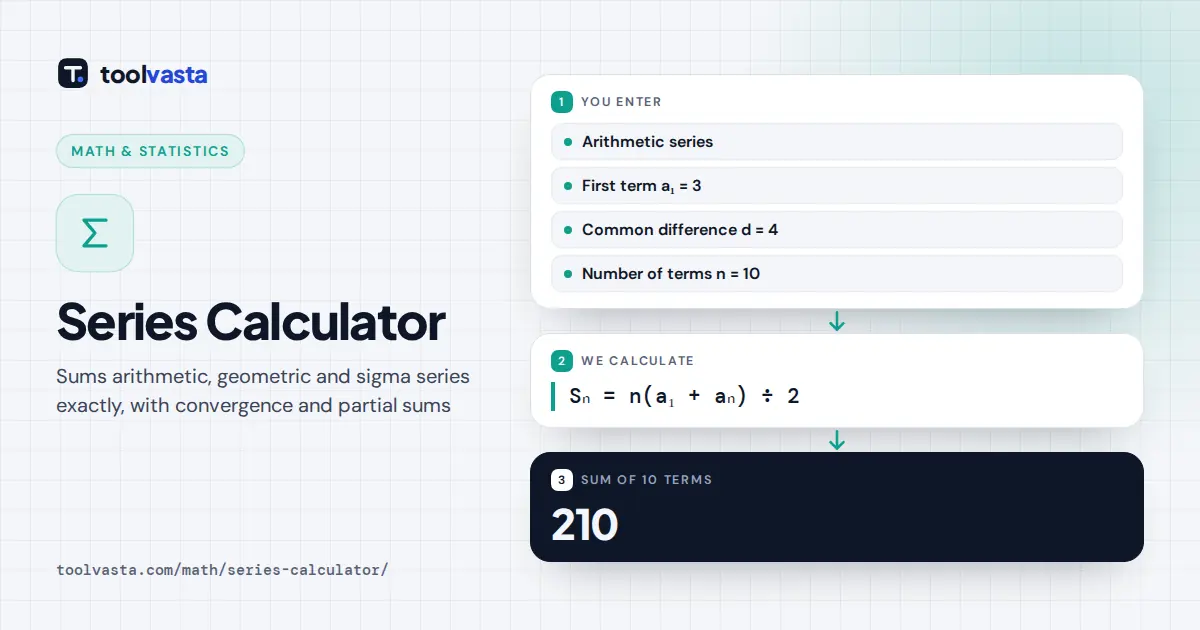
- Arithmetic: a₁ = 3, d = 4, n = 10. The 10th term is 3 + 9 × 4 = 39, and the sum is 10 × (3 + 39) ÷ 2 = 210.
- Geometric: a₁ = 2, r = 1/2, n = 10. The 10th term is 2 × (1/2)9 = 1/256, and S₁₀ = 2(1 − 1/1024) ÷ (1/2) = 1023/256 ≈ 3.996. Because |r| < 1, the infinite sum is 2 ÷ (1 − 1/2) = 4.
- Sigma: Σ k² from k = 1 to 10 = 1 + 4 + 9 + … + 100 = 385. The closed form n(n + 1)(2n + 1) ÷ 6 gives the same value, 10 × 11 × 21 ÷ 6 = 385.
When Does an Infinite Series Converge?
An infinite series converges when its partial sums settle on a finite value. For a geometric series the test is simple: it converges exactly when the ratio satisfies |r| < 1, and the limit is a₁ ÷ (1 − r). For r = −1 the partial sums jump back and forth, and for |r| > 1 they grow without bound. An arithmetic series with d ≠ 0 always diverges, because its terms never shrink toward zero.
| Series | Ratio or difference | Infinite sum |
|---|---|---|
| 1 + 1/2 + 1/4 + … | r = 1/2 | 2 |
| 81 − 54 + 36 − … | r = −2/3 | 243/5 = 48.6 |
| 5 + 15 + 45 + … | r = 3 | Diverges |
| 3 + 7 + 11 + … | d = 4 | Diverges |
Sigma Notation and Closed Forms
Sigma notation writes a sum compactly: Σ from k = a to b of f(k) means f(a) + f(a + 1) + … + f(b). There are b − a + 1 terms. When f(k) is a polynomial, the calculator also finds a closed form for the sum up to n, for example Σ k² from 1 to n = n³/3 + n²/2 + n/6. Telescoping sums such as Σ 1/(k(k + 1)) are evaluated exactly too: from 1 to 20 the total is 20/21. Terms with sine, square roots or other irrational values are added in floating point with compensated summation and shown to 12 significant figures.
Tips and Limits
- Use k as the index in sigma mode. Write products with brackets, such as 1/(k(k+1)).
- Sums of up to 1,000,000 terms are supported. Exact fractions are used for up to 5,000 rational terms.
- Infinite sums are given for geometric series. For other infinite series, a large upper limit shows how the partial sums behave, but a numeric trend is not a proof of convergence.
- From terms needs at least three values. A quadratic pattern needs at least four.
Frequently asked questions
How do you find the sum of an arithmetic series?
Use S = n(a₁ + aₙ) ÷ 2, where aₙ = a₁ + (n − 1)d is the last term. For 3 + 7 + 11 with 10 terms, the last term is 39 and the sum is 210.
What is the formula for a geometric series?
For n terms, S = a₁(1 − rⁿ) ÷ (1 − r) when r is not 1. If |r| < 1, the infinite series converges to a₁ ÷ (1 − r). If r = 1, the sum is simply n × a₁.
How do I know if a geometric series converges?
Look at the common ratio r. The infinite series converges only when the absolute value of r is less than 1. For r = 1/2 starting at 2, the sum approaches 4.
What does sigma notation mean?
The Greek letter Σ means add up. Σ from k = 1 to 5 of k² means 1 + 4 + 9 + 16 + 25 = 55. The expression after Σ gives each term, and the limits give the range of k.
What is the difference between a sequence and a series?
A sequence is a list of numbers, such as 2, 4, 6, 8. A series is the sum of those numbers, 2 + 4 + 6 + 8 = 20. This calculator finds both the nth term and the sum.
Can the calculator find an infinite sum for any series?
It gives exact infinite sums for geometric series with |r| < 1. For other series it evaluates finite partial sums, which show the trend but do not prove convergence on their own.