How to Use the Uncertainty Calculator
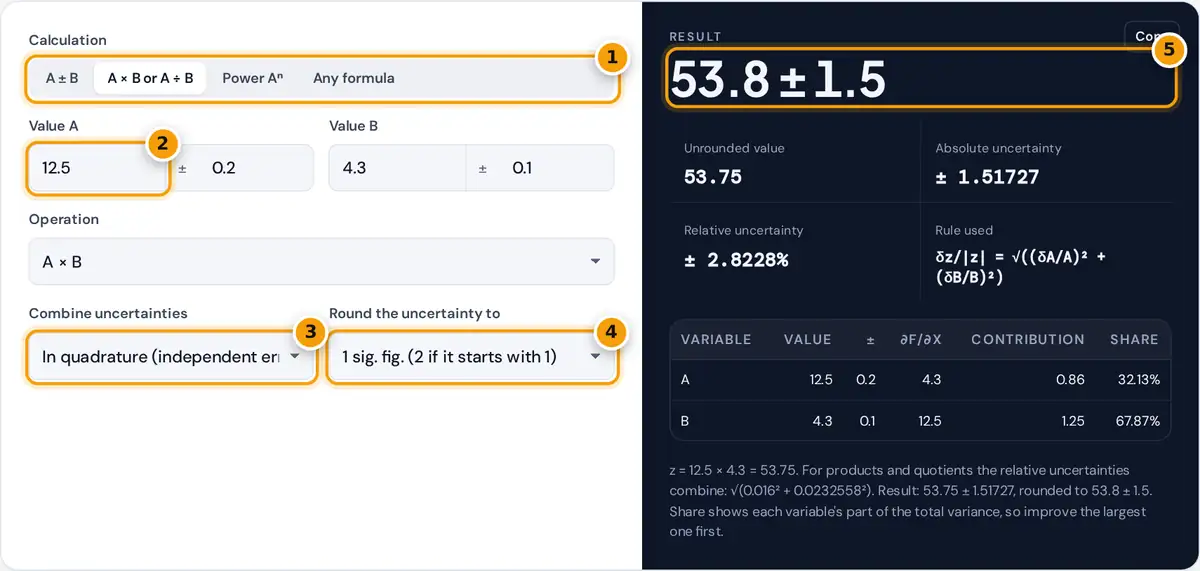
- Choose a sum, a product or quotient, a power, or any formula.
- Enter each value with its uncertainty after the ± sign.
- Combine in quadrature for independent errors, or use the worst case.
- Pick how to round: the usual lab rule, 1 or 2 significant figures.
- Read value ± uncertainty, the percent uncertainty and each variable's share.
Choose the kind of calculation. A ± B adds or subtracts two measurements, A × B or A ÷ B multiplies or divides them, and Power raises one measurement to an exponent. Enter each value with its uncertainty in the box after the ± sign.
For anything else, choose Any formula. Type the formula using the variable names you like, such as 4*pi^2*L/T^2 for g from a pendulum, then fill in each variable’s name, value and uncertainty. The calculator finds the partial derivatives numerically, so you do not have to.
The result is shown as value ± uncertainty, rounded by the usual lab rule, together with the unrounded numbers and the relative (percent) uncertainty. The table shows how much each variable contributes, which tells you which measurement to improve first.
Propagation Rules
Product or quotient, z = AB or A/B: δz/|z| = √((δA/A)² + (δB/B)²)
Power, z = Aⁿ: δz/|z| = |n| × δA/|A|
General, z = f(x, y, …): δz = √((∂f/∂x · δx)² + (∂f/∂y · δy)² + …)
These are first-order rules for independent, random uncertainties, as described in the NIST Technical Note 1297 guidelines on evaluating and expressing measurement uncertainty. Adding in quadrature reflects the fact that independent errors partly cancel. The worst case option adds the contributions directly, which gives an upper bound that some introductory courses use.
Worked Examples
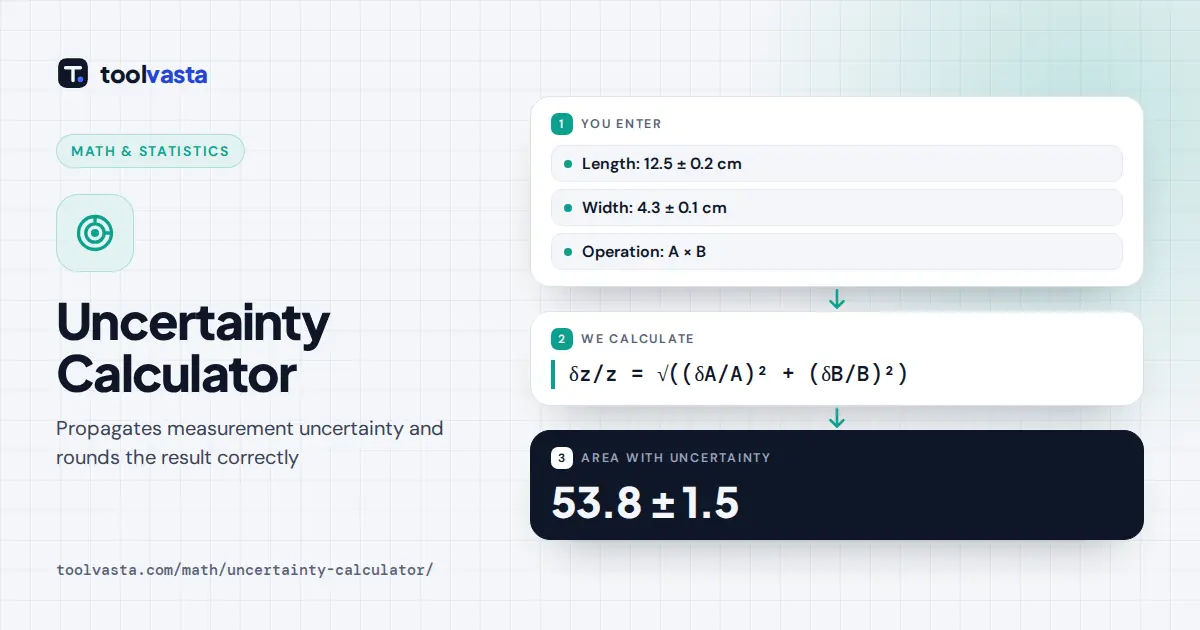
- Area of a rectangle: 12.5 ± 0.2 cm by 4.3 ± 0.1 cm. The area is 53.75 cm². The relative uncertainties are 0.016 and 0.023256, so the combined relative uncertainty is √(0.016² + 0.023256²) = 0.028228, or 2.82 percent. That is ±1.5173 cm², reported as 53.8 ± 1.5 cm².
- Sum: 12.5 ± 0.2 plus 4.3 ± 0.1 gives 16.8 ± √(0.04 + 0.01) = 16.8 ± 0.2236, reported as 16.8 ± 0.2.
- Power: a cube with side 2.0 ± 0.1 cm has volume 8.0 cm³, with relative uncertainty 3 × 0.05 = 15 percent, so V = 8.0 ± 1.2 cm³.
- Pendulum: g = 4π²L/T² with L = 0.750 ± 0.005 m and T = 1.74 ± 0.02 s gives g = 9.7796 m/s². The contributions are 0.0652 from L and 0.2248 from T, so δg = 0.2341 and g = 9.8 ± 0.2 m/s². Timing accounts for over 90 percent of the variance.
Absolute and Relative Uncertainty
Absolute uncertainty has the same units as the measurement, such as ±0.2 cm. Relative uncertainty divides it by the value, giving a pure number or percentage, such as 0.2 ÷ 12.5 = 1.6 percent. Sums and differences combine absolute uncertainties, while products, quotients and powers combine relative ones, which is why the quick rules look different.
Subtraction deserves care. Taking the difference of two similar values keeps the absolute uncertainty but shrinks the result, so the relative uncertainty can become very large. For example, 12.5 ± 0.2 minus 12.1 ± 0.2 is 0.4 ± 0.28, an uncertainty of 71 percent.
How to Round the Result
A common convention is to round the uncertainty to one significant figure, or to two if its first digit is 1, and then round the value to the same decimal place. That is the default here. So 53.75 ± 1.517 becomes 53.8 ± 1.5, and 16.8 ± 0.2236 becomes 16.8 ± 0.2. Choose two significant figures if your course or journal asks for it, and keep unrounded values for intermediate steps.
| Unrounded | Reported |
|---|---|
| 53.75 ± 1.5173 | 53.8 ± 1.5 |
| 2.90698 ± 0.08206 | 2.91 ± 0.08 |
| 9.7796 ± 0.2341 | 9.8 ± 0.2 |
Assumptions and Limits
- The rules assume the uncertainties are independent. Correlated errors, such as two readings from the same miscalibrated meter, need a covariance term.
- The method is a linear approximation. It is accurate when each uncertainty is small compared with its value. For large relative uncertainties or strongly curved functions, consider a Monte Carlo simulation.
- Relative uncertainty is undefined when the result is zero.
- Trigonometric functions use radians. Use sind, cosd and tand for angles in degrees.
Frequently asked questions
How do you propagate uncertainty when multiplying?
Add the relative uncertainties in quadrature: δz/|z| = √((δA/A)² + (δB/B)²). Multiply the result by |z| to get the absolute uncertainty. Division uses exactly the same rule.
How do you add uncertainties for a sum?
For a sum or a difference, combine the absolute uncertainties in quadrature: δz = √(δA² + δB²). The worst case rule, δA + δB, gives a larger and more cautious estimate.
What is relative or percent uncertainty?
Relative uncertainty is the absolute uncertainty divided by the value. Multiply by 100 for percent uncertainty. It lets you compare the precision of measurements with different units or sizes.
How does uncertainty change with a power?
For z = Aⁿ, the relative uncertainty is multiplied by the exponent: δz/|z| = |n| × δA/|A|. Squaring a length doubles its percent uncertainty, and a square root halves it.
How do I propagate uncertainty through any formula?
Take the partial derivative of the formula with respect to each variable, multiply it by that variable's uncertainty, and combine the results in quadrature. Choose Any formula and the calculator does this numerically.
How many significant figures should the uncertainty have?
Usually one, or two when the first digit is 1. Then round the measured value to the same decimal place as the uncertainty, for example 53.8 ± 1.5 rather than 53.75 ± 1.5173.