How to Use the Right Triangle Calculator
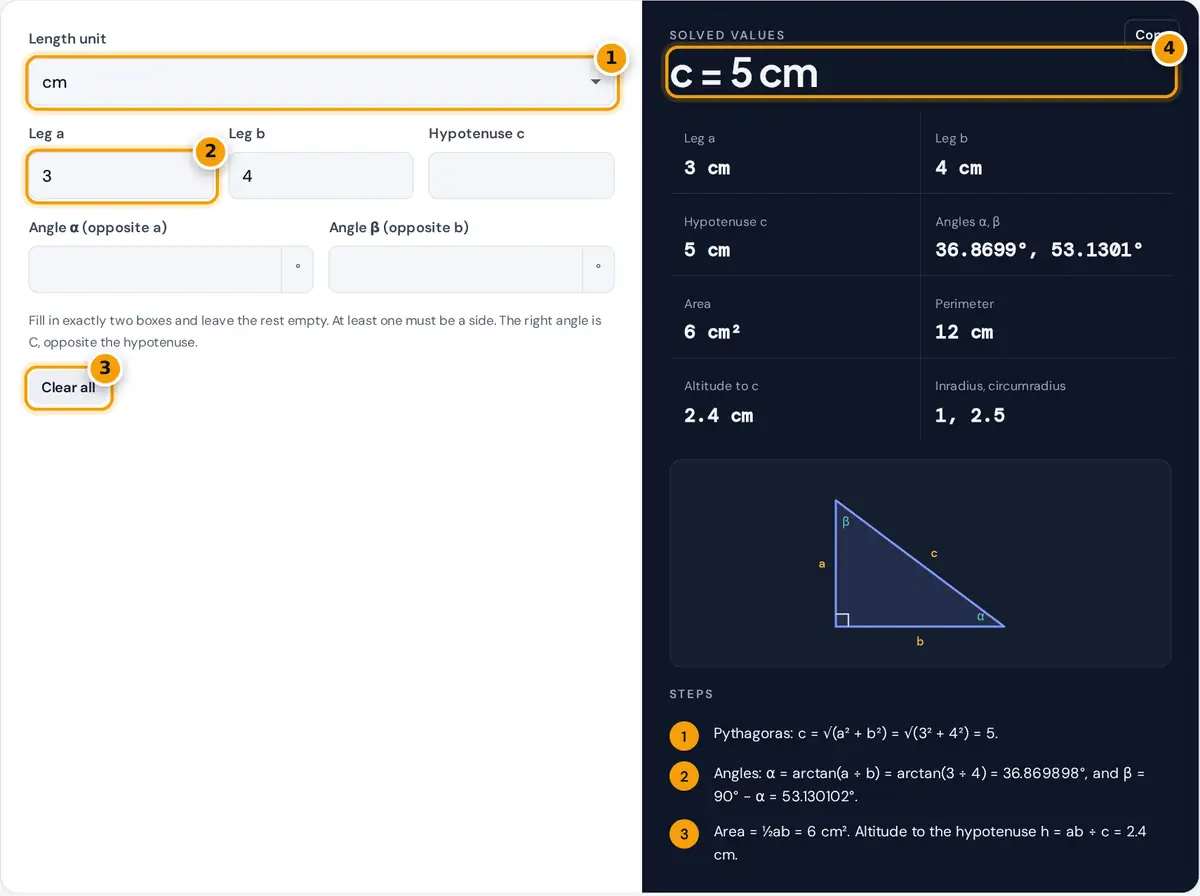
- Pick the length unit.
- Fill in any two values: legs, hypotenuse or an acute angle.
- Clear all boxes to start a new triangle.
- Read the solved sides, then angles, area and the steps.
Fill in exactly two of the five boxes and leave the other three empty. You can enter both legs, one leg and the hypotenuse, or any side together with one of the acute angles. Leg a is opposite angle α, leg b is opposite angle β, and the hypotenuse c is the longest side, opposite the right angle.
The calculator immediately solves the triangle. It shows every side and angle, the area and perimeter, the altitude from the right angle to the hypotenuse, and the radii of the inscribed and circumscribed circles. The steps explain which rule was used, Pythagoras or one of the SOH CAH TOA ratios, and the sketch is drawn to scale.
Right Triangle Formulas
sin α = a/c cos α = b/c tan α = a/b α + β = 90°
Area = ½ab Altitude to c: h = ab/c
Inradius r = (a + b − c)/2 Circumradius R = c/2
SOH CAH TOA is a memory aid: Sine is Opposite over Hypotenuse, Cosine is Adjacent over Hypotenuse, and Tangent is Opposite over Adjacent. For angle α, the opposite side is a and the adjacent side is b.
Worked Examples
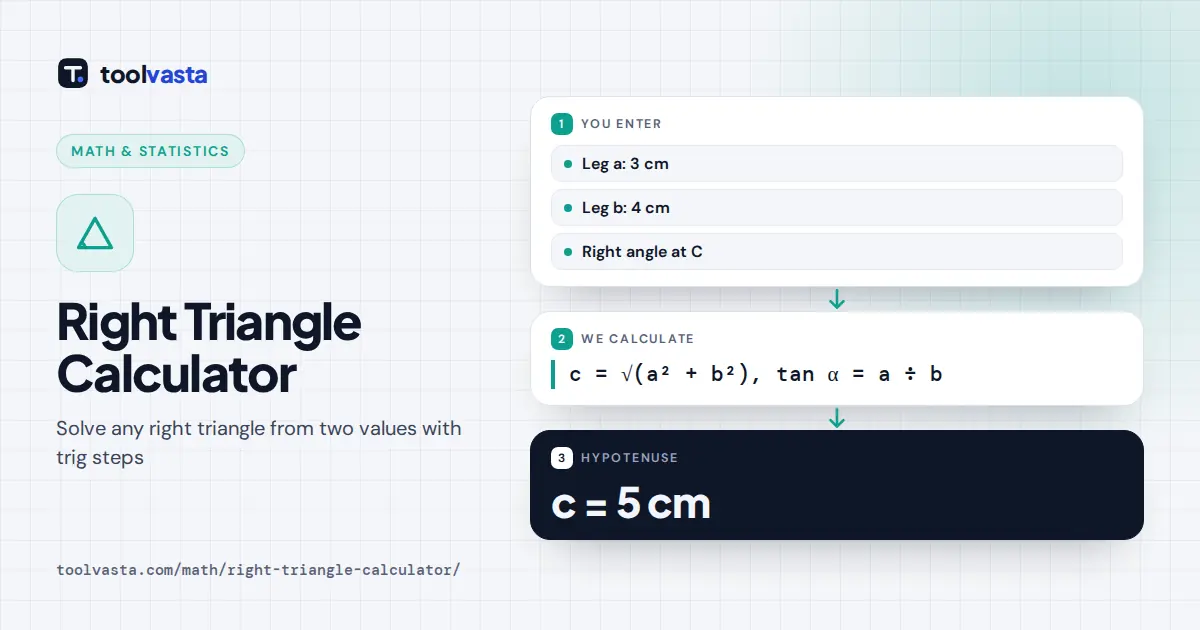
- Two legs: a = 3 and b = 4 give c = √(9 + 16) = 5. Then α = arctan(3/4) = 36.8699° and β = 53.1301°. The area is 6, the perimeter 12, the altitude 12/5 = 2.4, the inradius 1 and the circumradius 2.5.
- Hypotenuse and leg: c = 13 and a = 5 give b = √(169 − 25) = 12.
- Side and angle: a ladder 6 m long (c) leaning at 75° to the ground reaches a height of 6 × sin 75° = 5.79555 m, with its foot 6 × cos 75° = 1.55291 m from the wall. Here the 75° angle is opposite the height, so it is α.
Always check that your answer is sensible: the hypotenuse must be the longest side, and the larger angle is always opposite the longer leg.
Pythagorean Triples
| a | b | c | Smaller angle |
|---|---|---|---|
| 3 | 4 | 5 | 36.87° |
| 5 | 12 | 13 | 22.62° |
| 8 | 15 | 17 | 28.07° |
| 7 | 24 | 25 | 16.26° |
| 20 | 21 | 29 | 43.60° |
Any multiple of a triple is also a triple, so 6, 8, 10 and 30, 40, 50 are right triangles too. Builders use the 3-4-5 rule to check that a corner is square: mark 3 units along one side and 4 along the other, and the diagonal should measure exactly 5.
Special Right Triangles
In a 45-45-90 triangle the legs are equal and the hypotenuse is leg × √2. In a 30-60-90 triangle the sides are in the ratio 1 : √3 : 2, with the shortest side opposite the 30° angle. Try them here: enter a = 1 and α = 45, or c = 2 and α = 30.
Real-World Uses
Right triangles turn up wherever something is level and something is vertical. A carpenter finds the length of a rafter from the rise and run of a roof. A surveyor finds the height of a building from the distance to its base and the angle of elevation to the top. A ladder against a wall, a wheelchair ramp, the diagonal of a TV screen and the shortest path across a rectangular field are all right triangles. In each case you know two values, which is exactly what this calculator needs. For a screen with a 16:9 shape and a 55 in diagonal, for example, the width is about 47.9 in and the height about 27.0 in.
Tips and Limits
- Two angles alone are not enough, because similar triangles of every size share the same angles.
- The hypotenuse must be longer than each leg, and each acute angle must be below 90°.
- Angles are in degrees. Results are rounded for display, but the copy button includes more digits.
- For triangles without a right angle, use a general triangle solver with the laws of sines and cosines.
Frequently asked questions
How do you solve a right triangle?
You need two values, with at least one side. Use Pythagoras when you know two sides, and sine, cosine or tangent when you know a side and an angle. The two acute angles always add up to 90 degrees.
How do I find the hypotenuse?
Square both legs, add them and take the square root: c = √(a² + b²). For legs 3 and 4, c = √25 = 5. The hypotenuse is always the longest side.
How do I find a missing leg?
Subtract the square of the known leg from the square of the hypotenuse and take the square root: b = √(c² − a²). For c = 13 and a = 5, b = 12.
What does SOH CAH TOA mean?
It is a memory aid for the trig ratios: sine is opposite over hypotenuse, cosine is adjacent over hypotenuse, and tangent is opposite over adjacent, all measured from the chosen angle.
How do I find an angle from two sides?
Use an inverse trig function. With both legs, α = arctan(a ÷ b). With a leg and the hypotenuse, α = arcsin(a ÷ c). Then the other angle is 90 degrees minus α.
Why can't I solve it with two angles?
Two angles fix the shape but not the size. Triangles with angles of 30, 60 and 90 degrees can be any size, so you need at least one side length to get actual measurements.