How to Use the Cone Volume Calculator
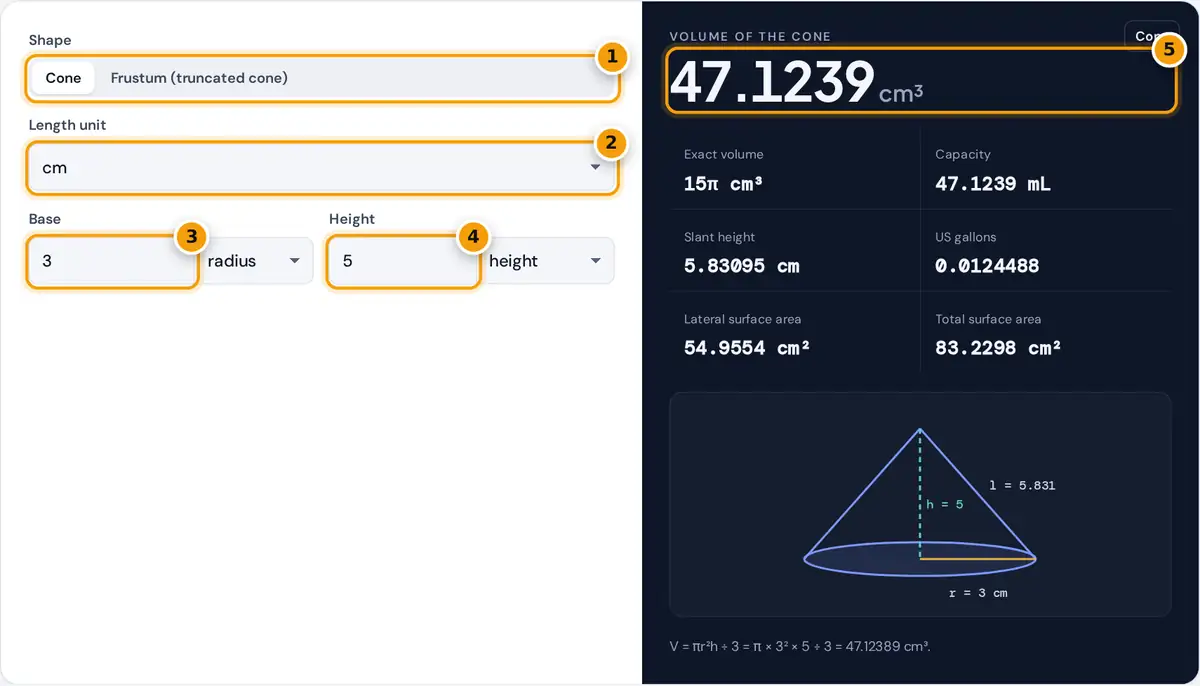
- Choose a cone or a frustum (truncated cone).
- Pick the length unit.
- Enter the radius, or switch the menu to diameter.
- Enter the height, or switch to slant height.
- Read the volume, the π form, the capacity and the surface areas.
Choose Cone or Frustum, pick a length unit and enter the base size. The menu next to the base lets you type either the radius or the diameter, so there is no need to halve a measurement yourself. For the height, choose the vertical height or the slant height measured along the side. The volume appears at once in cubic units, together with the exact answer as a multiple of π.
The result panel also gives the capacity in liters or milliliters and in US gallons, the slant height (or the vertical height if you entered the slant), the lateral surface area and the total surface area. A labeled sketch shows which measurement is which.
Cone Volume Formula
Lateral area = πrl Total area = πrl + πr²
Frustum: V = (1/3)πh(R² + Rr + r²) l = √(h² + (R − r)²)
A cone holds exactly one third of the volume of a cylinder with the same base and height. That is why the formula is the cylinder volume, πr²h, divided by 3. A frustum is a cone with its tip cut off parallel to the base, with a bottom radius R and a top radius r.
Worked Examples
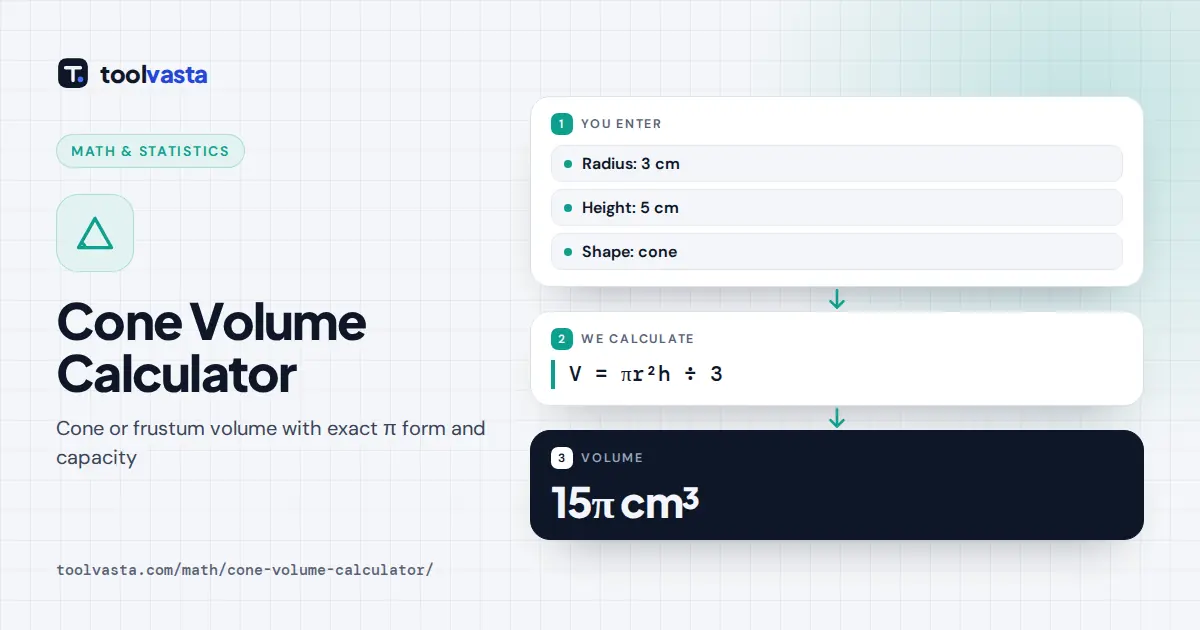
- Cone: radius 3 cm and height 5 cm. V = (1/3) × π × 3² × 5 = 15π ≈ 47.1239 cm³, or about 47.12 mL. The slant height is √(9 + 25) = 5.83095 cm, the lateral area is π × 3 × 5.83095 = 54.9554 cm², and the total surface area is 83.2298 cm².
- From the slant height: radius 2 in and slant height 5 in. The height is √(25 − 4) = 4.58258 in, so V = (1/3) × π × 4 × 4.58258 = 19.1954 in³.
- Frustum: bottom radius 4, top radius 2 and height 6 (any unit). V = (1/3) × π × 6 × (16 + 8 + 4) = 56π ≈ 175.929 cubic units.
Cone Volumes for Common Sizes
| Radius | Height | Volume (exact) | Volume |
|---|---|---|---|
| 1 cm | 3 cm | π cm³ | 3.1416 cm³ |
| 3 cm | 5 cm | 15π cm³ | 47.1239 cm³ |
| 5 cm | 12 cm | 100π cm³ | 314.159 cm³ |
| 1 m | 3 m | π m³ | 3,141.59 L |
Notice that doubling the radius multiplies the volume by four, while doubling the height only doubles it. The radius matters most, so measure it carefully.
Everyday Uses
Cone volume comes up when estimating a pile of sand, gravel or grain, which naturally forms a cone, and when working out the capacity of a funnel, a hopper or an ice cream cone. Frustum volume is useful for cups, flower pots, buckets and tapered lampshades. For a conical pile, measure around the base to get the circumference C, then use r = C ÷ (2π).
Surface Area of a Cone
The curved side of a cone unrolls into a sector of a circle whose radius is the slant height l. Its area is πrl, the lateral area. Add the circular base, πr², for the total surface area of a closed cone. For the example with r = 3 cm and l = 5.83095 cm, that gives 54.9554 + 28.2743 = 83.2298 cm². An open cone, such as a paper cup or a funnel, uses only the lateral area. For a frustum the lateral area is π(R + r)l, and a closed frustum adds both circles.
Tips and Limits
- The formulas assume a right circular cone, with the tip directly above the center of the base. An oblique cone has the same volume but a different surface area.
- All lengths must use the same unit. The answer is in that unit cubed, and 1 cm³ equals 1 mL.
- Gallons are US liquid gallons of 3.785411784 liters.
- When you enter a slant height, it must be longer than the radius (or the difference of the radii for a frustum).
Frequently asked questions
What is the formula for the volume of a cone?
V = (1/3)πr²h, where r is the radius of the base and h is the vertical height. It is one third of the volume of a cylinder with the same base and height.
How do I find the volume of a cone with the diameter?
Halve the diameter to get the radius, then use V = (1/3)πr²h. In the calculator, choose diameter from the menu next to the base and it does the conversion for you.
How do you find the volume from the slant height?
First find the vertical height with h = √(l² − r²), using the slant height l and the radius r. Then use V = (1/3)πr²h. The calculator does both steps automatically.
What is a frustum?
A frustum is a cone with the top cut off parallel to the base, like a cup or a bucket. Its volume is (1/3)πh(R² + Rr + r²), with bottom radius R and top radius r.
How do I convert cone volume to liters?
Work in centimeters and divide cubic centimeters by 1,000, because 1,000 cm³ is one liter. In meters, multiply cubic meters by 1,000. The calculator shows the capacity directly.
Why is a cone one third of a cylinder?
Slicing both shapes into thin discs shows that the cone's disc area grows with the square of the height. Adding those discs up, which is integration, gives exactly one third of the cylinder.