How to Use the Synthetic Division Calculator
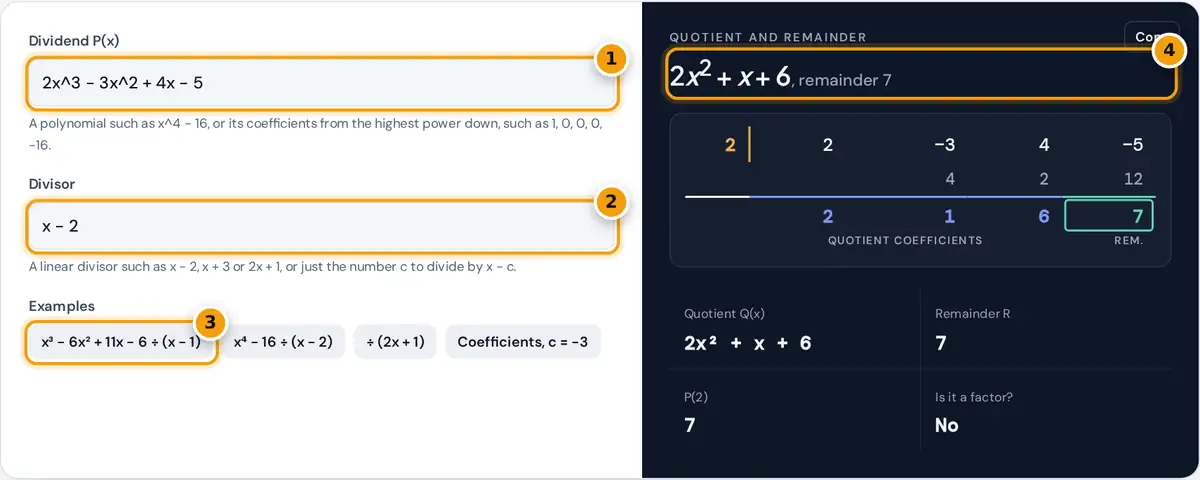
- Type the dividend as a polynomial or as coefficients from the highest power.
- Type the divisor, such as x - 2 or 2x + 1, or just the number c.
- Or load an example, including missing powers and a 2x + 1 divisor.
- Read the quotient and remainder, the tableau and whether the divisor is a factor.
Type the dividend as a polynomial, such as 2x^3 - 3x^2 + 4x - 5, or as a list of coefficients from the highest power down, such as 2, -3, 4, -5. Then type the divisor: x - 2, x + 3, 2x + 1, or simply the number c when you want to divide by x − c. Missing powers are filled in with 0 automatically, so x^4 - 16 works as typed.
The result panel shows the quotient and remainder, the complete synthetic division tableau, the value P(c) and whether the divisor is a factor. Below the tool, each bring-down, multiply and add step is written out, and the result is checked with the remainder theorem. All arithmetic is exact, so fractional values of c such as −1/2 give exact fractions.
How Synthetic Division Works
Synthetic division is a shortcut for dividing a polynomial by x − c. It works only with the coefficients, so there is far less writing than in long division.
- Write c in the corner box and the coefficients of P(x) in a row, including 0 for any missing power.
- Bring the first coefficient straight down to the bottom row.
- Multiply that number by c, write the product under the next coefficient, and add the column.
- Repeat the multiply and add steps to the end of the row.
- The last number is the remainder. The other bottom numbers are the coefficients of the quotient, which has degree one less than P(x).
Factor theorem: x − c is a factor of P(x) exactly when P(c) = 0
Worked Example
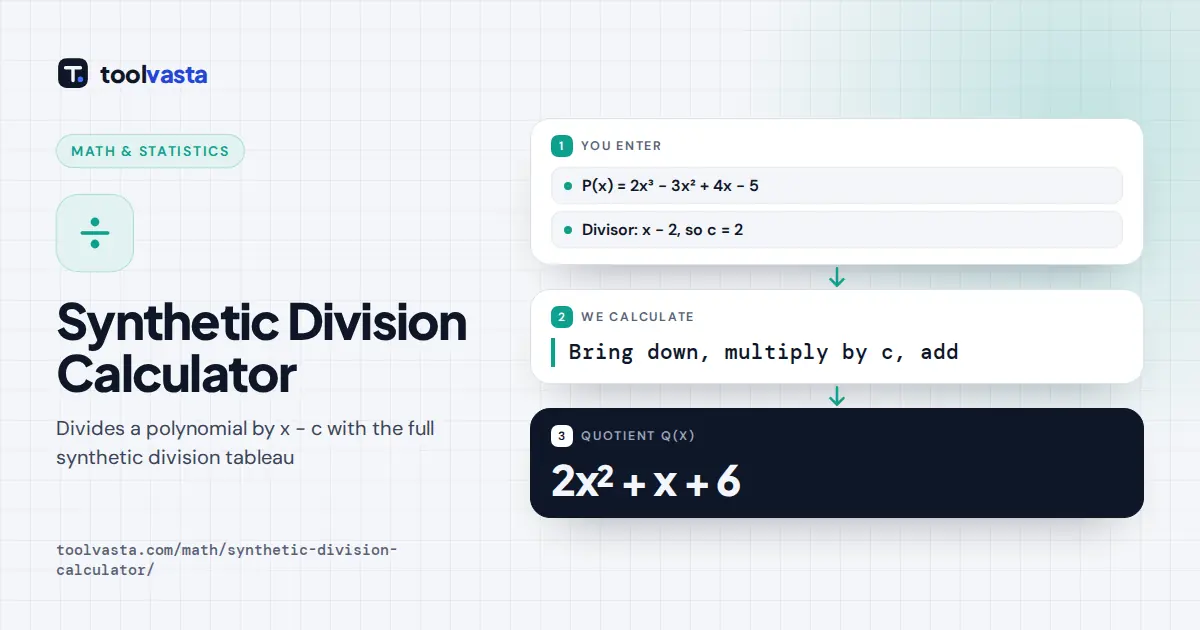
Divide 2x³ − 3x² + 4x − 5 by x − 2, so c = 2. Bring down 2. Multiply 2 × 2 = 4 and add to −3 to get 1. Multiply 1 × 2 = 2 and add to 4 to get 6. Multiply 6 × 2 = 12 and add to −5 to get 7.
| c = 2 | x³ | x² | x | constant |
|---|---|---|---|---|
| Coefficients | 2 | −3 | 4 | −5 |
| Products | 4 | 2 | 12 | |
| Sums | 2 | 1 | 6 | 7 |
The quotient is 2x² + x + 6 and the remainder is 7. Check with the remainder theorem: P(2) = 16 − 12 + 8 − 5 = 7.
When the Divisor Is 2x + 1
Synthetic division needs a divisor with leading coefficient 1. For a divisor such as 2x + 1, write it as 2(x + 1/2) and use c = −1/2. Run the tableau as usual, then divide every quotient coefficient by 2. The remainder stays the same. For example, (6x³ + 5x² − 2x + 1) ÷ (2x + 1) has tableau sums 6, 2, −3 and 5/2, so the quotient is 3x² + x − 3/2 and the remainder is 5/2.
What Synthetic Division Is Used For
- Testing roots: a remainder of 0 means c is a root and x − c is a factor. For x³ − 6x² + 11x − 6, dividing by x − 1 leaves x² − 5x + 6 = (x − 2)(x − 3).
- Evaluating polynomials: the remainder equals P(c), so the tableau is a fast way to evaluate a polynomial by hand. This is called synthetic substitution.
- Factoring step by step: after finding one root with the rational root test, divide it out and work on the smaller quotient.
Synthetic Division or Long Division?
Both methods give the same quotient and remainder. Long division works for any divisor, but it writes every power of x and every subtraction. Synthetic division keeps only the numbers, so dividing a degree 4 polynomial takes four quick multiply and add steps. Use synthetic division whenever the divisor is linear, and long division for divisors such as x² + 1.
Tips and Limits
- Always include a 0 for every missing power, or the columns will not line up.
- For divisors of degree 2 or more, such as x² + 1, use polynomial long division instead.
- Polynomials up to degree 30 with one variable are supported.
Frequently asked questions
How do you do synthetic division?
Write c from the divisor x − c and the coefficients of the polynomial. Bring down the first coefficient, then repeatedly multiply by c and add to the next coefficient. The last number is the remainder.
What if a power of x is missing?
Write 0 as its coefficient. For x⁴ − 16, use 1, 0, 0, 0, −16. Leaving the gap out shifts the columns and gives a wrong answer.
Can you use synthetic division with 2x + 1?
Yes. Use c = −1/2, the root of 2x + 1 = 0, then divide each quotient coefficient by 2. The remainder does not change.
What does a remainder of 0 mean?
It means the divisor x − c is a factor of the polynomial and c is a root, so P(x) = (x − c)Q(x) exactly. This is the factor theorem.
What is the remainder theorem?
When a polynomial P(x) is divided by x − c, the remainder equals P(c). So synthetic division is also a quick way to evaluate a polynomial at x = c.
When can synthetic division not be used?
When the divisor is not linear, such as x² − 3x + 1 or x³ + 2. Synthetic division only works for divisors of the form x − c or ax + b, so use polynomial long division instead.