How to Use the Radical Calculator
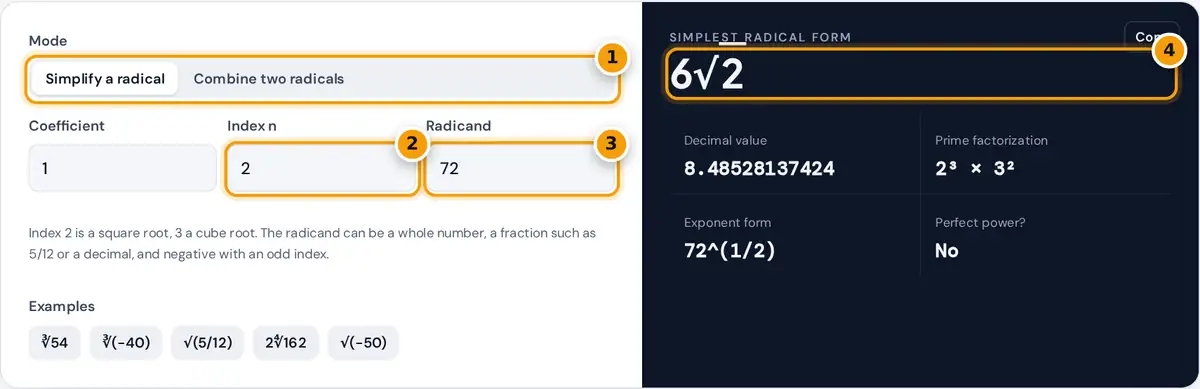
- Choose to simplify one radical or combine two with + − × ÷.
- Set the index: 2 for a square root, 3 for a cube root.
- Enter the radicand. Fractions and negative numbers with odd indexes work.
- Read the simplest radical form, the decimal and the prime factorization.
In Simplify a radical mode, enter the coefficient in front of the root (usually 1), the index n (2 for a square root, 3 for a cube root) and the number under the root, called the radicand. The answer appears in simplest radical form with its decimal value, the prime factorization of the radicand and the equivalent exponent form. The radicand can be a fraction such as 5/12, in which case the denominator is rationalized, or a negative number with an odd index.
In Combine two radicals mode, enter a second radical and choose add, subtract, multiply or divide. Each radical is simplified first, like radicals are combined, products and quotients with different indices are converted to a common index, and every denominator is rationalized. A decimal check confirms the exact answer.
How to Simplify a Radical
ⁿ√a = a1/n √(p/q) = √(pq) ÷ q
- Write the radicand as a product of prime factors.
- Group equal primes into sets of n, the index. Each complete set comes out of the root as a single factor.
- Multiply everything that came out by the coefficient. Whatever primes are left stay under the root.
A radical is in simplest form when the radicand has no factor that is a perfect nth power, there is no fraction under the root, and there is no root in a denominator.
Worked Examples
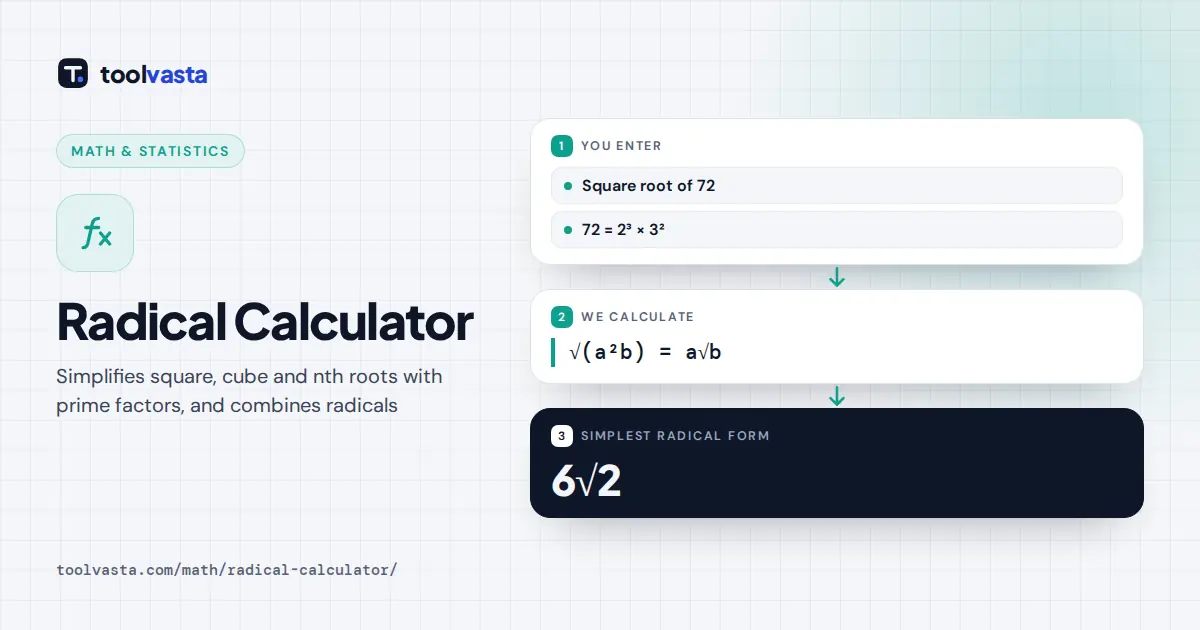
- √72: 72 = 2³ × 3². One pair of 2s and one pair of 3s come out, leaving one 2 inside: √72 = 2 × 3 × √2 = 6√2 ≈ 8.485281374.
- ∛54: 54 = 2 × 3³. The three 3s come out: ∛54 = 3∛2 ≈ 3.77976315.
- √(5/12): multiply top and bottom by 12 to get √60 ÷ 12. Since 60 = 2² × 15, √60 = 2√15, so the answer is 2√15/12 = √15/6 ≈ 0.645497224.
- 3√12 + 5√27: 3√12 = 6√3 and 5√27 = 15√3. They are like radicals, so the sum is 21√3 ≈ 36.37306696.
Adding, Multiplying and Dividing Radicals
| Operation | Rule | Example |
|---|---|---|
| Add or subtract | Only like radicals combine: same index, same radicand | 4√18 − 2√8 = 12√2 − 4√2 = 8√2 |
| Multiply | Multiply coefficients and radicands with the same index | √6 × √15 = √90 = 3√10 |
| Divide | Divide, then rationalize the denominator | √10 ÷ √6 = √15/3 |
| Different indices | Rewrite with the least common index | √2 × ∛3 = ⁶√8 × ⁶√9 = ⁶√72 |
Roots of Negative Numbers
An odd root of a negative number is a negative real number, because a negative number cubed is negative: ∛(−40) = −2∛5 ≈ −3.419951893. An even root of a negative number has no real value. The calculator then writes the answer with the imaginary unit i = √(−1), for example √(−50) = 5√2 i.
Perfect Squares and Cubes to Know
Simplifying is much faster when you recognize perfect powers hidden inside the radicand. Look for the largest perfect square (or cube) that divides it, then take its root outside.
| n | 2 | 3 | 4 | 5 | 6 | 7 | 8 | 9 | 10 |
|---|---|---|---|---|---|---|---|---|---|
| n² | 4 | 9 | 16 | 25 | 36 | 49 | 64 | 81 | 100 |
| n³ | 8 | 27 | 64 | 125 | 216 | 343 | 512 | 729 | 1000 |
For example, 72 = 36 × 2 gives √72 = 6√2 in one step, and 250 = 125 × 2 gives ∛250 = 5∛2.
Tips and Limits
- Decimals are converted to exact fractions, so √0.5 is treated as √(1/2) = √2/2.
- Indexes from 2 to 20 are supported. Very large radicands are factored with fast prime tests, but numbers with two huge prime factors may stay unsimplified.
- Unlike radicals such as √3 + 5√2 cannot be combined. The calculator leaves them as a simplified sum.
Frequently asked questions
How do you simplify a square root?
Factor the number into primes, take out one factor for every pair of equal primes, and leave the rest under the root. For example, √72 = √(2² × 3² × 2) = 6√2.
What is simplest radical form?
A radical is in simplest form when no perfect square (or perfect nth power) divides the radicand, no fraction is left under the root, and no radical remains in a denominator.
How do you simplify a cube root?
Factor the radicand and group equal primes in threes. Each group of three comes out as one factor. For example, ∛54 = ∛(3³ × 2) = 3∛2.
Can you add radicals with different radicands?
Only after simplifying, and only if the radicals then match. 3√12 + 5√27 = 6√3 + 15√3 = 21√3, but √3 + √2 cannot be combined.
How do you rationalize a denominator?
Multiply the top and bottom by the radical needed to make the denominator a perfect power. For 1/√6, multiply by √6/√6 to get √6/6, which has no root left in the denominator.
What is the square root of a negative number?
It is not a real number. Using the imaginary unit i = √(−1), √(−50) = 5√2 i. Odd roots of negative numbers are real, for example ∛(−8) = −2.