How to Use the Population Density Calculator
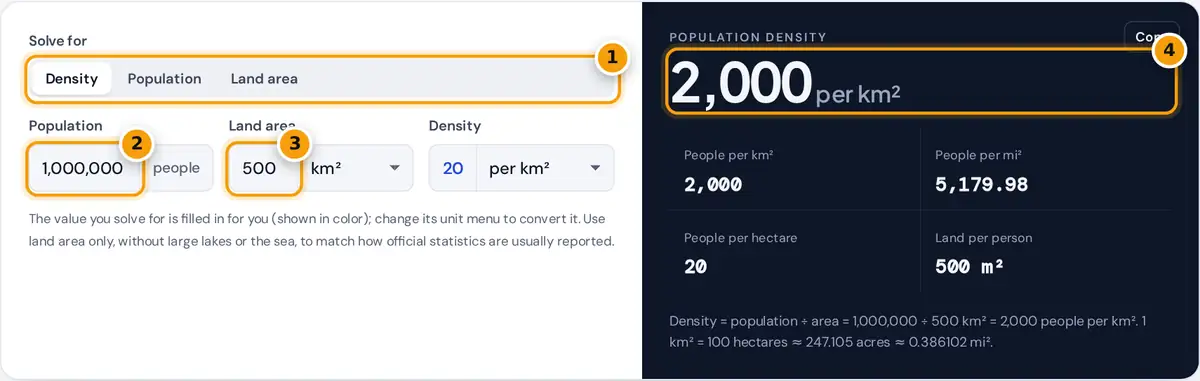
- Choose to solve for density, population or land area.
- Enter the population.
- Enter the land area and pick its unit.
- Read the density in several units and the land per person.
Enter the number of people and the land area, then choose the area unit: square kilometers, square miles, hectares, acres or square meters. The population density appears straight away in the unit you pick, and the result panel lists it per square kilometer, per square mile and per hectare, along with how much land there is for each person.
To work backward, choose Population and enter the density and area, or choose Land area and enter the population and density. This is useful for planning questions such as how many residents a new neighborhood will hold at a target density.
Population Density Formula
Population = density × land area Land area = population ÷ density
1 km² = 100 ha ≈ 247.105 acres ≈ 0.386102 mi² 1 mi² ≈ 2.58999 km²
This is the arithmetic density, the most common measure, and the one used in most census tables and atlases. Because 1 square mile is about 2.59 square kilometers, a density per square mile is always about 2.59 times larger than the same density per square kilometer.
Worked Examples
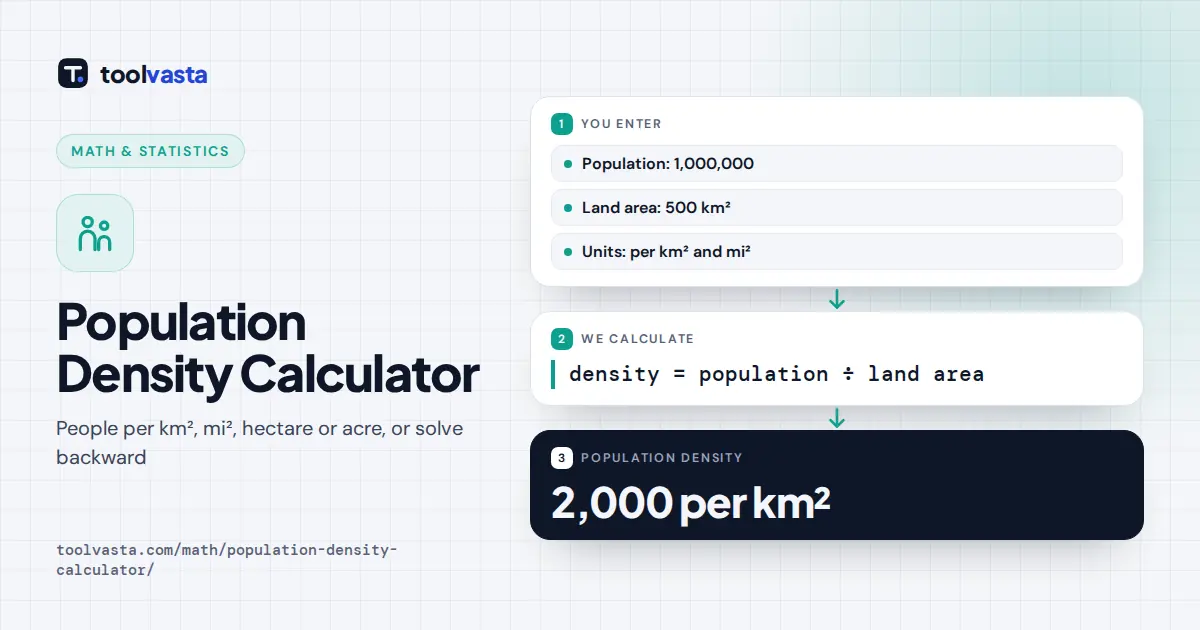
- Density: a city of 1,000,000 people on 500 km² of land has 1,000,000 ÷ 500 = 2,000 people per km². That is 5,179.98 per mi² and 20 per hectare, or 500 m² of land for each person.
- Population: a new district of 3.4 km² planned at 4,000 people per km² would hold 4,000 × 3.4 = 13,600 residents.
- Area: a county of 250,000 people at 965.251 people per mi² covers 250,000 ÷ 965.251 = 259 mi², which is about 670.8 km².
When comparing places, always compare densities in the same unit. A figure of 2,000 per km² and one of 5,180 per mi² describe the same density, even though the numbers look very different. The calculator shows both side by side to avoid that confusion.
Density Unit Conversions
| Per km² | Per mi² | Per hectare | Land per person |
|---|---|---|---|
| 10 | 25.9 | 0.1 | 10 ha |
| 100 | 259 | 1 | 1 ha |
| 1,000 | 2,590 | 10 | 1,000 m² |
| 5,000 | 12,950 | 50 | 200 m² |
| 10,000 | 25,900 | 100 | 100 m² |
Converting is a single multiplication, so the table also works in reverse: divide a per square mile figure by about 2.59 to get the density per square kilometer.
Interpreting Density
A single average can hide a lot. A country can have a low overall density while most people live in a few crowded cities, with large empty areas elsewhere. Geographers therefore also use physiological density, which divides the population by arable land only, and agricultural density, which counts only farmers. For cities, comparing neighborhoods, or using census tracts, gives a far more realistic picture than one figure for the whole area.
Density in Planning
Planners often express density per hectare or per acre for individual sites, and per square kilometer or square mile for whole cities. Residential density can also be counted in dwellings instead of people: multiply dwellings per hectare by the average household size to estimate people per hectare. For example, 40 dwellings per hectare with an average of 2.5 people each is 100 people per hectare, or 10,000 per km². Use the Population and Land area modes to test scenarios, such as how much land a target population needs at a given density, or how many residents an area can hold.
Tips and Data Sources
- Use land area, excluding large lakes and coastal water, because that is how official density figures are normally reported.
- Take the population and area from the same source and year, such as your national statistics office, so the two match.
- Boundaries matter: a city proper, an urban area and a metropolitan area can have very different densities.
- Results are averages. They say nothing about how people are spread within the area.
Frequently asked questions
How do you calculate population density?
Divide the number of people by the land area. A town of 50,000 people on 25 km² has a population density of 50,000 ÷ 25 = 2,000 people per square kilometer.
How do I convert people per km² to people per mi²?
Multiply by about 2.59, because one square mile equals 2.58999 square kilometers. A density of 2,000 people per km² is therefore about 5,180 people per mi².
Should I use total area or land area?
Use land area. Official statistics normally exclude large lakes, rivers and coastal water, so including them would make the density look lower than the published figures for the same place.
What is the difference between arithmetic and physiological density?
Arithmetic density divides the population by all land. Physiological density divides it by arable land only, showing the pressure on farmland. This calculator computes arithmetic density by default.
How do I find the population from density?
Multiply the density by the land area in matching units. At 4,000 people per km² over 3.4 km², the population is 13,600. Choose Population in the calculator to do this.
What does land per person mean?
It is the inverse of density: the average land area for each resident. At 2,000 people per km², each person has 500 square meters, which includes roads, parks and all other land.