How to Use the Laplace Transform Calculator
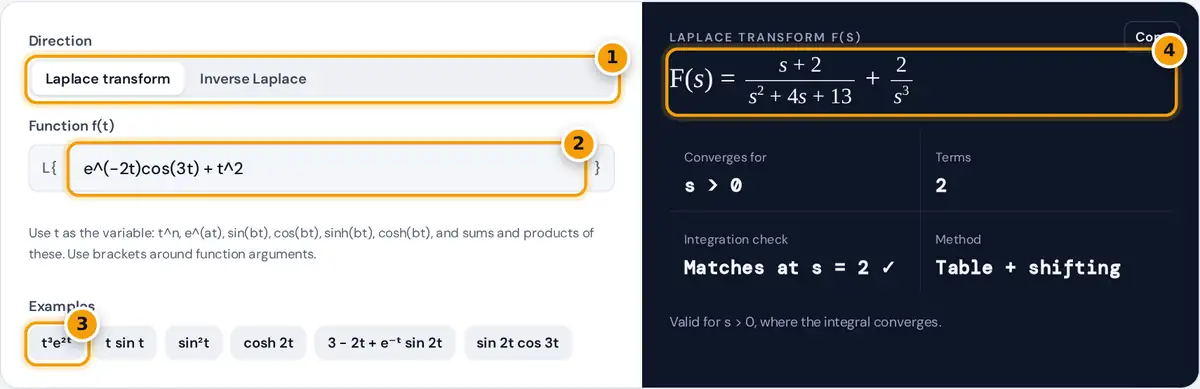
- Choose Laplace transform for f(t) to F(s), or Inverse Laplace for F(s) back to f(t).
- Type the function, for example e^(-2t)cos(3t) + t^2, or a ratio of polynomials in s.
- Or tap an example to load a typical textbook problem.
- Read F(s) or f(t), the region of convergence and the integration check, then the steps.
Choose Laplace transform to go from f(t) to F(s), or Inverse Laplace to go from F(s) back to f(t). In forward mode, type a function of t built from powers tn, exponentials e^(at), sin(bt), cos(bt), sinh(bt) and cosh(bt), including sums and products such as t·e^(−t) or sin(t)^2. In inverse mode, type a ratio of polynomials in s. The denominator can be typed expanded, like s^2+3s+2, or factored, like s^2(s+1).
The answer appears in the result panel with the region of convergence or the number of poles, and an independent check: the calculator integrates e−stf(t) numerically and confirms it matches F(s). The steps below the tool name every table entry and theorem used, and in inverse mode they show the partial fraction decomposition with the value of each constant.
The Laplace Transform Definition
The integral converges when s is large enough to overpower the growth of f(t). For eat that means s > a, which is why the calculator reports a region of convergence. The transform turns derivatives into multiplication by s, so linear differential equations with initial conditions become algebra problems in s.
Laplace Transform Table
| f(t) | F(s) | Valid for |
|---|---|---|
| 1 | 1/s | s > 0 |
| tn | n!/sn+1 | s > 0 |
| eat | 1/(s − a) | s > a |
| sin(bt) | b/(s² + b²) | s > 0 |
| cos(bt) | s/(s² + b²) | s > 0 |
| sinh(bt) | b/(s² − b²) | s > |b| |
| cosh(bt) | s/(s² − b²) | s > |b| |
| eatf(t) | F(s − a) | first shifting theorem |
| tnf(t) | (−1)nF(n)(s) | multiplication by tn |
Worked Examples
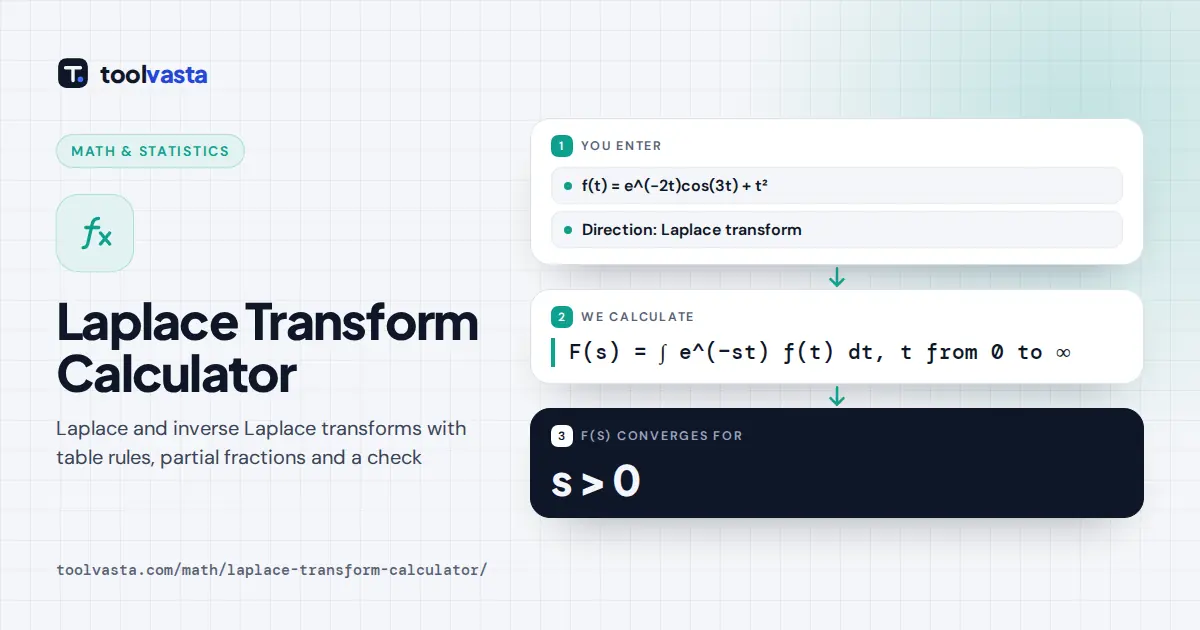
Forward: find L{e−2tcos(3t) + t²}. By linearity, transform each term. From the table, L{cos(3t)} = s/(s² + 9), and the shifting theorem replaces s by s + 2, giving (s + 2)/((s + 2)² + 9) = (s + 2)/(s² + 4s + 13). Also L{t²} = 2!/s³ = 2/s³. So F(s) = (s + 2)/(s² + 4s + 13) + 2/s³, valid for s > 0.
Inverse: find L−1{(s + 3)/(s² + 3s + 2)}. The denominator factors as (s + 1)(s + 2), so write the fraction as A/(s + 1) + B/(s + 2). Then s + 3 = A(s + 2) + B(s + 1). Setting s = −1 gives A = 2, and s = −2 gives B = −1. Since L−1{1/(s − a)} = eat, the answer is f(t) = 2e−t − e−2t.
Inverse Laplace by Partial Fractions
A proper rational function N(s)/D(s) splits into simple pieces, one for each factor of the denominator. A linear factor (s − a)k contributes A1/(s − a) + … + Ak/(s − a)k, and these invert to tn−1eat/(n − 1)!. An irreducible quadratic s² + ps + q contributes (Bs + C)/(s² + ps + q). Completing the square turns it into a shifted sine and cosine pair when the roots are complex, or a sinh and cosh pair when the roots are real but irrational. Squared quadratic factors are handled with the standard formulas for 1/(s² + b²)² and s/(s² + b²)².
When the numerator degree is not lower than the denominator degree, the calculator divides first. The polynomial part inverts to the Dirac delta and its derivatives, which act only at t = 0.
Tips and Limits
- All coefficients must be rational numbers, so answers stay exact. Square roots appear only where completing the square needs them, as in 1/(s² − 2), whose inverse is (√2/2)sinh(√2·t).
- Write arguments with brackets: sin(2t), not sin 2t. Phase shifts such as sin(t + 1) and unit step functions are not supported.
- In inverse mode the denominator must factor into rational linear and quadratic factors. A cubic such as s³ − 2 has an irrational real root and is rejected rather than approximated.
- The integration check uses Simpson's rule at one value of s to the right of every pole, which catches sign and coefficient mistakes.
Frequently asked questions
What is the Laplace transform used for?
It turns linear differential equations with initial conditions into algebraic equations in s. You solve for the transform of the unknown function, then use the inverse transform, usually with partial fractions, to get the solution in t.
How do you find an inverse Laplace transform?
Write F(s) as a proper fraction, factor the denominator, split it into partial fractions, then match each piece to a table entry such as 1/(s − a) → e^(at) or b/(s² + b²) → sin(bt).
What is the first shifting theorem?
Multiplying f(t) by e^(at) shifts the transform: L{e^(at)f(t)} = F(s − a). So e^(−2t)cos(3t) has the transform of cos(3t) with s replaced by s + 2.
What is the Laplace transform of t^n?
L{t^n} = n!/s^(n+1) for s > 0 and any whole number n. For example, L{t²} = 2/s³ and L{t³} = 6/s⁴. Multiplying by e^(at) then shifts s to s − a.
Why does the transform have a region of convergence?
The defining integral only exists when e^(−st) decays faster than f(t) grows. For e^(at) that needs s > a. The calculator reports the smallest such bound for your function.
Can it handle complex roots in the denominator?
Yes. An irreducible quadratic factor gives complex poles. Completing the square turns that piece into an exponentially shifted sine and cosine, as in (2s + 1)/(s² + 2s + 5) → e^(−t)(2cos 2t − ½ sin 2t).