How to Use the Expand and Simplify Calculator
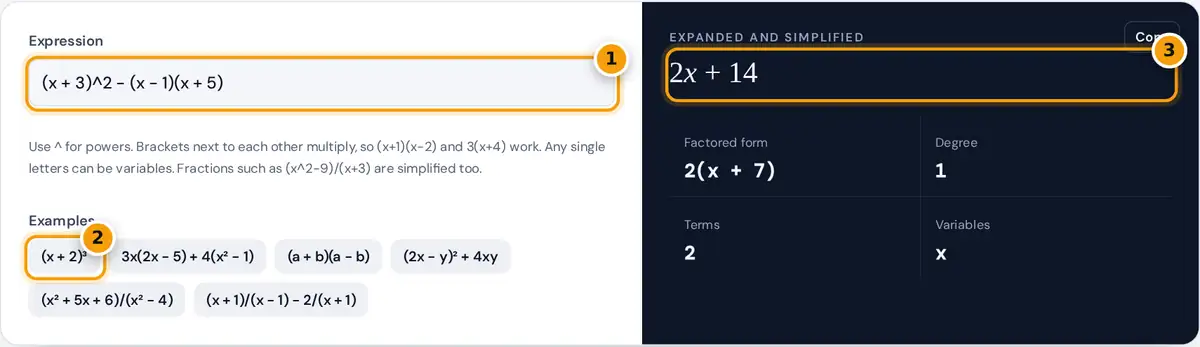
- Type the expression. Brackets next to each other multiply, as in (x+1)(x-2).
- Or tap an example such as (x + 2)³ or an algebraic fraction.
- Read the simplified result, the factored form and the degree, then each expansion step.
Type the expression you want to multiply out, using ^ for powers. Brackets written next to each other are multiplied, so (x+1)(x−2), 3(x+4) and 2x(x−5) all work, and any single letters can be variables. Press an example to see the kind of input that is accepted. The result updates as you type.
The result panel shows the simplified expression in standard form, highest power first, together with its factored form, degree and number of terms. Below the tool, each bracket is expanded on its own line with the method named, then the like terms are grouped and added. Algebraic fractions are combined over a common denominator and any common factor is canceled, with the excluded values listed.
Expanding Brackets: The Methods
FOIL: (a + b)(c + d) = ac + ad + bc + bd
Square of a binomial: (a + b)² = a² + 2ab + b²
Difference of squares: (a + b)(a − b) = a² − b²
Binomial theorem: (a + b)n = Σ C(n, k)an−kbk
Every method is the distributive law applied repeatedly: each term in one bracket multiplies each term in the other. The named patterns are shortcuts that save writing out every product. After expanding, simplify by collecting like terms, which are terms with exactly the same variables raised to the same powers, such as 3x² and −5x².
Worked Example
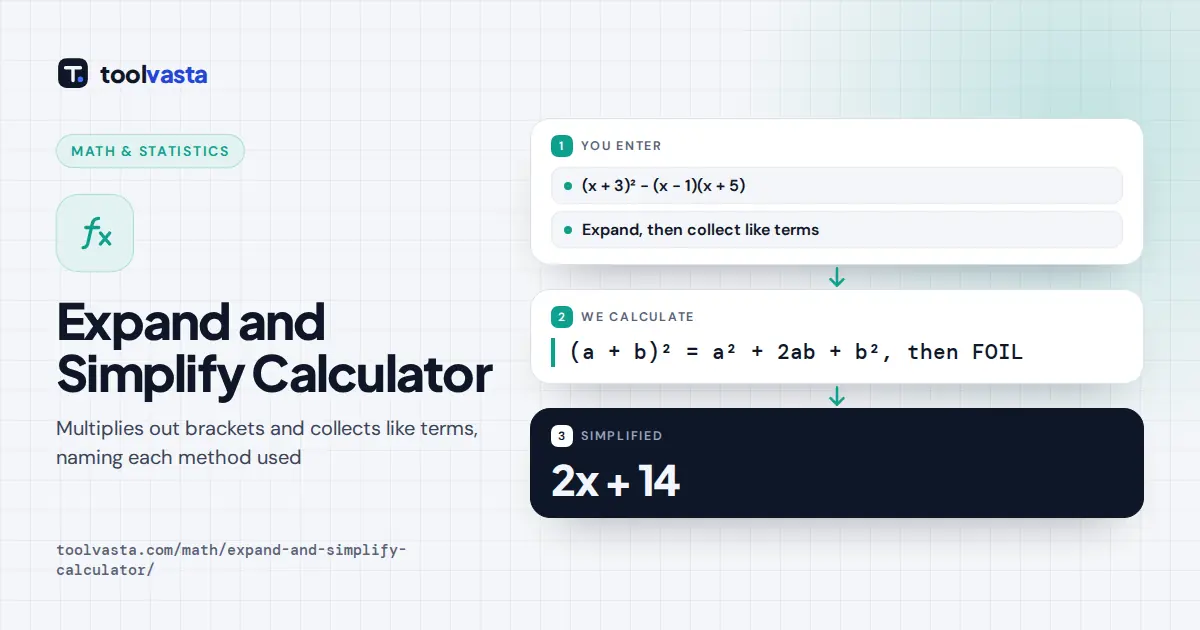
Expand and simplify (x + 3)² − (x − 1)(x + 5).
- Square of a binomial: (x + 3)² = x² + 6x + 9.
- FOIL: (x − 1)(x + 5) = x² + 5x − x − 5 = x² + 4x − 5.
- The second product is subtracted, so change every sign: −x² − 4x + 5.
- Collect like terms: x² − x² = 0, 6x − 4x = 2x and 9 + 5 = 14.
The answer is 2x + 14, which factors as 2(x + 7). A common mistake is to forget that the minus sign applies to every term of the second product.
Common Expansions
| Expression | Expanded |
|---|---|
| (x + 2)³ | x³ + 6x² + 12x + 8 |
| 3x(2x − 5) + 4(x² − 1) | 10x² − 15x − 4 |
| (a + b)(a − b) | a² − b² |
| (2x − y)² + 4xy | 4x² + y² |
| (x + 1/2)² | x² + x + 1/4 |
Simplifying Algebraic Fractions
To simplify a fraction such as (x² + 5x + 6)/(x² − 4), factor the top and bottom: (x + 2)(x + 3) over (x − 2)(x + 2). The common factor x + 2 cancels, leaving (x + 3)/(x − 2). The values that made the original denominator zero, x = 2 and x = −2, stay excluded even though x + 2 no longer appears. To add or subtract fractions, write them over a common denominator first: (x + 1)/(x − 1) − 2/(x + 1) = (x² + 3)/(x² − 1).
Common Mistakes When Expanding
- (x + 3)² is not x² + 9. Squaring a sum always produces the middle term, here 6x.
- A minus sign in front of a bracket changes the sign of every term inside it: −(x − 4) = −x + 4.
- Multiply every term in the bracket: 2(x + 5) = 2x + 10, not 2x + 5.
- x × x = x², not 2x. Add exponents when you multiply powers of the same variable: x² × x³ = x⁵.
Tips and Limits
- Polynomial work uses exact rational arithmetic, so 1/2 and 0.5 are treated as the same exact number.
- The factored form is found with the open-source nerdamer library and is only shown after it multiplies back to the expanded answer.
- Expressions with functions such as sin(x) or e^x are expanded with nerdamer and checked numerically. Trigonometric identities are not applied.
- Powers up to 60 are supported, but very large expansions can have many terms.
Frequently asked questions
How do you expand and simplify an expression?
Multiply out every bracket using the distributive law, so each term in one bracket multiplies each term in the other. Then collect like terms, adding the coefficients of terms with the same variables and powers.
What is the FOIL method?
A way to multiply two binomials: multiply the First terms, the Outer terms, the Inner terms and the Last terms, then add. For (x + 2)(x − 3): x² − 3x + 2x − 6 = x² − x − 6.
How do you expand (a + b)²?
Use the pattern (a + b)² = a² + 2ab + b². It is not a² + b², which is a common mistake. For example, (x + 3)² = x² + 6x + 9.
What are like terms?
Terms with exactly the same variables raised to the same powers, such as 4x²y and −x²y. Only like terms can be combined, by adding their coefficients.
How do you simplify an algebraic fraction?
Factor the numerator and the denominator completely, then cancel any factor that appears in both. Remember that values making the original denominator zero remain excluded.
What is the difference between expanding and factoring?
They are opposite processes. Expanding removes brackets, turning 2(x + 7) into 2x + 14. Factoring puts them back by writing an expression as a product of simpler factors.