How to Use the Gear Ratio Calculator
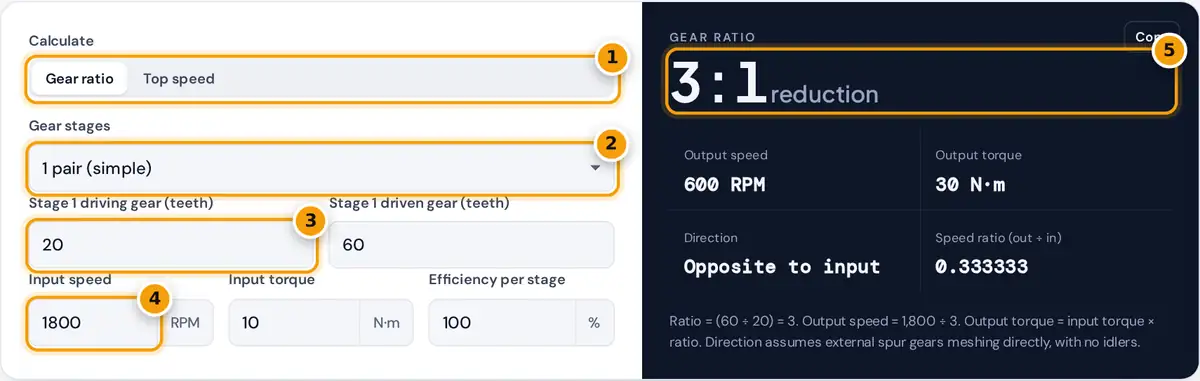
- Choose Gear ratio for tooth counts or Top speed for a vehicle.
- Pick one simple pair or a 2 or 3 stage compound train.
- Enter the teeth on the driving gear, then on the driven gear.
- Enter the input speed in RPM and the input torque.
- Read the gear ratio, then check output RPM, torque and direction.
In Gear ratio mode, enter the tooth count of the driving gear, the one connected to the motor or input shaft, and of the driven gear it turns. The ratio and its type appear instantly.
Add input speed in RPM and input torque in N·m to see output speed and torque. For a compound gear train, choose two or three stages, where each stage is one pair of meshing gears.
The efficiency per stage covers friction in each mesh, so lower it for worn or poorly lubricated gears. In Top speed mode, enter engine RPM, gear ratio, final drive and tire size for road speed.
Gear Ratio Formulas
The gear ratio equals driven teeth divided by driving teeth. For a compound train, multiply the ratios of all stages together, because each later stage further divides the speed passed on by the stage before.
Compound train: total ratio = ratio1 × ratio2 × ratio3
Output RPM = input RPM ÷ ratio Output torque = input torque × ratio × efficiency
Speed (km/h) = RPM ÷ (gear × final drive) × tire circumference (m) × 60 ÷ 1000
A ratio above 1 is a reduction: output RPM falls and output torque rises by the same factor, which is the gear's mechanical advantage. A ratio below 1 is an overdrive, trading torque for speed.
Power, which is torque times speed, stays the same apart from friction losses. That is why the calculator multiplies torque by the efficiency for every stage, while output speed depends only on the tooth counts.
Worked Examples
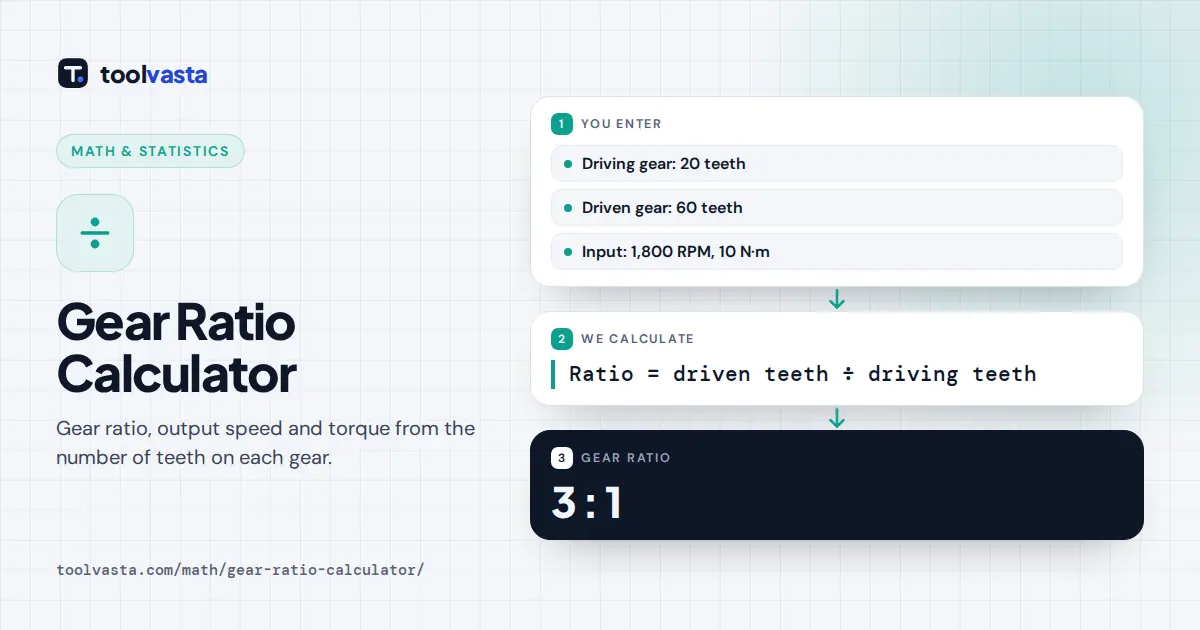
A 20-tooth gear drives a 60-tooth gear, so the ratio is 60 ÷ 20 = 3, written 3 : 1. With a motor at 1,800 RPM and 10 N·m, this simple gear pair outputs 1,800 ÷ 3 = 600 RPM.
Ignoring friction, output torque is 10 × 3 = 30 N·m, and the output shaft turns in the opposite direction to the motor. A 20-tooth gear driving a 10-tooth gear would instead be a 1 : 2 overdrive.
Now add a second stage: a 15-tooth gear on the same shaft as the 60-tooth gear drives a 45-tooth gear. The overall total is now 3 × 3 = 9 : 1, so output speed becomes 200 RPM.
| Setup | Ratio | Output speed | Output torque |
|---|---|---|---|
| 20 → 60, 100% efficiency | 3 : 1 | 600 RPM | 30 N·m |
| 20 → 60 then 15 → 45, 98% per stage | 9 : 1 | 200 RPM | 86.44 N·m |
Top Speed From RPM, Gearing and Tire Size
The top speed calculator divides engine RPM by the gear ratio times the final drive, the differential ratio, to get wheel RPM. Wheel RPM times circumference gives distance per minute, converted to km/h or mph.
The code gives width, sidewall percentage and rim diameter. A 225/45R17 tire has a diameter of 17 × 25.4 + 2 × 225 × 0.45 = 634.3 mm, using the exact inch of 25.4 mm defined by NIST length standards.
The tire circumference is therefore about 1.9927 m. At 6,000 RPM in a 0.79 top gear with a 3.42 final drive, the wheel speed is 2,220.7 RPM, giving a theoretical 265.5 km/h or 165.0 mph.
Typical Gear Ratios
Real machines use a wide spread of ratios. The table gives common ranges so you can sanity-check a result, though individual models and brands vary widely, especially among performance cars, trucks and specialist industrial gearboxes.
| Application | Typical ratio |
|---|---|
| Car first gear | 3.0 to 4.5 : 1 |
| Car top gear (overdrive) | 0.6 to 0.85 : 1 |
| Car final drive | 2.5 to 4.5 : 1 |
| Bicycle (50/11 to 34/32 chainring/cog) | 4.5 to 1.06 : 1 (output faster than pedals) |
| Hobby servo gearbox | 100 to 300 : 1 |
A car's first gear usually sits between 3.0 and 4.5 : 1 for strong pulling, while top gear is often an overdrive below 1 to keep highway RPM low and quiet, saving fuel on long trips.
On a bicycle, the chainring drives a smaller cog, so the wheel turns faster than the pedals. A hobby servo goes the other way, using 100 : 1 or more so a tiny motor delivers torque.
Idler Gears and Direction
Each direct mesh between external spur gears reverses the direction of rotation. A single pair turns the output the opposite way to the input, and in a compound train the direction alternates with every stage.
An idler gear placed between two gears restores the original direction without changing the overall ratio, because its tooth count cancels out. Idlers can also bridge a gap between shafts that sit too far apart.
Internal ring gears, belts and chains keep the same direction. In a typical car axle, the pinion turns the ring gear at a right angle, and the ring-to-pinion tooth ratio is the final drive ratio.
Notes and Limits
The gear calculations assume rigid gears with no slip or backlash. Real gearboxes also lose energy as heat. Torque is reported in newton meters, the coherent unit listed in the NIST guide to SI units.
Top speed is the theoretical speed set by gearing alone. Whether a vehicle reaches it depends on engine power, aerodynamic drag, rolling resistance and tire growth at high speed, which the calculator does not model.
Tire diameters from the size code are nominal, and the real rolling diameter under load is usually slightly smaller. Measuring one wheel revolution on the ground gives a more accurate circumference for any precise work.
Frequently asked questions
How do you calculate gear ratio?
Divide the number of teeth on the driven gear by the number on the driving gear. A 12-tooth gear driving a 48-tooth gear has a ratio of 48 divided by 12, which is 4, written 4 : 1.
Does a higher gear ratio mean more torque?
Yes. A higher ratio multiplies torque by the ratio and divides speed by the same amount. A 4 : 1 reduction gives four times the torque at one quarter of the speed, minus friction losses.
How do I calculate the ratio of a compound gear train?
Work out the ratio of each meshing pair, then multiply them together. Two stages of 3 : 1 give a total of 9 : 1, and three stages of 3 : 1 give 27 : 1.
How do I calculate top speed from RPM and gear ratio?
Divide the RPM by the gear ratio times the final drive ratio to get wheel RPM, multiply by the tire circumference in meters and by 60, then divide by 1,000 for km/h.
What does an idler gear do?
An idler sits between two gears and reverses the output direction without changing the overall gear ratio, because its own tooth count cancels out. It can also bridge a gap between two shafts.
What is the difference between reduction and overdrive?
A reduction has a ratio above 1, so the output turns slower with more torque. An overdrive has a ratio below 1, so the output turns faster with less torque, like a car's top gear.