How to Use the Discriminant Calculator
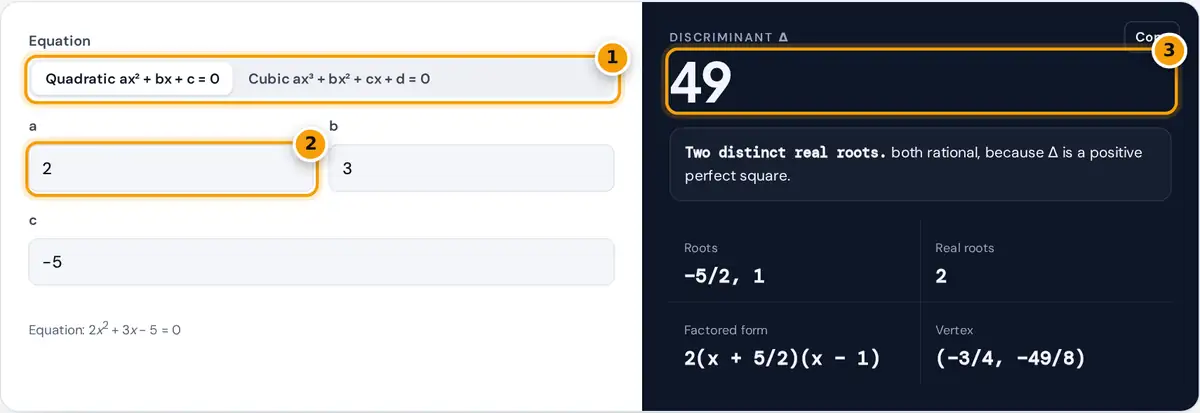
- Choose a quadratic or a cubic equation.
- Enter the coefficients a, b and c, using 0 for a missing term.
- Read the discriminant, what it means for the roots, and the exact roots.
Choose Quadratic for ax² + bx + c = 0 or Cubic for ax³ + bx² + cx + d = 0, then enter the coefficients. Use 0 for a missing term and a negative sign for subtraction, so x² − 4x + 1 = 0 has a = 1, b = −4 and c = 1. Fractions and decimals are accepted, and everything is calculated exactly.
The result panel shows the discriminant, a plain-language description of the roots, the roots themselves in exact form and, for a quadratic, the factored form and the vertex of the parabola. The steps below show the substitution into the formula and how the roots follow.
The Discriminant Formula
Roots: x = (−b ± √Δ) ÷ 2a
Cubic: Δ = 18abcd − 4b³d + b²c² − 4ac³ − 27a²d²
The discriminant is the expression under the square root in the quadratic formula. It discriminates between the possible kinds of roots without solving the equation, which is why it has that name.
What the Discriminant Tells You
| Quadratic discriminant | Roots | Graph of y = ax² + bx + c |
|---|---|---|
| Δ > 0, a perfect square | Two distinct rational roots | Crosses the x-axis twice; the quadratic factors over the integers |
| Δ > 0, not a perfect square | Two distinct irrational roots | Crosses the x-axis twice |
| Δ = 0 | One repeated real root | Touches the x-axis at the vertex |
| Δ < 0 | Two complex conjugate roots | Does not meet the x-axis |
For a cubic with real coefficients, Δ > 0 means three distinct real roots, Δ = 0 means at least two roots are equal (and all are real), and Δ < 0 means one real root and a pair of complex conjugates.
Worked Examples
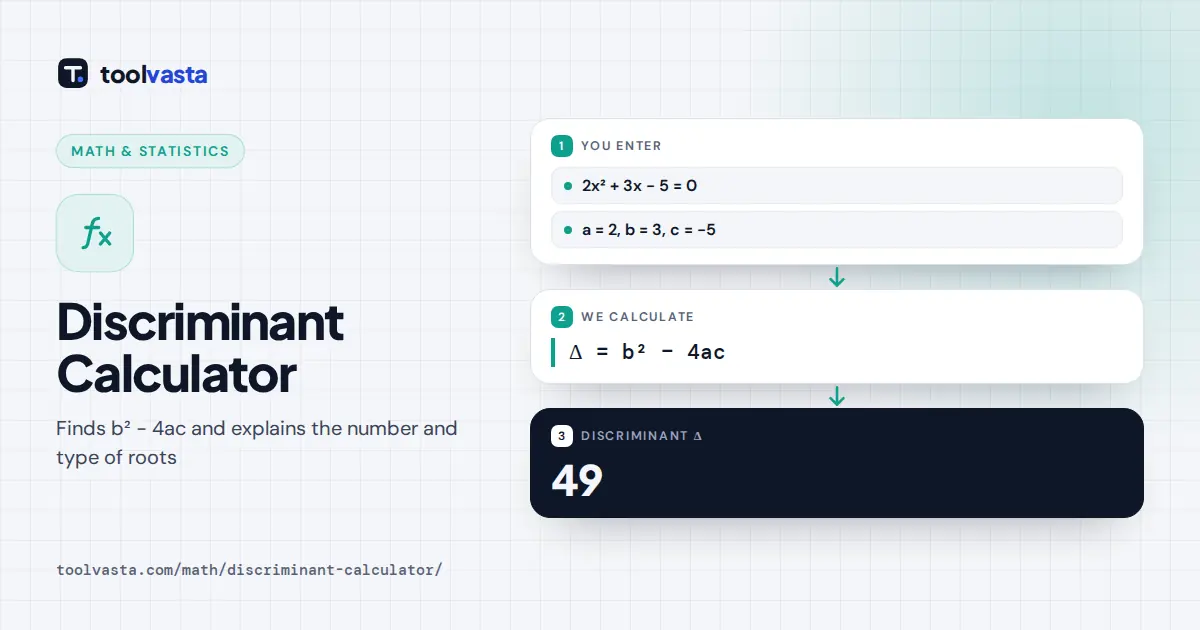
- 2x² + 3x − 5 = 0: Δ = 3² − 4 × 2 × (−5) = 9 + 40 = 49. Since 49 = 7², there are two rational roots: x = (−3 ± 7) ÷ 4, so x = 1 and x = −5/2. The quadratic factors as 2(x − 1)(x + 5/2) = (x − 1)(2x + 5).
- x² − 4x + 1 = 0: Δ = 16 − 4 = 12, positive but not a perfect square, so x = (4 ± √12) ÷ 2 = 2 ± √3.
- x² + 2x + 5 = 0: Δ = 4 − 20 = −16, so the roots are complex: x = −1 ± 2i.
- x³ − 6x² + 11x − 6 = 0: Δ = 4 > 0, so there are three distinct real roots. They are 1, 2 and 3.
Where the Discriminant Is Used
Teachers ask for the discriminant to decide how many times a parabola meets the x-axis, to find the values of a parameter k that give equal roots (set Δ = 0 and solve for k), and to check whether a quadratic can be factored over the integers before trying. In geometry it tells you whether a line meets a circle or a parabola in two points, one point (a tangent) or none.
Finding k for Equal Roots
A favorite exam question gives a quadratic with an unknown coefficient and asks for the value that makes the roots equal. Write the discriminant in terms of k and set it to zero. For kx² + 4x + 1 = 0, Δ = 16 − 4k = 0, so k = 4, and the equation becomes 4x² + 4x + 1 = (2x + 1)² = 0. For two distinct real roots you would solve 16 − 4k > 0 instead, giving k < 4 with k ≠ 0.
Tips and Limits
- a must not be zero. If it is, the equation has a lower degree.
- Cubic roots are exact when the rational root test finds a root. Otherwise they are given to 10 significant figures.
- The perfect square test works with fractions too: Δ = 9/4 counts as a perfect square because it is (3/2)².
Frequently asked questions
What is the discriminant of a quadratic?
It is b² − 4ac for the equation ax² + bx + c = 0. It is the part under the square root in the quadratic formula, and its sign tells you how many real roots there are.
What does a negative discriminant mean?
There are no real roots. The two roots are complex conjugates of the form p ± qi, and the graph of the quadratic does not cross or touch the x-axis.
What does a discriminant of zero mean?
The quadratic has one repeated real root, x = −b ÷ 2a, and it is a perfect square. Its graph touches the x-axis at exactly one point, the vertex.
How do you know if the roots are rational?
When the discriminant is a positive perfect square, such as 49, and the coefficients are rational, the roots are rational and the quadratic can be factored.
How do you find k for equal roots?
Write the discriminant in terms of k, set it equal to 0 and solve. For x² + kx + 9 = 0, k² − 36 = 0, so k = 6 or k = −6.
Is there a discriminant for cubic equations?
Yes. For ax³ + bx² + cx + d it is 18abcd − 4b³d + b²c² − 4ac³ − 27a²d². Positive means three distinct real roots, negative means one real root.