How to use the density calculator
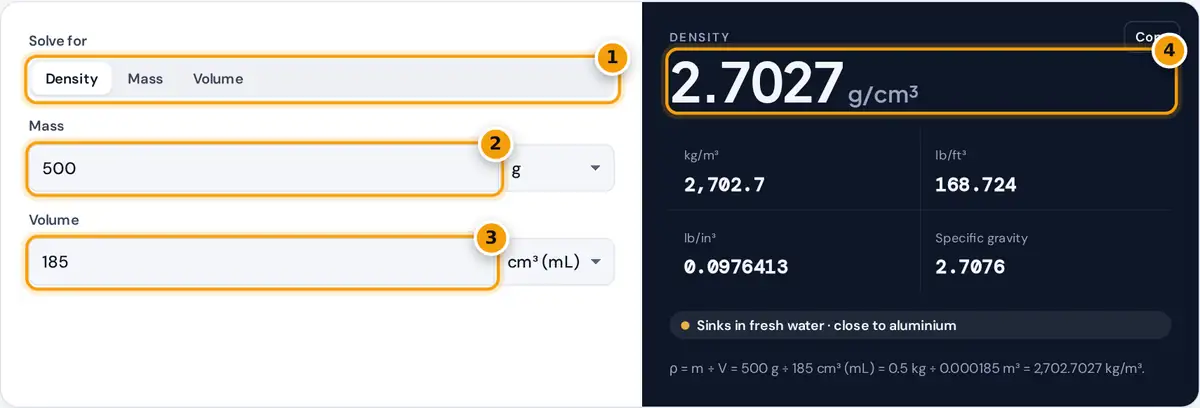
- Choose what to solve for: density, mass or volume.
- Enter the mass and pick its unit, from mg to lb.
- Enter the volume and pick its unit, from mL to US gallons.
- Read the density, then check kg/m³, lb/ft³, specific gravity and the closest material.
Pick what you want to find. To calculate density, enter the mass and the volume, each in any unit. To find mass, enter the volume and the density, or choose a material from the list to fill in a typical density. To find volume, enter the mass and the density. The result is shown in several units, and the badge tells you whether the object would float in fresh water and which common material it is close to.
Density formula
1 g/cm³ = 1 g/mL = 1 kg/L = 1,000 kg/m³ ≈ 62.428 lb/ft³
Specific gravity = ρ ÷ ρwater
Density tells you how much mass is packed into each unit of volume. The calculator converts everything to kilograms and cubic metres first, so you can mix units freely, for example pounds with liters.
Worked examples
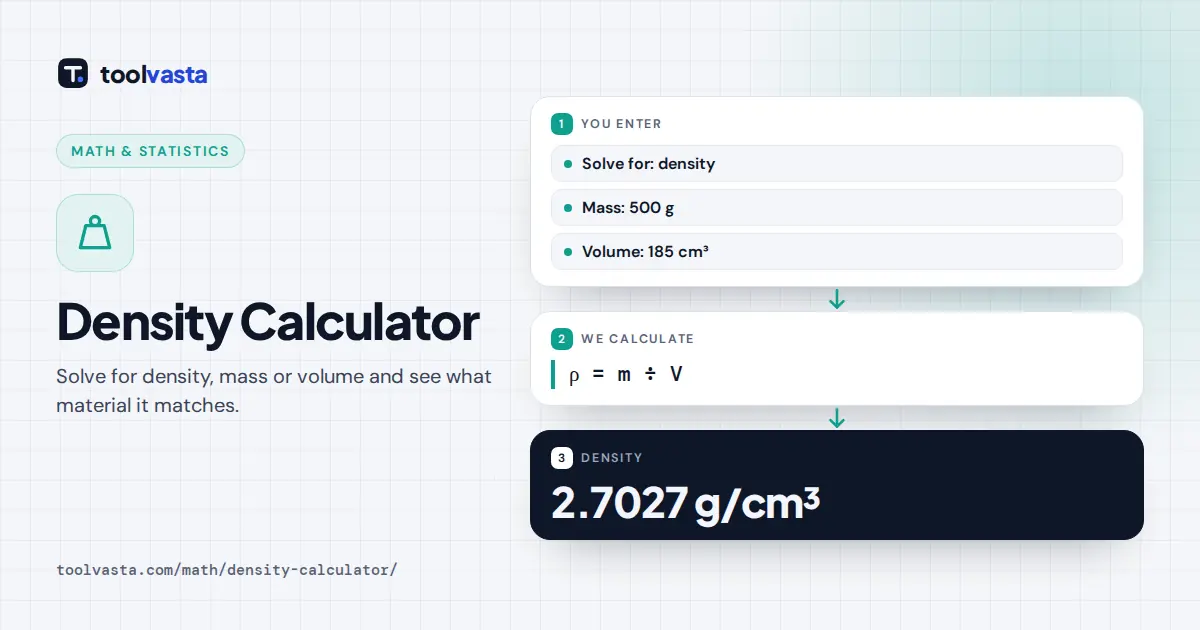
- Find density: a block has a mass of 500 g and a volume of 185 cm³. ρ = 500 ÷ 185 = 2.7027 g/cm³, very close to aluminium (2.70 g/cm³). It sinks in water.
- Find mass: 2 L of steel at 7.85 g/cm³ has a mass of 7.85 × 2,000 = 15,700 g, or 15.7 kg.
- Find volume: 1 kg of gold at 19.32 g/cm³ occupies 1,000 ÷ 19.32 = 51.76 cm³, about the size of a matchbox.
Densities of common materials
| Material | g/cm³ | kg/m³ |
|---|---|---|
| Air (20 °C, sea level) | 0.0012 | 1.204 |
| Ethanol | 0.789 | 789 |
| Ice | 0.917 | 917 |
| Water (20 °C) | 0.998 | 998 |
| Seawater | 1.025 | 1,025 |
| Aluminium | 2.70 | 2,700 |
| Steel (typical) | 7.85 | 7,850 |
| Copper | 8.96 | 8,960 |
| Lead | 11.34 | 11,340 |
| Gold | 19.32 | 19,320 |
Values are typical figures near room temperature. Alloys, woods, concrete and fuels vary from sample to sample, so treat them as estimates.
Will it float?
An object floats when its average density is lower than that of the liquid. Ice (0.917 g/cm³) floats in water with about 92% of its volume below the surface, because the submerged fraction equals the ratio of the two densities. A steel ship floats because its hull encloses a lot of air, which lowers its average density below that of seawater.
Measuring volume for density
For regular shapes, measure the dimensions and use the right volume formula. For irregular objects, use water displacement: put the object in a measuring cylinder and read how much the water level rises. One milliliter of displaced water equals one cubic centimeter of volume.
Notes
Density depends on temperature and, for gases, strongly on pressure. Water is densest at about 4 °C (0.99997 g/cm³) and its density at 20 °C, 0.9982 g/cm³, is used here for the float test and specific gravity. Gallons and fluid ounces are US measures.
Frequently asked questions
How do you calculate density?
Divide mass by volume: ρ = m ÷ V. A 300 g object with a volume of 120 cm³ has a density of 2.5 g/cm³.
What is the density of water?
About 1 g/cm³, or 1,000 kg/m³. More precisely it is 0.9982 g/cm³ at 20 °C and 0.99997 g/cm³ at 4 °C.
How do you find mass from density and volume?
Multiply density by volume: m = ρ × V. Make sure the units match, for example g/cm³ with cm³ gives grams.
How do I convert g/cm³ to kg/m³?
Multiply by 1,000. So 2.7 g/cm³ is 2,700 kg/m³.
What is specific gravity?
The ratio of a substance's density to the density of water. It has no units. Anything with a specific gravity below 1 floats in fresh water.