How to Use the Projectile Motion Calculator
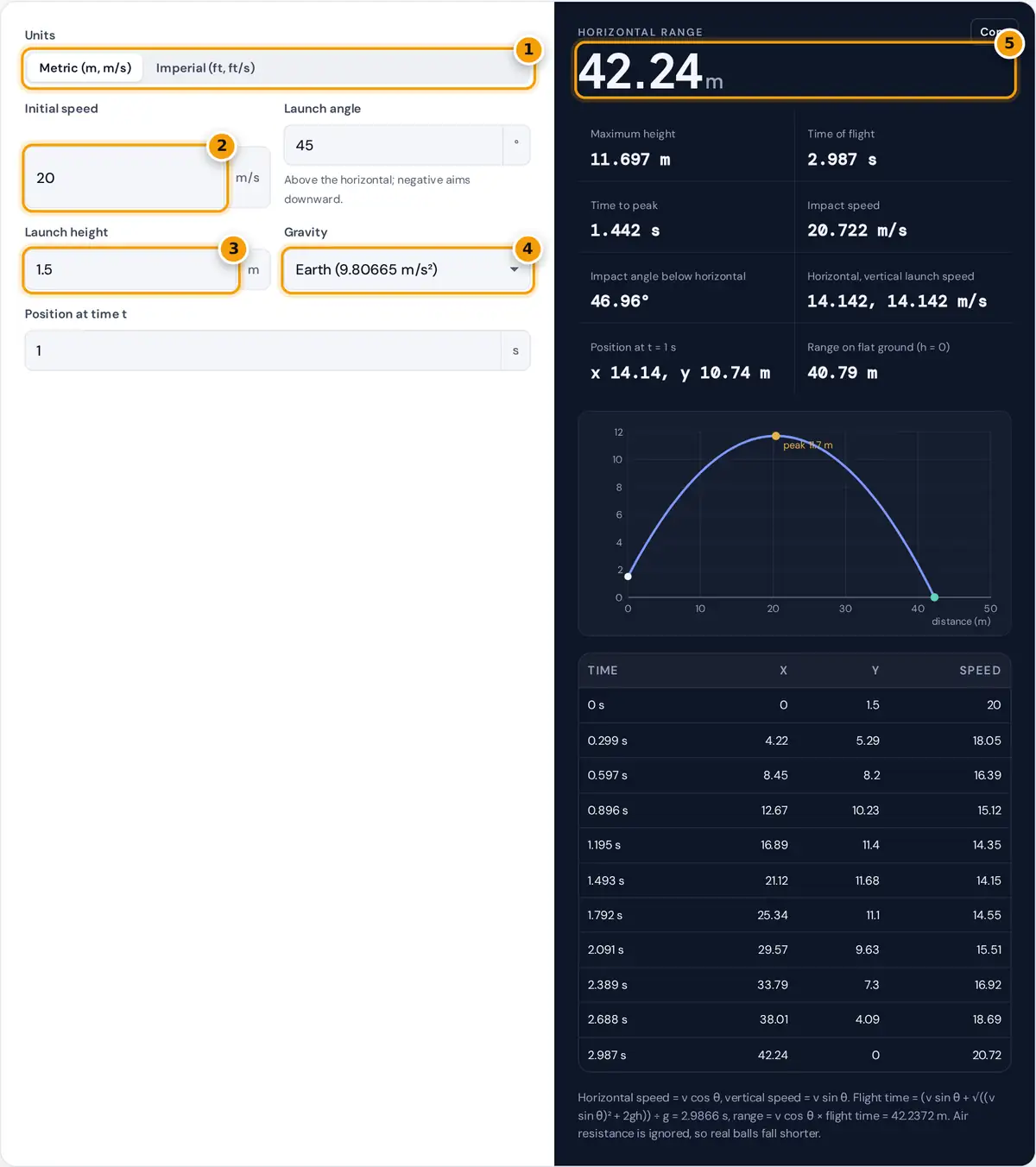
- Choose metric or imperial units.
- Enter the launch speed and the angle above the horizontal.
- Enter the launch height above the landing level, if any.
- Keep Earth gravity or pick the Moon, Mars, Jupiter or a custom value.
- Read the range, peak height, flight time and impact speed, with the chart and table.
Choose metric or imperial units, then enter the launch speed, the launch angle above the horizontal and the launch height above the landing level. Leave the gravity on Earth or switch to the Moon, Mars, Jupiter or a custom value. The results update as you type.
You get the horizontal range, the maximum height, the total time of flight, the time to the peak, the impact speed and angle, and the starting velocity components. The chart draws the trajectory to scale with the peak and landing point marked, and the table lists the position and speed at eleven moments during the flight. Enter any time t to read the position at that moment.
Switching between metric and imperial converts the numbers already entered, so the physical situation stays the same and only the units change. A negative angle aims the launch downward, which is useful for objects thrown from a roof or a cliff. The copy button copies the range, peak height and flight time as one line of text.
Projectile Motion Equations
x(t) = vₓt y(t) = h + vᵧ₀t − ½gt²
Time of flight: T = (vᵧ₀ + √(vᵧ₀² + 2gh)) ÷ g
Range: R = vₓT Max height: H = h + vᵧ₀² ÷ (2g)
Flat ground (h = 0): R = v² sin 2θ ÷ g
The horizontal motion has constant velocity, while the vertical motion has constant downward acceleration g. Combining the two gives the familiar parabola. Standard gravity on Earth is defined as exactly 9.80665 m/s², the value given by NIST, which is 32.174 ft/s².
Worked Example
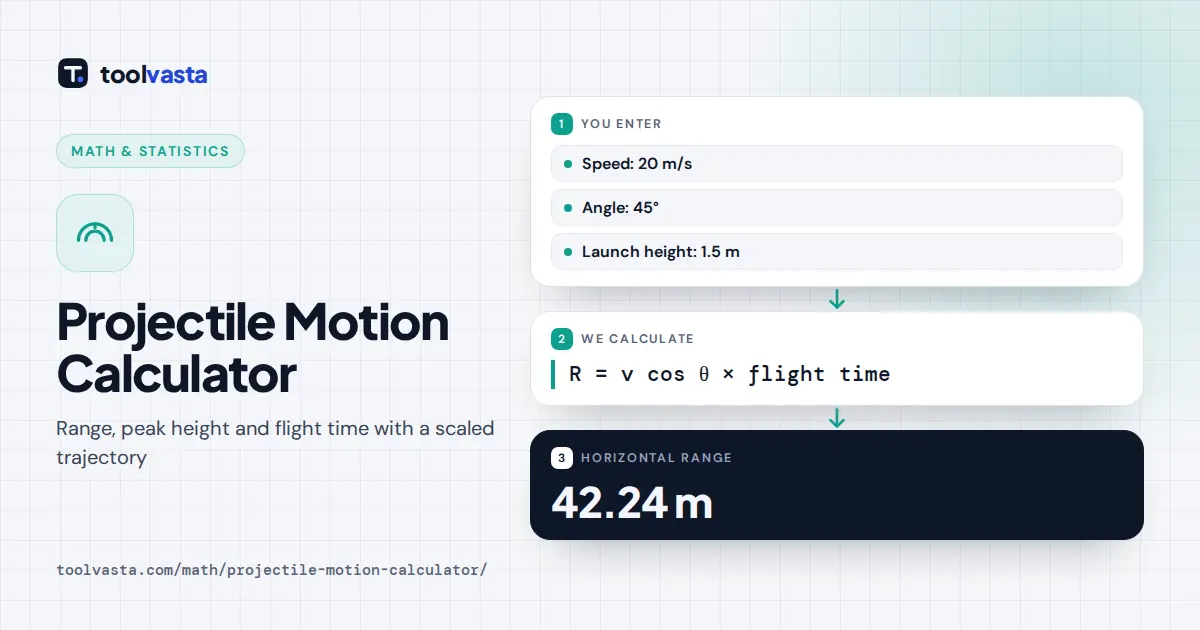
A ball is thrown at 20 m/s at 45° from a height of 1.5 m. The velocity components are both 20 × 0.70711 = 14.1421 m/s.
- Time of flight: T = (14.1421 + √(14.1421² + 2 × 9.80665 × 1.5)) ÷ 9.80665 = 2.9866 s.
- Range: R = 14.1421 × 2.9866 = 42.24 m.
- Maximum height: H = 1.5 + 14.1421² ÷ (2 × 9.80665) = 11.697 m, reached after 1.442 s.
- Impact: the vertical speed is 14.1421 − 9.80665 × 2.9866 = −15.146 m/s, so the ball lands at 20.722 m/s, 46.96° below the horizontal.
Thrown from ground level instead, the same ball would travel v² sin 90° ÷ g = 400 ÷ 9.80665 = 40.79 m. On the Moon, with g = 1.62 m/s², it would travel 246.9 m.
Horizontal Launch From a Height
When an object is launched horizontally, with an angle of 0°, from a height h, the fall time depends only on the height: t = √(2h ÷ g). The horizontal speed simply carries it forward during that time. A ball rolled off a 20 m cliff at 15 m/s falls for √(40 ÷ 9.80665) = 2.0196 s and lands 15 × 2.0196 = 30.29 m from the base, moving at 24.84 m/s at 52.86° below the horizontal. A ball dropped from rest at the same moment would hit the ground at exactly the same time.
Which Angle Gives the Longest Range?
On level ground and without air resistance, 45° gives the greatest range, and pairs of complementary angles such as 30° and 60° land at the same spot. When the launch point is above the landing point, the best angle is a little below 45°, because the extra fall time favors a flatter throw.
| Angle (20 m/s, h = 0) | Range | Max height | Flight time |
|---|---|---|---|
| 15° | 20.39 m | 1.366 m | 1.056 s |
| 30° | 35.32 m | 5.099 m | 2.039 s |
| 45° | 40.79 m | 10.197 m | 2.884 s |
| 60° | 35.32 m | 15.296 m | 3.533 s |
| 75° | 20.39 m | 19.029 m | 3.940 s |
Assumptions and Limits
- Air resistance is ignored. Real balls, arrows and bullets fall short of these figures, especially at high speed.
- Gravity is constant and the ground is flat. This is accurate for everyday heights and distances.
- The launch height is measured above the landing level. For a target above the launch point, the formulas need a different landing condition.
- Spin, wind and lift are not modeled.
Frequently asked questions
How do you calculate the range of a projectile?
Find the time of flight T = (v sin θ + √((v sin θ)² + 2gh)) ÷ g, then multiply by the horizontal speed v cos θ. On level ground this simplifies to R = v² sin 2θ ÷ g.
What is the formula for maximum height?
The maximum height is H = h + (v sin θ)² ÷ (2g), where h is the launch height. The projectile reaches it after a time of v sin θ ÷ g, when its vertical velocity is zero.
What angle gives the maximum range?
On level ground without air resistance, a 45 degree launch gives the longest range. From a raised launch point, the optimal angle is slightly less than 45 degrees.
How does launch height change the result?
A higher launch point adds fall time, so the projectile travels farther and lands faster and at a steeper angle. The calculator includes the height in both the range and the impact speed.
Does the calculator include air resistance?
No. It uses the ideal model with constant gravity and no drag, which is what physics courses use. Real projectiles travel shorter distances, so treat the results as an upper limit.
What value of g should I use?
Standard gravity is 9.80665 m/s², or 32.174 ft/s². Many textbooks round it to 9.8 or 9.81 m/s². Choose Custom to match the value your course uses.