How to Use the Trapezoid Area Calculator
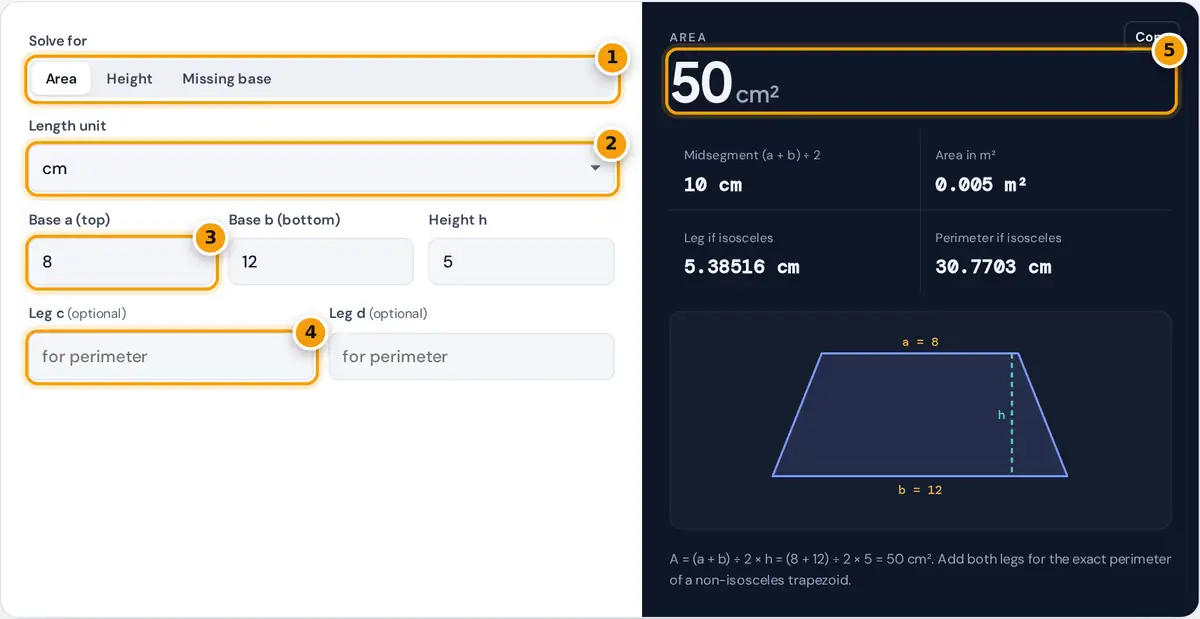
- Choose to solve for area, height or a missing base.
- Pick the length unit.
- Enter the two parallel bases and the height.
- Optionally add both legs for the exact perimeter.
- Read the result with the midsegment and perimeter.
Choose what you want to find. For the area, enter the two parallel sides, called bases a and b, and the height between them. To find the height, enter the area and both bases. To find a missing base, enter the area, the height and the base you know. Pick a length unit first and the results use matching units.
The result panel also shows the midsegment, which is the average of the two bases, and the leg length the trapezoid would have if it were isosceles. Enter both leg lengths to get the exact perimeter of any trapezoid. Without them, the perimeter shown assumes an isosceles shape.
Trapezoid Area Formula
h = 2A ÷ (a + b) b = 2A ÷ h − a
Midsegment m = (a + b) ÷ 2, so A = m × h
Isosceles leg = √(h² + ((b − a) ÷ 2)²)
The formula averages the two bases and multiplies by the height. One way to see why: put two copies of the trapezoid together, one upside down, and they form a parallelogram with base a + b and height h. The trapezoid is half of it. The height must be perpendicular to the bases, not measured along a slanted leg.
Worked Examples
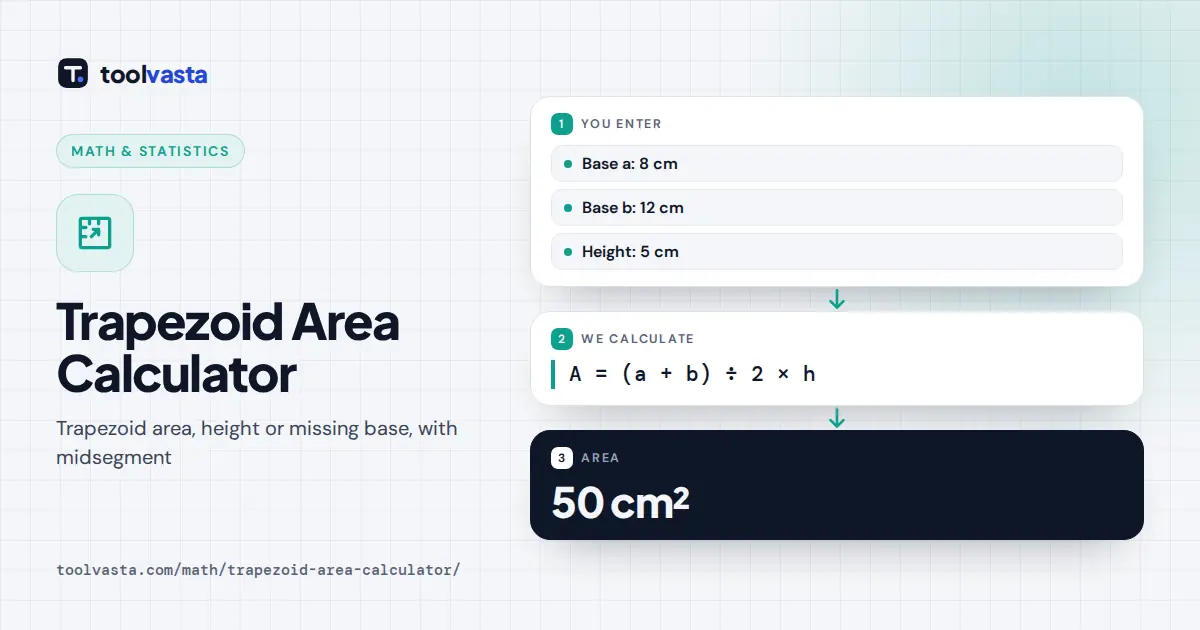
- Area: bases 8 cm and 12 cm, height 5 cm. A = (8 + 12) ÷ 2 × 5 = 10 × 5 = 50 cm². The midsegment is 10 cm, and an isosceles version would have legs of √(25 + 4) = 5.38516 cm, for a perimeter of 30.7703 cm.
- Height: an area of 84 m² with bases 10 m and 14 m gives h = 2 × 84 ÷ 24 = 7 m.
- Missing base: an area of 45 ft², a height of 6 ft and one base of 6 ft gives b = 2 × 45 ÷ 6 − 6 = 9 ft.
You can also check an answer by splitting the trapezoid into a rectangle and two triangles. For bases 8 and 12 with height 5, the rectangle is 8 × 5 = 40 and the two triangles together are ½ × 4 × 5 = 10, giving 50.
Quick Reference
| Base a | Base b | Height | Area |
|---|---|---|---|
| 4 | 6 | 3 | 15 |
| 8 | 12 | 5 | 50 |
| 10 | 14 | 7 | 84 |
| 2.5 | 4.5 | 2 | 7 |
When both bases are equal, the shape is a parallelogram and the formula reduces to base times height. When one base shrinks to zero, it becomes a triangle and the formula gives ½bh.
Practical Uses
Trapezoids show up in real projects all the time: the side of a sloped roof, a tapered garden bed, the cross-section of a ditch or a road embankment, and a deck that narrows at one end. For an irregular plot, you can split it into trapezoids and add the areas. This is also the idea behind the trapezoidal rule for estimating the area under a curve.
Area Units and Conversions
Area is always in square units, and conversions are squared too. One square meter is 10,000 square centimeters, one square foot is 144 square inches and one square yard is 9 square feet. If the bases are in feet and the height is in inches, convert everything to one unit before you multiply. For flooring, paint or sod, add a waste allowance to the area, typically a few percent, because material is cut to fit the sloped edges of the trapezoid.
Tips and Terminology
- In the United States and Canada a trapezoid has one pair of parallel sides. In British English that shape is called a trapezium, and the formula is the same.
- It does not matter which base you call a or b.
- Measure the height straight across between the parallel sides. Using a leg instead gives an area that is too large.
- A leg can never be shorter than the height, and the calculator checks this.
- Area is in square units: square centimeters, square feet and so on.
Frequently asked questions
What is the formula for the area of a trapezoid?
Add the two parallel sides, divide by 2 and multiply by the height: A = (a + b) ÷ 2 × h. For bases 8 and 12 with height 5, the area is 50 square units.
How do you find the height of a trapezoid?
Rearrange the area formula: h = 2A ÷ (a + b). Multiply the area by 2 and divide by the sum of the two bases. For an area of 84 and bases 10 and 14, h = 7.
How do you find a missing base?
Use b = 2A ÷ h − a. Double the area, divide by the height and subtract the known base. If the result is zero or negative, the numbers cannot describe a trapezoid.
What is the midsegment of a trapezoid?
The midsegment joins the midpoints of the two legs. It is parallel to the bases and its length is their average, (a + b) ÷ 2. The area equals the midsegment times the height.
Is a trapezoid the same as a trapezium?
In North American English, a trapezoid has exactly one pair of parallel sides. British English calls that shape a trapezium. The area formula is identical under either name.
Can I use a slanted side as the height?
No. The height must be perpendicular to the bases. A slanted leg is longer than the height, so using it would overestimate the area. Only a right trapezoid has a leg equal to the height.