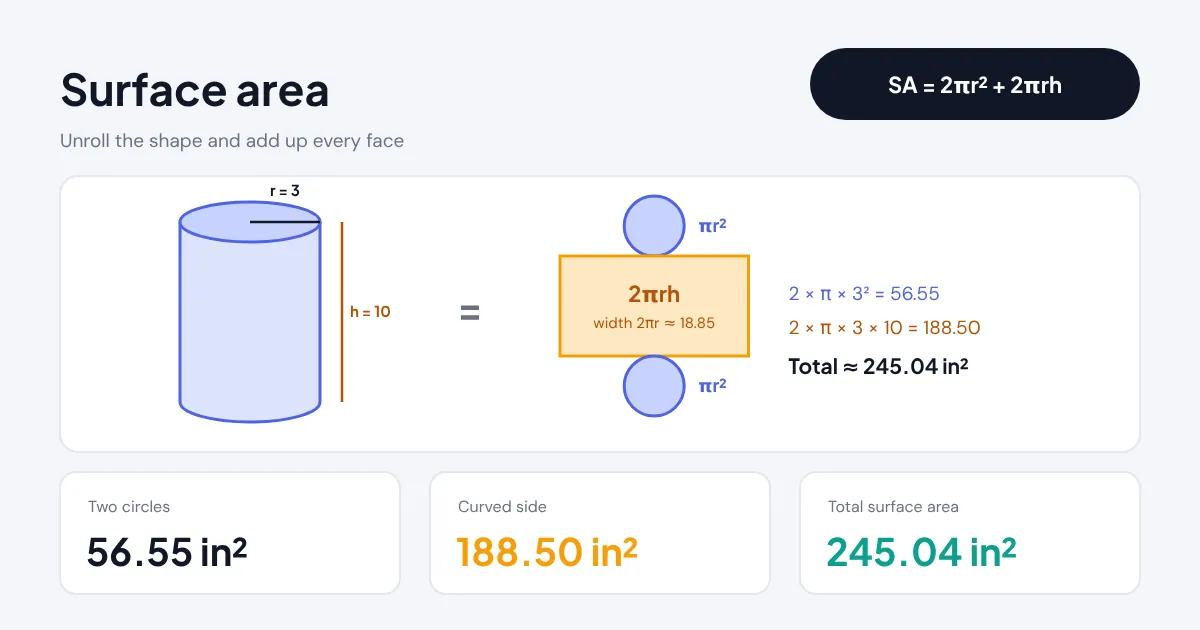
Quick answer: Surface area is the total area of every face of a 3D shape. A surface area calculator adds those faces for you: a cylinder with radius 3 in and height 10 in has SA = 2πr² + 2πrh = 2π(9) + 2π(30) ≈ 245.04 in². This tool covers 8 shapes and also shows lateral area and volume.
What Does Surface Area Measure?
A surface area calculator finds the total outside area of a solid, the amount of paper, paint or sheet metal it would take to cover every face once. Pick a shape, enter its measurements, and the calculator returns the total surface area in square units along with the lateral area (the sides only), the area of the bases, the volume and, for cones and pyramids, the slant height.
It handles the 8 solids that come up most in school and in practical work: cube, rectangular prism, sphere, hemisphere, cylinder, cone, square pyramid and triangular prism. Each result shows the formula with your numbers in it, so you can check homework line by line. All units work, from millimeters to yards, and the answer is always in the square of the unit you choose. If you also need how much the shape holds, the box volume calculator and the cone volume calculator go deeper on capacity.
How Do You Find the Surface Area of a Shape, Step by Step?
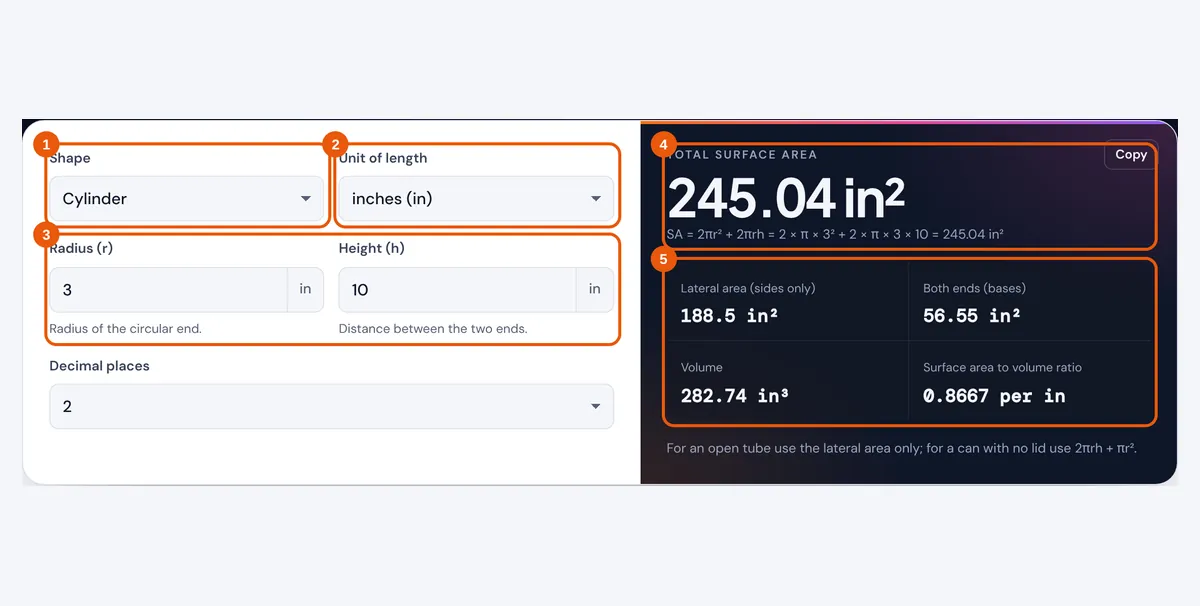
- Choose the shape from the list, for example cylinder or square pyramid.
- Pick the unit of length your measurements are in.
- Enter the measurements shown for that shape, such as radius and height. Use the vertical height for cones and pyramids; the calculator works out the slant height.
- Choose how many decimal places you want.
- Read the total surface area, then the lateral area, base area and volume underneath.
Make sure every measurement uses the same unit. Mixing inches and feet is the most common reason a surface area answer comes out wrong.
What Are the Surface Area Formulas?
Every surface area formula is the sum of the areas of the faces. Flat faces use rectangle, triangle or circle area, and curved faces use the formula you get by unrolling them.
Sphere: SA = 4πr² Hemisphere (closed): SA = 3πr²
Cylinder: SA = 2πr² + 2πrh Cone: SA = πr² + πrs, where s = √(r² + h²)
Square pyramid: SA = a² + 2as, where s = √(h² + (a/2)²)
Triangular prism: SA = 2 × (triangle area) + (a + b + c) × L
Worked example (cone): a cone has base radius 3 cm and vertical height 4 cm. The slant height is s = √(3² + 4²) = √25 = 5 cm. The base is π × 3² = 28.27 cm² and the curved surface is π × 3 × 5 = 47.12 cm², so the total is 75.40 cm². Using 4 instead of 5 for the curved surface is the classic mistake; the Pythagorean theorem calculator shows why the slant is the hypotenuse.
Worked example (box): a shipping box is 8 in long, 5 in wide and 3 in tall. SA = 2(8 × 5 + 8 × 3 + 5 × 3) = 2(40 + 24 + 15) = 158 in². That is the minimum cardboard needed before any flaps or overlap.
How Do the Shapes Compare?
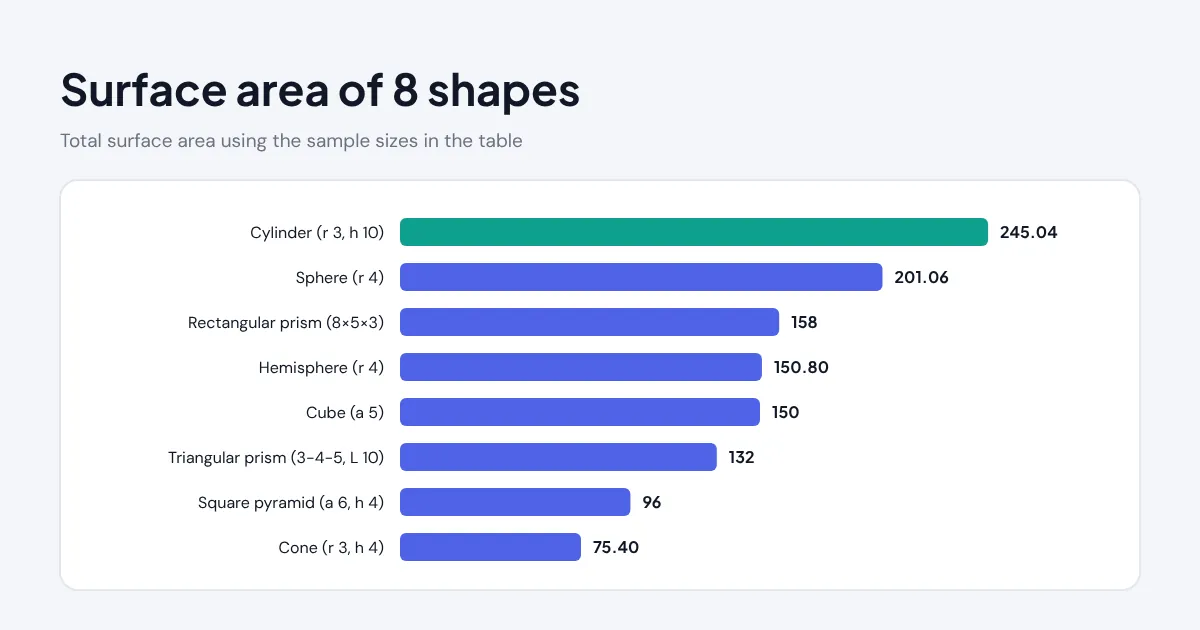
The table uses one simple size for each shape so you can compare totals side by side. Values are rounded to two decimal places, and every row can be reproduced with the calculator.
| Shape | Sample size | Total surface area | Lateral area | Volume |
|---|---|---|---|---|
| Cube | a = 5 | 150 | 100 | 125 |
| Rectangular prism | 8 × 5 × 3 | 158 | 78 | 120 |
| Sphere | r = 4 | 201.06 | 201.06 | 268.08 |
| Hemisphere | r = 4 | 150.80 | 100.53 | 134.04 |
| Cylinder | r = 3, h = 10 | 245.04 | 188.50 | 282.74 |
| Cone | r = 3, h = 4 | 75.40 | 47.12 | 37.70 |
| Square pyramid | a = 6, h = 4 | 96 | 60 | 48 |
| Triangular prism | 3-4-5 triangle, L = 10 | 132 | 120 | 60 |
Notice that the sphere has the smallest surface for the volume it holds compared with the box and the cylinder. That is why bubbles and droplets are round, and why the surface area to volume ratio, shown in the calculator for shapes without a slant, matters in biology and engineering.
When Do You Need Surface Area?
You need surface area whenever something has to cover the outside of a solid: painting a tank, wrapping a gift, insulating a pipe, quoting sheet metal for ductwork or estimating heat loss through the skin of a building. For walls and ceilings in a room, the paint calculator already subtracts doors and windows.
In school, surface area of prisms and pyramids made from rectangles and triangles is part of the Common Core grade 7 geometry standards, and spheres, cones and cylinders follow in high school geometry. Keep units consistent with the NIST Guide for the Use of the International System of Units: area is always length squared, so converting 1 ft² to inches gives 144 in², not 12.
Related Tools
- Box Volume Calculator
- Cone Volume Calculator
- Circumference Calculator
- Area of a Triangle Calculator
- Pythagorean Theorem Calculator
- Trigonometry Calculator
For every shape in one place, read surface area formulas for every 3D shape, with worked examples.
Frequently asked questions
How do you find the surface area of a 3D shape?
Find the area of each face and add them. For curved shapes, use the formula for the unrolled surface, such as 2πrh for the side of a cylinder.
What is the difference between lateral and total surface area?
Lateral area counts only the sides. Total surface area adds the top and bottom bases. A cylinder of radius 3 and height 10 has lateral area 188.50 and total area 245.04.
Is surface area measured in square or cubic units?
Square units, such as in², ft² or cm², because it measures area. Volume is the one measured in cubic units.
What is the surface area of a sphere?
SA = 4πr². A ball with radius 4 in has a surface area of 4 × π × 16 ≈ 201.06 in².
Do I use the slant height or the height for a cone?
The curved surface uses the slant height s. If you only know the vertical height h, find s = √(r² + h²) first. This calculator does that step for you.
How do I find the surface area of an open box or a cup?
Work out the total, then subtract the face that is missing. An open-top box loses one lw face, and a cup shaped like a cylinder uses 2πrh + πr².