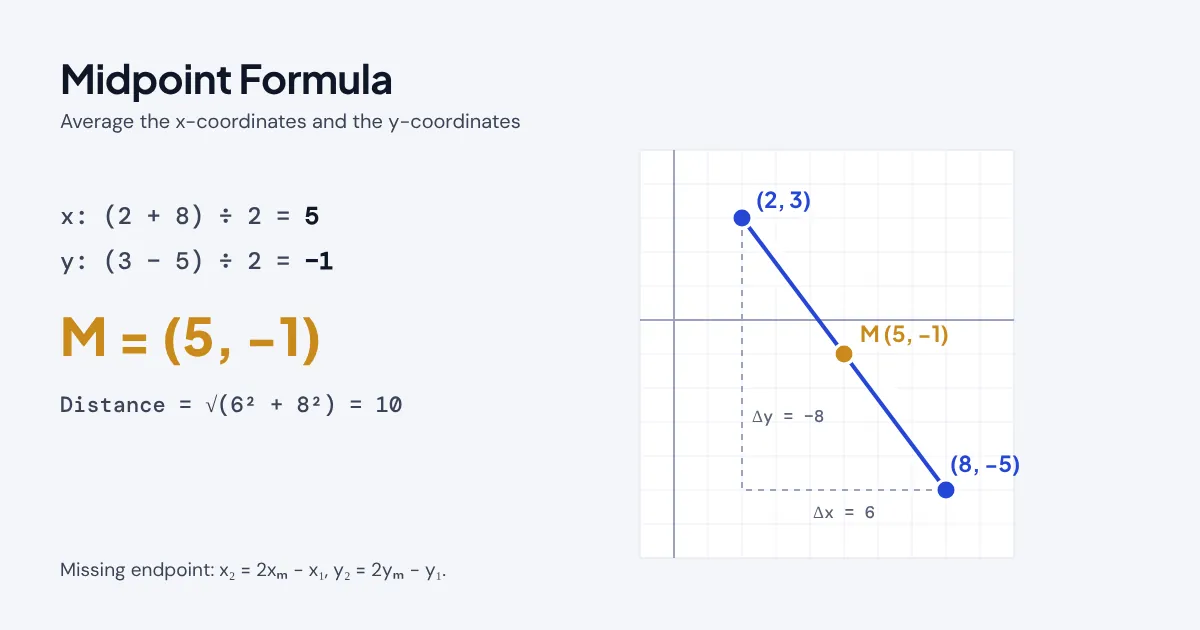
Quick answer: The midpoint of two points is the average of their coordinates: M = ((x₁ + x₂) ÷ 2, (y₁ + y₂) ÷ 2). For (2, 3) and (8, −5), M = ((2 + 8) ÷ 2, (3 − 5) ÷ 2) = (5, −1). This midpoint calculator also finds a missing endpoint, works in 3D and gives the distance, slope and perpendicular bisector.
What Is the Midpoint of a Line Segment?
A midpoint calculator finds the point exactly halfway between two points on a graph. You enter the coordinates of both endpoints and it returns the midpoint, along with the length of the segment, its slope, the equation of the line through the points and the perpendicular bisector. A small plot shows the two points and the midpoint so you can spot a typing mistake at a glance.
It also works in reverse. If you know one endpoint and the midpoint, the missing endpoint mode finds the other end, which is a common homework and test question. Switch to 3D to add z-coordinates for problems in space, such as locating the center of a beam or a point between two GPS fixes on a local grid.
How Do You Find the Point Halfway Between Two Coordinates?

- Choose Midpoint, or Missing endpoint if you already know the midpoint.
- Pick 2D for x and y, or 3D to add a z-coordinate.
- Enter the coordinates of both points. Negative numbers and decimals are fine.
- Read the midpoint, the fraction form and the distance, slope and bisector, then press Copy.
When a coordinate of the answer is not a whole number, the calculator shows it as an exact fraction too, so (11/4, 3/4) appears alongside (2.75, 0.75). Teachers usually want the fraction form, while a drawing or CAD file needs the decimal.
What Is the Midpoint Formula?
The midpoint formula averages the x-coordinates and averages the y-coordinates. It is one of the coordinate geometry skills in the high school geometry standards of the Common Core State Standards, where students learn to find a point that splits a segment in a given ratio. The midpoint is the special case where the ratio is 1:1.
In 3D: M = ( (x₁ + x₂) ÷ 2 , (y₁ + y₂) ÷ 2 , (z₁ + z₂) ÷ 2 )
Distance d = √( (x₂ − x₁)² + (y₂ − y₁)² )
Worked example. Find the midpoint of (−4, 1) and (6, 9):
- x: (−4 + 6) ÷ 2 = 2 ÷ 2 = 1.
- y: (1 + 9) ÷ 2 = 10 ÷ 2 = 5.
- Midpoint M = (1, 5). The segment is √(10² + 8²) = √164 ≈ 12.81 units long.
The distance uses the Pythagorean theorem on the horizontal and vertical gaps. The Pythagorean theorem calculator shows that step on its own if you want to see the triangle behind it.
How Do You Find a Missing Endpoint?
Double the midpoint and subtract the endpoint you know, one coordinate at a time. Because the midpoint is the average, x₂ = 2xₘ − x₁ and y₂ = 2yₘ − y₁.

| Point 1 | Point 2 | Midpoint | Distance |
|---|---|---|---|
| (2, 3) | (8, −5) | (5, −1) | 10 |
| (−4, 1) | (6, 9) | (1, 5) | 12.806 |
| (1.5, −2) | (4, 3.5) | (2.75, 0.75) | 6.042 |
| (0, 0) | (10, 0) | (5, 0) | 10 |
| (1, 2) | (7, −4), found | (4, −1), given | 8.485 |
| (0, 0, 0) | (4, 6, 10) | (2, 3, 5) | 12.329 |
A quick check: the midpoint must lie between the two endpoints in every coordinate. If it does not, a sign has slipped, usually when a negative number is subtracted.
Where Is the Midpoint Formula Used?
Outside the classroom, the midpoint is how you center things. Carpenters use it to find the middle of a board or wall, designers use it to center a logo between two guides, and surveyors use it to set a point halfway between two stakes. In geometry it is the first step in finding a perpendicular bisector, which the calculator gives as an equation, and the center of a circle when you know the two ends of a diameter.
The slope and line equation it reports are the same ones you would get from the linear equation calculator, so you can move straight on to graphing the line. For values that fall a set fraction of the way between two points rather than halfway, the interpolation calculator handles any ratio.
Related Tools
- Pythagorean Theorem Calculator
- Linear Equation Calculator
- Interpolation Calculator
- Right Triangle Calculator
- Line of Best Fit Calculator
- Ramp Slope Calculator
Frequently asked questions
How do you find the midpoint of two points?
Add the two x-coordinates and divide by 2, then add the two y-coordinates and divide by 2. The two results are the coordinates of the midpoint.
Can a midpoint have fractions or decimals?
Yes. If the sum of the coordinates is odd, the midpoint lands on a half, such as (3.5, 2). The calculator shows both the fraction and the decimal.
How do you find an endpoint from a midpoint?
Multiply each midpoint coordinate by 2 and subtract the matching coordinate of the known endpoint. With endpoint (1, 2) and midpoint (4, −1), the other endpoint is (7, −4).
Does the order of the points matter?
No. Swapping the two points gives the same midpoint and the same distance. Only the sign of Δx and Δy changes.
What is the perpendicular bisector?
It is the line that passes through the midpoint at a right angle to the segment. Its slope is the negative reciprocal of the segment's slope, so a slope of −4/3 gives a bisector slope of 3/4.