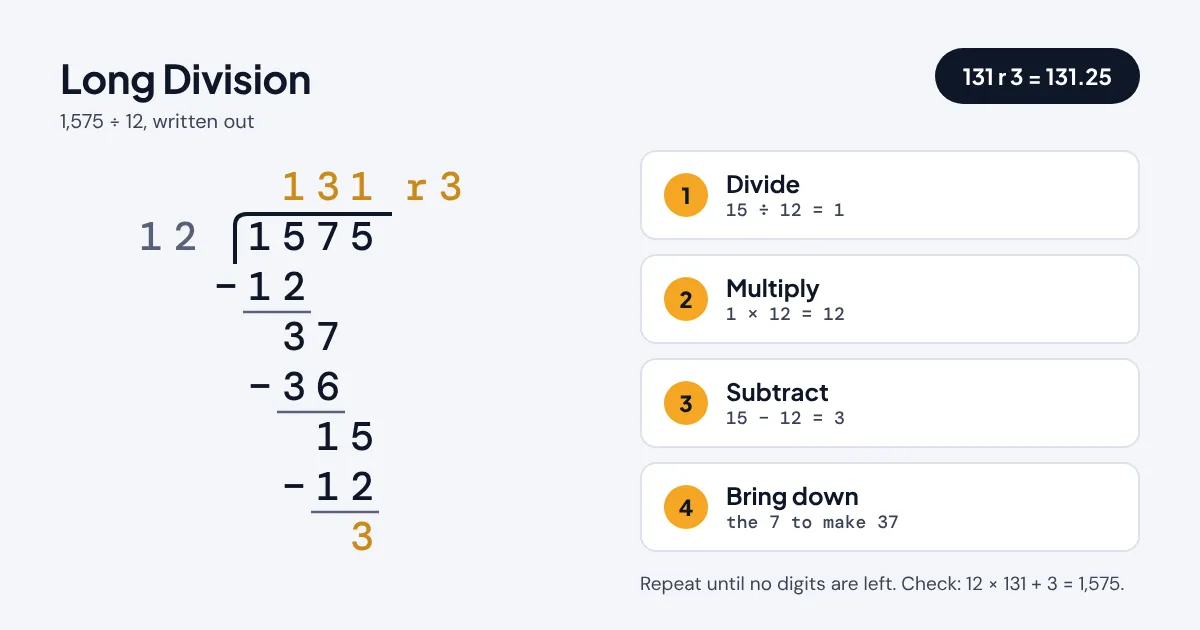
Quick answer: Long division splits a big division into small steps that repeat: divide, multiply, subtract, bring down. For 1,575 ÷ 12: 15 ÷ 12 = 1 r 3, 37 ÷ 12 = 3 r 1, 15 ÷ 12 = 1 r 3, so the answer is 131 r 3, or 131.25. This long division calculator writes out every step and the full layout.
Why Show the Written Method, Not Just the Answer?
A long division calculator divides one number by another and shows the written method, not just the answer. It lays the sum out the way it is taught in school, with the quotient on top, the divisor on the left and each subtraction underneath, then lists the steps in plain words. That makes it useful for checking homework, for parents who learned a different layout, and for anyone who needs to see where a remainder comes from.
It handles very large whole numbers exactly, accepts decimals in either number and lets you choose between a remainder, a decimal to a set number of places, or a mixed number. Recurring decimals such as 100 ÷ 7 are spotted and the repeating block is named.
How Do You Set Up a Division Problem?

- Type the dividend, the number being divided, in the first box.
- Type the divisor, the number you are dividing by, in the second box.
- Choose whether you want a whole number with a remainder or a decimal to a set number of places.
- Follow the numbered steps on the left and the written layout on the right, then copy the answer.
Every answer comes with a check line. Multiplying the divisor by the quotient and adding the remainder should give back the dividend exactly, which is the quickest way to prove a long division is right.
How Do You Do Long Division Step by Step?
Work from left to right through the digits of the dividend, repeating the same four moves each time. This is the formal written method in the national curriculum for England, which expects Year 6 pupils to divide numbers up to four digits by a two-digit number this way.
2. Multiply: quotient digit × divisor
3. Subtract: current number − that product
4. Bring down the next digit and repeat
Worked example. 9,876 ÷ 32:
- 32 does not go into 9, so start with 98. 98 ÷ 32 = 3, 3 × 32 = 96, 98 − 96 = 2.
- Bring down the 7 to make 27. 27 ÷ 32 = 0, so write 0 above the 7 and keep 27.
- Bring down the 6 to make 276. 276 ÷ 32 = 8, 8 × 32 = 256, 276 − 256 = 20.
The answer is 308 r 20. Check: 32 × 308 + 20 = 9,876. The zero in the middle is the step most people miss; leaving it out would give 38, which is clearly far too small. If the divisor is a single digit, the same process is usually written more compactly as short division, also called the bus stop method.
How Do You Write the Remainder?
A remainder can be written three ways, and the right one depends on the question. The table uses 1,575 ÷ 12 and 100 ÷ 7.

| Form | 1,575 ÷ 12 | 100 ÷ 7 | Best for |
|---|---|---|---|
| Remainder | 131 r 3 | 14 r 2 | Sharing whole items |
| Mixed number | 131 1/4 | 14 2/7 | Exact fractions |
| Decimal | 131.25 | 14.285714... | Money and measures |
| Rounded up | 132 | 15 | How many boxes or coaches are needed |
| Rounded down | 131 | 14 | How many full sets you can make |
To turn a remainder into a fraction, put it over the divisor and simplify: 3/12 = 1/4. Real problems often need rounding instead. If 1,575 pupils travel in coaches of 12 seats, you need 132 coaches, not 131. To simplify the fraction part by hand, the fraction calculator reduces it in one step.
How Do You Do Long Division with Decimals?
Make the divisor a whole number first by moving its decimal point to the right, and move the dividend's point the same number of places. 45.6 ÷ 0.8 becomes 456 ÷ 8, which is 57. If the dividend still has a decimal point, place the point in the answer directly above it and carry on dividing as normal. To keep going past the last digit, add zeros after the decimal point; each zero brought down gives one more decimal place.
Some divisions never end. 100 ÷ 7 gives 14.285714285714..., where the block 285714 repeats forever because the remainders start to cycle. The calculator detects the cycle, rounds the answer to the places you choose and tells you which digits repeat. For the reverse job, multiplying large numbers on paper, the long multiplication calculator uses the same column layout.
Related Tools
- Long Multiplication Calculator
- Synthetic Division Calculator
- Fraction Calculator
- Modulo Calculator
- LCM Calculator
- BODMAS Calculator
Frequently asked questions
What are the steps of long division?
Divide, multiply, subtract and bring down, repeated until no digits are left. Whatever remains at the end is the remainder.
What do you do when the divisor does not go into a digit?
Write 0 in the answer above that digit, bring down the next digit and try again. Skipping the zero is the most common long division mistake.
How do you check a long division answer?
Multiply the quotient by the divisor and add the remainder. You should get the dividend. For 131 r 3 from 1,575 ÷ 12: 12 × 131 + 3 = 1,575.
What is the difference between long and short division?
Both use the same steps. Short division, or the bus stop method, keeps the subtraction in your head and is used for single-digit divisors. Long division writes every product and subtraction down, which is easier with two-digit or larger divisors.
Can the remainder be bigger than the divisor?
No. If it is, the quotient digit was too small. Increase it by one and subtract again.