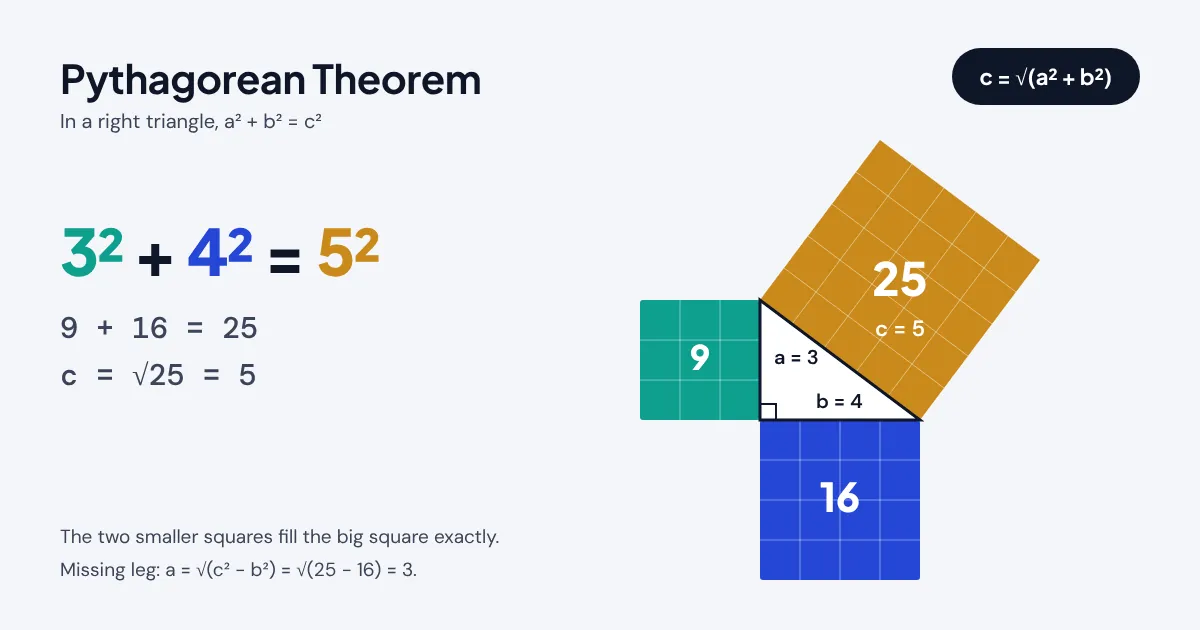
Quick answer: The Pythagorean theorem says that in a right triangle a² + b² = c², where c is the hypotenuse. To find c, square both legs, add them and take the square root: for legs of 3 and 4, c = √(9 + 16) = √25 = 5. To find a leg, use a = √(c² − b²). This Pythagorean theorem calculator does both and shows the working.
Which Side of a Right Triangle Can You Solve For?
A Pythagorean theorem calculator finds the missing side of a right-angled triangle when you know the other two. Give it both legs and it returns the hypotenuse; give it the hypotenuse and one leg and it returns the other leg. It also works out the area, the perimeter and the two acute angles, and draws the triangle to scale so you can see whether the answer makes sense.
The fourth mode runs the theorem backwards. Enter any three side lengths and it tells you whether they form a right triangle, an acute triangle, an obtuse triangle or no triangle at all. That is the check builders use when they set out a square corner with the 3-4-5 rule, and the one teachers ask for in exam questions.
How Do You Find a Missing Side?
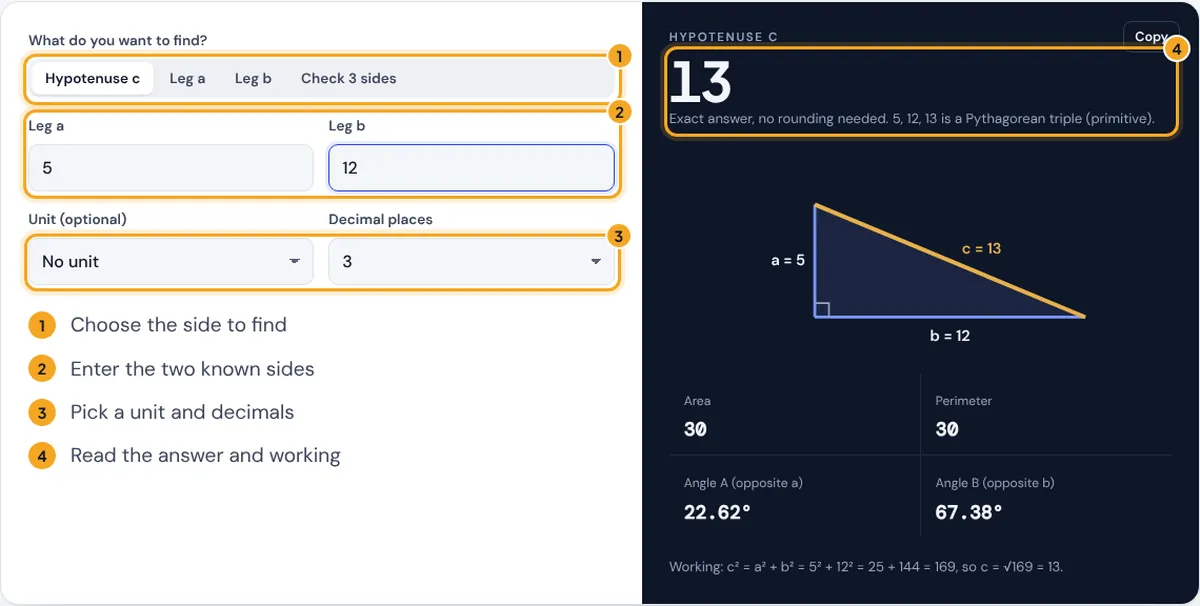
- Choose what you want to find: the hypotenuse c, leg a, leg b, or a check of three sides.
- Type the two known sides. The box for the missing side is hidden so you cannot fill in the wrong one.
- Pick a unit and the number of decimal places if you want them shown in the answer.
- Read the missing side, the exact surd form, the angles and the line-by-line working, then press Copy.
The hypotenuse is always the side opposite the right angle and always the longest side. If you enter a hypotenuse that is shorter than a leg, the calculator stops and tells you, because no right triangle has those measurements.
What Is the Pythagorean Theorem Formula?
The formula is a² + b² = c², where a and b are the two shorter sides that meet at the right angle and c is the hypotenuse. Rearranging it gives the version you need for each missing side. In England it sits in the Key Stage 3 and GCSE content of the national curriculum for mathematics, and in the United States it is part of the grade 8 geometry standards.
a = √(c² − b²)
b = √(c² − a²)
Worked example. A ladder 5 m long leans against a wall with its foot 1.5 m from the wall. How high up the wall does it reach?
- The ladder is the hypotenuse, so c = 5 and the ground distance is b = 1.5.
- a² = c² − b² = 25 − 2.25 = 22.75.
- a = √22.75 = 4.77 m to two decimal places.
The top of the ladder is about 4.77 m up the wall. When both known sides are whole numbers, the calculator also gives the exact surd, for example √50 = 5√2 for legs of 5 and 5. If you need to simplify other roots by hand, the radical calculator shows the factor steps.
What Are the Most Common Pythagorean Triples?
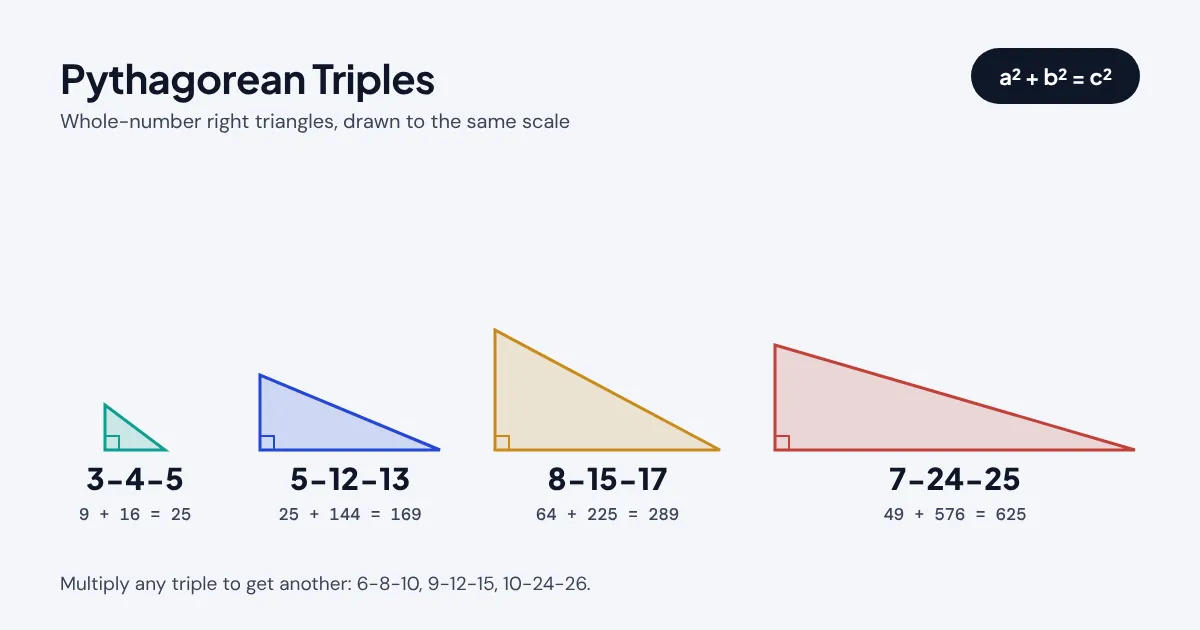
A Pythagorean triple is a set of three whole numbers that fit a² + b² = c² exactly. They are worth learning because they turn many exam and site problems into mental arithmetic.
| a | b | c | Check: a² + b² = c² |
|---|---|---|---|
| 3 | 4 | 5 | 9 + 16 = 25 |
| 5 | 12 | 13 | 25 + 144 = 169 |
| 8 | 15 | 17 | 64 + 225 = 289 |
| 7 | 24 | 25 | 49 + 576 = 625 |
| 20 | 21 | 29 | 400 + 441 = 841 |
| 9 | 40 | 41 | 81 + 1,600 = 1,681 |
| 12 | 35 | 37 | 144 + 1,225 = 1,369 |
| 6 | 8 | 10 | 36 + 64 = 100 (3-4-5 doubled) |
Any multiple of a triple is also a triple, so 6-8-10, 9-12-15 and 30-40-50 all form right angles. The calculator labels a triple as primitive when the three numbers share no common factor. For triangles that are not right-angled, the triangle calculator uses the sine and cosine rules instead.
How Do You Check Whether a Triangle Is Right-Angled?
Square the two shorter sides, add them and compare the total with the square of the longest side. If they are equal, the triangle has a right angle; if the total is bigger, every angle is acute; if it is smaller, the largest angle is obtuse. This is the converse of the theorem, and it is the reason a 3-4-5 tape measure check gives a true 90° corner for a patio, shed base or stud wall.
Measuring errors matter on site. If your diagonal is a few millimetres out, the check mode shows how far a² + b² is from c² and gives the actual largest angle, so you can judge whether the corner is close enough. To find the length of a sloping run, such as a ramp, the ramp slope calculator combines the same theorem with gradient rules. For a line between two plotted points, the midpoint calculator returns its length, which is the same theorem applied to coordinates.
Related Tools
- Right Triangle Calculator
- Triangle Calculator
- Area of a Triangle Calculator
- Radical Calculator
- Exponent Calculator
- Midpoint Calculator
To see the rule in everyday use, read the Pythagorean theorem explained with real-life examples.
Frequently asked questions
How do you find the hypotenuse with the Pythagorean theorem?
Square each leg, add the two squares and take the square root of the total. For legs of 6 and 8, c = √(36 + 64) = √100 = 10.
How do you find a missing leg?
Subtract the square of the known leg from the square of the hypotenuse, then take the square root. For a hypotenuse of 13 and a leg of 5, the other leg is √(169 − 25) = √144 = 12.
Does the Pythagorean theorem work for every triangle?
No. It only applies to right-angled triangles. For other triangles use the cosine rule, c² = a² + b² − 2ab cos C, which becomes the Pythagorean theorem when C is 90°.
Which side is the hypotenuse?
It is the side opposite the right angle, and it is always the longest side. The other two sides are called legs, or the adjacent and opposite sides in trigonometry.
Do the units matter?
All sides must be in the same unit. Convert centimetres to metres, or inches to feet, before you start. The answer comes out in that same unit, and the area in square units.